


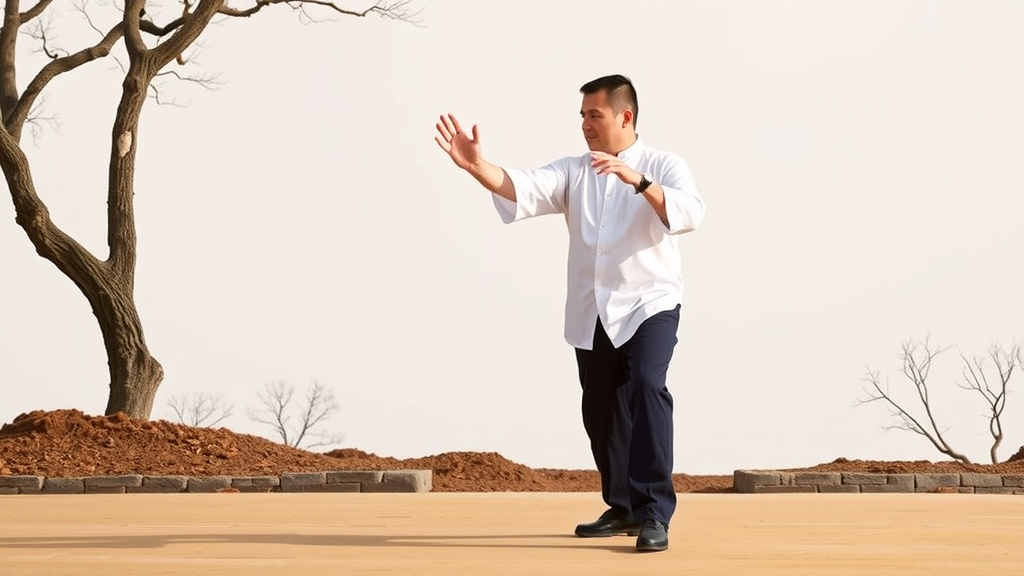
Close your eyes and touch your nose. You can do it without looking because your brain constantly tracks where every joint and limb is in space, a sense scientists call proprioception. It is the silent sixth sense behind every step you take, every ball you catch, and every time you catch yourself from falling. Now, a sweeping new analysis of two decades of research suggests that mindfulness-based practices, and Tai Chi in particular, may sharpen this hidden sense, though the researchers themselves urge caution about just how big the benefit really is.
The study, published in the journal Mindfulness, is a Bayesian multilevel meta-analysis of randomized controlled trials conducted between 2005 and 2025. A team led by Senyao Du of Macao Polytechnic University and Guowen Ai of Hainan Normal University searched six databases, screened more than 4,000 records, and ultimately included 22 randomized controlled trials covering 1,397 participants and 112 separate effect sizes. The trials came from China, India, Thailand, the United States, Iran, and other countries, and tested interventions ranging from Tai Chi and Qigong to yoga and walking meditation against no intervention, health education, or other forms of exercise.
What makes this analysis unusual is its statistical machinery. Rather than relying on traditional frequentist methods, the team used Bayesian multilevel models, which estimate full probability distributions for effect sizes and allow researchers to compute Bayes factors, a measure of how strongly the data support a real effect over no effect. The team also restricted inclusion to three relatively pure laboratory tests of proprioception: joint position reproduction, threshold to detection of passive motion, and the active movement extent discrimination assessment. These vision-occluded paradigms minimize contributions from other senses, making the pooled estimate more interpretable than earlier reviews that lumped together heartbeat detection, tactile tasks, and balance proxies.
The headline result was striking. In the unadjusted model, mindfulness-based interventions improved proprioceptive accuracy with a standardized effect size of Hedges’ g of minus 0.70, where negative values indicate reduced error in proprioceptive judgments. The 95 percent highest density interval ran from minus 0.96 to minus 0.44, and the Bayes factor reached 4,290, which by conventional criteria constitutes overwhelming evidence for a nonzero effect. In plain terms, people who practiced mind-body exercises became measurably better at judging joint angles and detecting passive movements than people who did not.
Subgroup analyses added texture to that headline. Tai Chi showed the largest and most credible effect of any intervention, with g of minus 0.82 and a Bayes factor above 900. Yoga, Qigong, and walking meditation produced negative point estimates but intervals that included zero and Bayes factors at or below one, meaning the evidence for those practices was inconclusive rather than supportive. The most dramatic subgroup was older adults, who showed the greatest improvement of any population at g of minus 0.84 with a Bayes factor of roughly 210,000. College students, teenagers, and athletes showed no credible effects, and for athletes the point estimate actually leaned in the opposite direction, though without statistical significance.
Why would Tai Chi outperform its cousins? The authors point to its distinctive movement signature. Sequences such as Wave Hands Like Clouds and Single Whip demand slow, fluid, multi-joint coordination with continuous transitions between lengthening and shortening muscle contractions, a loading pattern that may efficiently stimulate muscle spindles, Golgi tendon organs, and joint receptors. Tai Chi also fuses movement with breath and concentrated attention, a cognitive-motor integration that engages brain networks for body awareness, movement planning, and executive control. Yoga and Qigong, by contrast, lean more heavily on static postures, and walking meditation involves highly automated, repetitive motion that may offer too little novel proprioceptive challenge to drive adaptive remodeling.
The body-site findings reinforce a mechanical story. The knee and ankle showed the most reliable improvements, with credible effects for ankle dorsiflexion and plantar flexion in particular. These are exactly the joints most loaded during weight-bearing Tai Chi and yoga postures. Dorsiflexion improved more than plantar flexion, plausibly because everyday walking and standing already train the latter, leaving a narrower window for plasticity. Effects were also detectable with the passive motion detection and joint position reproduction tests but not with the more cognitively demanding discrimination task, suggesting the interventions primarily sharpen raw afferent signaling rather than higher-order sensory decision-making.
But here is the catch that keeps this study honest. A significant multilevel Egger test revealed small-study effects, the statistical fingerprint of publication bias, in which smaller, less precise studies tend to report larger effects. When the team applied bias-correction models and averaged across them, the corrected estimate carried a standard error nearly as large as the effect itself, and the resulting confidence interval spanned zero. In the worst case, publication bias could explain all of the observed benefit. The authors also graded the evidence using the GRADE framework and rated the overall certainty for the pooled effect as low, citing serious risk of bias, serious inconsistency, and serious publication bias concerns. Blinding participants to Tai Chi is, after all, impossible.
Still, the practical signals are hard to ignore. Effects grew with intervention duration, with roughly 16 weeks emerging as the point where benefits became most consistent, and the improvement was strongest in older adults, precisely the population where declining proprioception contributes to falls and lost independence. Because mindfulness practices are low-intensity, low-cost, and highly repeatable, they could complement neurorehabilitation programs for people with knee osteoarthritis, chronic ankle instability, or post-stroke deficits, while also delivering well-documented mental health benefits that conventional proprioceptive training cannot. The authors are careful to say these applications should be tested in dedicated large, preregistered, multicenter trials before firm clinical recommendations are made. For now, the message is a measured one: your body’s inner compass may indeed be trainable through the slow, deliberate art of Tai Chi, but science is still calibrating exactly how much the needle moves.
Subject of Research: The effects of mindfulness-based interventions on proprioceptive accuracy
Article Title: The Effects of Mindfulness-Based Interventions on Proprioception: A Bayesian Multilevel Meta-Analysis of Evidence from Randomized Controlled Trials
Article References: Du, S., Ai, G., Zhao, S., Ng, S. F., Siu, T. L., & Ning, Z. (2026). The Effects of Mindfulness-Based Interventions on Proprioception: A Bayesian Multilevel Meta-Analysis of Evidence from Randomized Controlled Trials. Mindfulness. https://doi.org/10.1007/s12671-026-02986-5
Image Credits: AI Generated
DOI: 10.1007/s12671-026-02986-5
Keywords: mindfulness, proprioception, Tai Chi, meta-analysis, Bayesian statistics, body awareness, older adults, yoga, Qigong, neurorehabilitation, publication bias, randomized controlled trials
Cite Scienmag News
Glenn Wilkins. (September 25, 2026). Tai Chi May Sharpen Your Body’s Inner Compass, But the Evidence Comes With a Catch. Scienmag. https://scienmag.com/tai-chi-may-sharpen-your-bodys-inner-compass-but-the-evidence-comes-with-a-catch/
Glenn Wilkins. "Tai Chi May Sharpen Your Body’s Inner Compass, But the Evidence Comes With a Catch." Scienmag, 25 September 2026, https://scienmag.com/tai-chi-may-sharpen-your-bodys-inner-compass-but-the-evidence-comes-with-a-catch/. Accessed 4 October 2026.
Glenn Wilkins. "Tai Chi May Sharpen Your Body’s Inner Compass, But the Evidence Comes With a Catch." Scienmag. September 25, 2026. https://scienmag.com/tai-chi-may-sharpen-your-bodys-inner-compass-but-the-evidence-comes-with-a-catch/


