

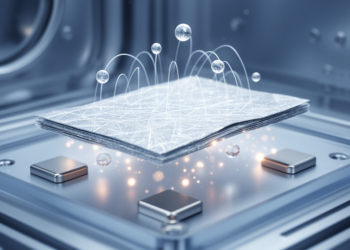
Magnetic 2D Material Shows Promise as Reversible Hydrogen Gas Sensor
New density functional theory calculations show that atomically thin MnBi2Te4 reversibly adsorbs hydrogen molecules while preserving its magnetism, making it ...
New density functional theory calculations show that atomically thin MnBi2Te4 reversibly adsorbs hydrogen molecules while preserving its magnetism, making it ...

Researchers exfoliated molybdenum disulfide using aqueous extracts of three medicinal plants, producing few-layer, semiconducting nanomaterials under mild conditions.

Researchers at South Korea's Institute for Basic Science chemically converted a single tungsten diselenide crystal into a complete high-performance transistor, ...
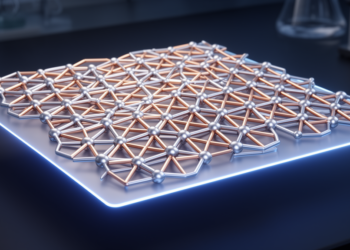
Researchers have exfoliated a van der Waals kagome crystal family down to the monolayer limit, revealing a gate-tunable, isolated flat ...
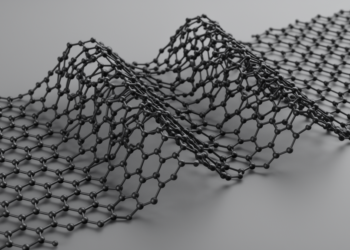
Researchers have created graphene films with record strength, toughness and 5 percent elastic strain by assembling folded flakes into an ...
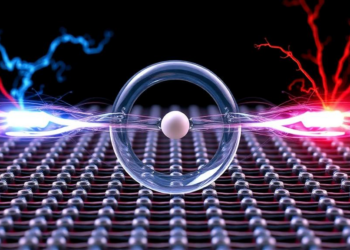
Researchers have shown that gate voltages can slide graphene's atomic layers between stacking configurations, reversibly switching a ferromagnetic phase on ...
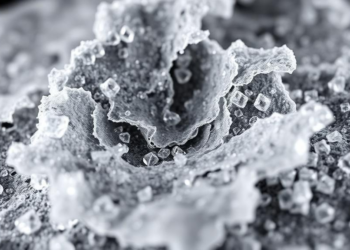
Researchers at UC Santa Barbara have developed a cryogenic shock exfoliation method that produces giant, ultraclean rhombohedral graphene flakes, clearing ...

A new review in Opto-Electronic Manufacturing details how laser-induced phase transitions can precisely reprogram two-dimensional materials for next-generation electronic and ...

First-principles calculations predict that a new silicene-like strontium sulfide nanosheet is stable and tunable, and that adsorbing a single vanadium ...

A new theoretical study shows that an intrinsic screening scale in planar quantum electrodynamics systematically suppresses the spontaneous generation of ...


Embark on a thrilling journey of discovery with Scienmag.com—your ultimate source for cutting-edge breakthroughs. Immerse yourself in a world where curiosity knows no limits and tomorrow’s possibilities become today’s reality!