

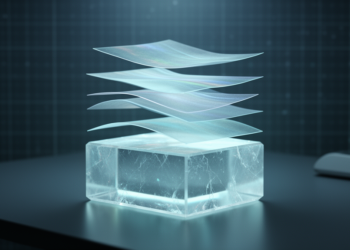
Computational method predicts thousands of new exfoliable 2D materials from ordinary crystals
A new computational method from HZDR and TU Dresden predicts separable atomic layers in any crystal, identifying 2,531 promising two-dimensional ...
A new computational method from HZDR and TU Dresden predicts separable atomic layers in any crystal, identifying 2,531 promising two-dimensional ...
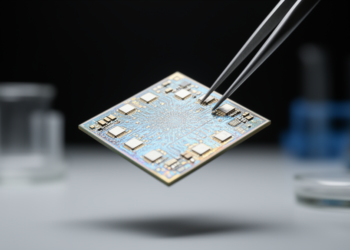
A new review argues that engineering atomically sharp interfaces in two-dimensional materials can break flash memory's long-standing trade-offs among speed, ...
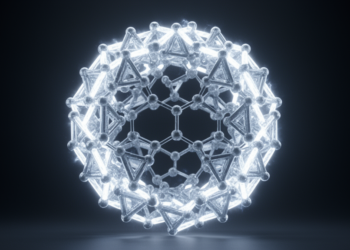
Scientists have directly observed topological edge states in a two-dimensional supramolecular diatomic Kagome lattice assembled from triptycene-derived organic molecules, opening ...
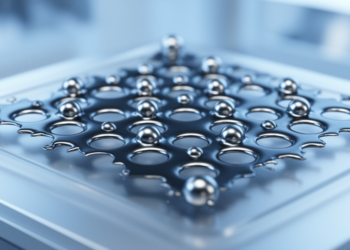
A review finds that defects in liquid-metal-derived two-dimensional materials arise from coupled oxidation, fluid dynamics, printing, and transfer, creating opportunities ...
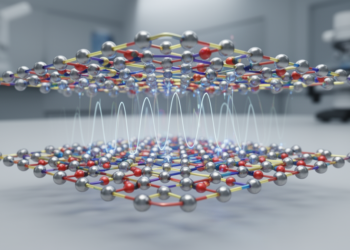
Controlling stacking order in two-dimensional indium selenide changes ferroelectric polarization and enables homojunction memristors with lower switching voltages and an ...
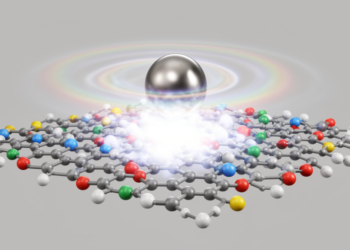
First-principles calculations of a MoSi₂N₂P₂ monolayer indicate that adsorbed 4d transition-metal atoms can produce metallic, magnetic and element-specific optical properties.
First-principles calculations predict that monolayer FeCoCl2, FeCoBr2, FeVSe2, and FeVTe2 are stable half-metals with magnetic ordering temperatures up to 550 ...
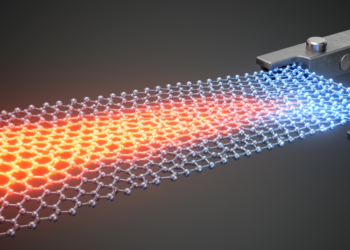
Heat usually radiates the way a campfire warms your face: photons fly across empty space, and the total flow obeys ...
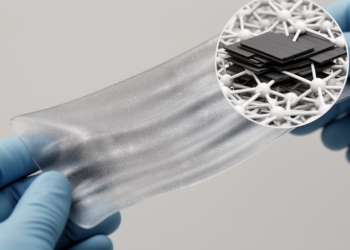
A new review highlights how MXene-cellulose composites combine electrical conductivity with biocompatibility for wound dressings and wearable health sensors, while ...
A simulated five-layer SPR biosensor combining silver, copper, black phosphorus, and franckeite achieves record sensitivity gains for label-free disease detection.


Embark on a thrilling journey of discovery with Scienmag.com—your ultimate source for cutting-edge breakthroughs. Immerse yourself in a world where curiosity knows no limits and tomorrow’s possibilities become today’s reality!