


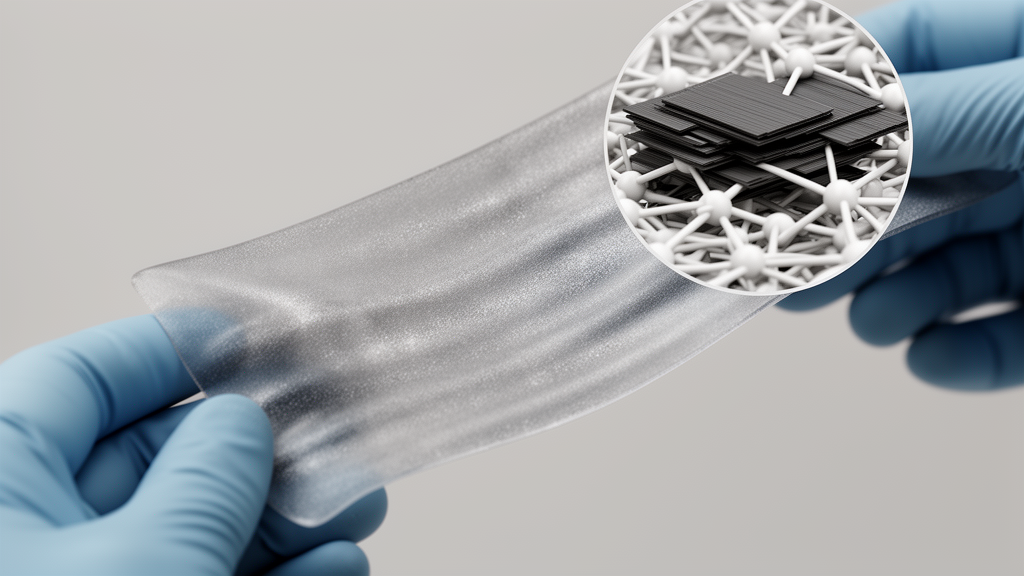
A new review published in Frontiers in Sensors has brought together the scattered evidence on one of the most intriguing pairings in modern materials science: MXenes, a family of two-dimensional transition metal carbides, nitrides and carbonitrides, and cellulose, the most abundant organic polymer on Earth. Written by Mokae Bambo, Teboho Clement Mokhena and Joe Modise of Vaal University of Technology, the DSI/Mintek Nanotechnology Innovation Centre and the University of Mpumalanga, the review argues that combining these two materials could yield a single platform that is simultaneously electrically conductive, mechanically robust, biocompatible and biodegradable — precisely the combination needed for next-generation wound dressings and wearable health monitors. The timing is significant, because healthcare systems worldwide are under mounting pressure from chronic disease, ageing populations and rising treatment costs, and nanotechnology-based solutions are increasingly seen as part of the answer.
MXenes first emerged in the early 2010s when researchers chemically exfoliated layered ceramic compounds known as MAX phases, stripping away the aluminium or other group III and IV element layers to leave atomically thin sheets. The resulting materials follow the general formula M(n+1)X(n)Tx, where M is an early transition metal such as titanium, niobium or molybdenum, X is carbon and/or nitrogen, and Tx represents surface terminations of hydroxyl, oxygen or fluorine groups inherited from the synthesis process. Since the landmark synthesis of Ti3C2Tx in 2011, roughly thirty MXene compositions have been prepared experimentally, with many more predicted theoretically. What makes them extraordinary is their property profile: electrical conductivity exceeding 20,000 S per centimetre, volumetric capacitance above 2,800 F per cubic centimetre, high thermal conductivity, hydrophilicity and a large surface area — a combination that has fuelled interest in energy storage, catalysis, sensing and, increasingly, biomedicine.
Yet pristine MXenes carry serious liabilities when considered for healthcare. When processed alone, the nanosheets tend to restack and agglomerate, collapsing the accessible surface area and degrading electrochemical performance. Their structural stability is limited, and the most common synthesis route — direct etching of MAX precursors in hydrofluoric acid — leaves behind fluorine-containing residues that are toxic, corrosive and difficult to manage. The review notes that HF etching of Ti3C2 typically requires around 24 hours at room temperature with concentrations between 30 and 50 percent, and that the process can introduce structural distortion and loss of crystallinity. For biomedical use, these fluorinated surfaces are problematic: they increase hydrophobicity, interact unfavourably with cell membranes and can release fluoride ions. Surface modification or integration with biocompatible materials is therefore often essential before MXenes can safely touch human tissue.
This is where cellulose enters the picture. Cellulose is a polysaccharide of D-glucose units linked by beta(1→4) glycosidic bonds, with three hydroxyl groups per glucose unit. Those hydroxyls allow neighbouring chains to lock together through extensive hydrogen bonding, giving cellulose its fibrous strength and rigidity — but also making it notoriously difficult to dissolve. The review describes how chemical modification into derivatives, or conversion into nanocellulose in the form of cellulose nanocrystals and cellulose nanofibers, can overcome this processing barrier. Cellulose brings renewability, biodegradability, low toxicity and intrinsic hydrophilicity to the partnership, and its hydroxyl-rich surface forms strong interfacial bonds with MXene terminations through hydrogen bonding and van der Waals forces. The result is an interconnected conductive network embedded in a mechanically robust, biocompatible scaffold that facilitates electron and ion transport while resisting the restacking that plagues MXenes alone.
The synthesis story is evolving rapidly. Beyond direct HF etching, researchers have developed in situ HF-generating methods using mixtures such as hydrochloric acid and lithium fluoride, where lithium ions intercalate between the sheets and prevent restacking, eliminating the need for a separate exfoliation step. Fluoride salt etchants such as ammonium hydrogen difluoride can simultaneously etch and intercalate, expanding the lattice parameter by roughly 25 percent compared with HF-etched samples. More radically, fluoride-free routes are gaining ground: molten salt etching with zinc chloride can substitute aluminium with zinc at moderate temperatures, yielding MXenes terminated with chlorine, bromine or iodine groups that can then be swapped for oxygen, sulphur, amine or selenium functionalities through substitution reactions. Alkaline treatments offer another path — one study using sodium hydroxide produced MXenes that showed no cytotoxicity in HeLa cells even at concentrations up to 2,000 micrograms per millilitre and retained structural integrity for two weeks under oxidative conditions. Electrochemical etching in binary aqueous electrolytes has produced flakes as large as 18.6 micrometres with yields exceeding 90 percent, while chemical vapour deposition can grow single-layer MXenes with precise thickness control and no hazardous etchants at all.
Once the ingredients are ready, fabrication methods determine the final architecture. Vacuum filtration, the most widely adopted technique, drives an aqueous dispersion through a membrane to form compact multilayer films; one team using a one-pot milling process with a supermass collider grinder achieved films with a roughly 1,388 percent improvement in mechanical properties and a 3,726 percent increase in electrical conductivity. Layer-by-layer self-assembly builds gradient composites through alternating deposition cycles, with scanning electron microscopy confirming seamless integration of the two phases. Solution casting allows slow solvent evaporation, giving components time to rearrange and form hydrogen bonds; one study found that 50 percent cellulose nanocrystals was the optimal content for tensile strength and toughness in MXene films. Dip-coating, meanwhile, has produced strain sensors on thermoplastic polyurethane fabrics with a sensing range of about 83 percent, a gauge factor of 3,405 and a detection limit of just 0.1 percent. Hydrogel formation and in situ nanoparticle incorporation round out the toolkit, each method trading scalability against structural control in different ways.
The healthcare applications are where the story becomes genuinely compelling. In wound care, electrical stimulation dressings have shown promise for chronic wounds, but conventional systems rely on external power sources that introduce safety risks. A biodegradable hydrogel of Ti3C2Tx MXene and bacterial cellulose, with tuneable conductivity ranging from 2.8 × 10⁻⁵ to 7.0 × 10⁻⁴ S per centimetre depending on MXene content, worked synergistically with external electrical stimulation to enhance NIH3T3 cell proliferation in vitro and accelerate wound healing in vivo. A separate bacterial cellulose-MXene sponge designed for diabetic wounds mimics the extracellular matrix, generates endogenous electric fields, kills bacteria through photothermal conversion, and supported granulation, collagen deposition, angiogenesis and re-epithelialisation within 14 days. A sprayable MXene-carboxymethyl cellulose-pectin hydrogel loaded with tranexamic acid accelerated skin regeneration, reduced inflammation and upregulated vascular endothelial growth factor expression in full-thickness wound models. Notably, the review cautions that MXene can negatively affect cell proliferation at higher loadings, so concentration optimisation is essential.
On the sensing side, MXene-cellulose composites are enabling wearable devices that convert mechanical deformation into electrical signals. A hydrogel combining MXene with quaternized cellulose nanofibers achieved a tensile strength of 449 kilopascals, stretchability exceeding 1,700 percent, a gauge factor of 2.24 across a working range of 0 to 1,465 percent strain, and response and recovery times of 141 and 140 milliseconds respectively — capable of tracking everything from joint movement to vocal patterns. Another hybrid embedding MXene and cellulose nanocrystals in polydimethylsiloxane detected an 8 percent resistance change during finger bending and survived 300 dynamic tension cycles at 5 percent strain. An electronic skin based on MXene and TEMPO-oxidized cellulose nanofibers reached a tensile strength near 125 megapascals, electromagnetic shielding of 36 decibels, a detection limit of 0.2 pascals and durability over 10,000 cycles, monitoring finger bending, chewing and facial expressions.
Significant hurdles remain before clinical translation. MXene oxidation is perhaps the most serious: Ti3C2Tx degrades in water within two weeks, and the black colour and colloidal stability of a dispersion turn out to be unreliable indicators of oxidation. Mitigation strategies include freeze-drying into redispersible powders, cold storage, and antioxidant integration — one composite with tannic acid and tunicate-derived cellulose nanofibers retained 81.4 S per centimetre conductivity while reaching 98.3 megapascals in mechanical strength with markedly improved oxidation resistance. Cytotoxicity, driven largely by reactive oxygen species generation, is strongly dose-dependent: viability typically remains above 80 to 90 percent below roughly 10 to 20 micrograms per millilitre, while immune cells such as macrophages show greater sensitivity. Smaller particles near 280 nanometres are better tolerated than larger ones, sodium-intercalated MXenes are less toxic than lithium-intercalated ones, and nitrogen-substituted carbonitride compositions show superior biocompatibility owing to fewer fluorine terminations. The review also flags batch-to-batch variability across the many independent synthesis protocols as a barrier to reliable comparison and standardisation.
The authors close with a forward-looking agenda: green and scalable synthesis routes that minimise harsh etchants, energy-efficient fabrication such as continuous casting and roll-to-roll processing, smart functionalities including self-healing and real-time sensing, and systematic long-term in vivo studies to establish safety. They frame the work within the United Nations Sustainable Development Goals on industry, responsible consumption and climate action, arguing that life-cycle assessment and circular economy principles should guide material design. If those pieces come together, MXene-cellulose composites could move from laboratory curiosity to clinical reality — flexible, conductive, biodegradable materials that heal wounds while monitoring the body that wears them.
Subject of Research: MXene-cellulose composites for wound dressing and wearable health monitoring applications
Article Title: MXene-cellulose composite for healthcare applications: synthesis, properties and future outlook
Article References: Bambo, M., Mokhena, T. C., & Modise, J. (2026). MXene-cellulose composite for healthcare applications: synthesis, properties and future outlook. Frontiers in Sensors, 7, Article 1757732. https://doi.org/10.3389/fsens.2026.1757732
Image Credits: AI Generated
DOI: 10.3389/fsens.2026.1757732
Keywords: MXene, cellulose, nanocomposites, wound dressing, wearable sensors, health monitoring, two-dimensional materials, biocompatibility, electrical stimulation, nanocellulose, biomedical engineering, sustainable materials
Cite Scienmag News
Denise Maddox. (October 16, 2026). How MXene-Cellulose Composites Could Transform Wound Care and Wearable Health Sensors. Scienmag. https://scienmag.com/how-mxene-cellulose-composites-could-transform-wound-care-and-wearable-health-sensors/
Denise Maddox. "How MXene-Cellulose Composites Could Transform Wound Care and Wearable Health Sensors." Scienmag, 16 October 2026, https://scienmag.com/how-mxene-cellulose-composites-could-transform-wound-care-and-wearable-health-sensors/. Accessed 16 October 2026.
Denise Maddox. "How MXene-Cellulose Composites Could Transform Wound Care and Wearable Health Sensors." Scienmag. October 16, 2026. https://scienmag.com/how-mxene-cellulose-composites-could-transform-wound-care-and-wearable-health-sensors/


