

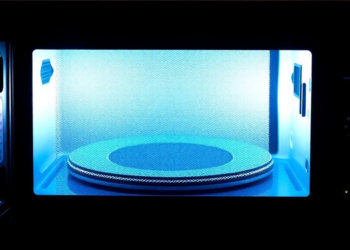
Microwave Timing Holds the Key to Quantum Dot–MXene Electrodes for Zinc Batteries
Researchers at Jilin Normal University show that precisely timed microwave irradiation can generate MXene quantum dots on a vanadium carbide ...
Researchers at Jilin Normal University show that precisely timed microwave irradiation can generate MXene quantum dots on a vanadium carbide ...
Researchers at the University of Illinois Urbana-Champaign and the National Energy Technology Laboratory showed that coal-derived carbon nanodots enable the ...

Researchers have developed an etching-flux technique that forces single-crystal 2D semiconductors to nucleate deterministically at pattern centres, enabling high-mobility transistors ...
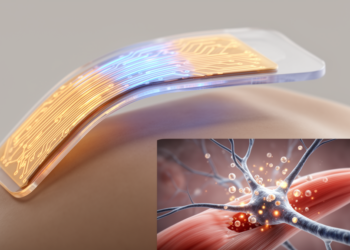
Researchers have created a flexible memristor based on hexagonal boron nitride whose synaptic strength is programmed directly by bending, mimicking ...
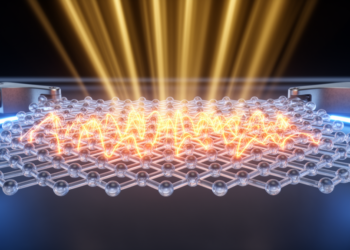
First-principles calculations reveal that a new boron-carbon-nitride monolayer remains stable under wide tensile strain while its bandgap, light absorption, and ...
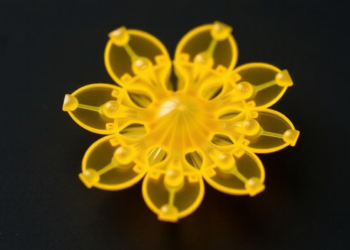
Researchers in China have grown a nanoflower-like FeOOH/MXene composite by electrodeposition that delivers high areal capacitance and long cycling stability ...
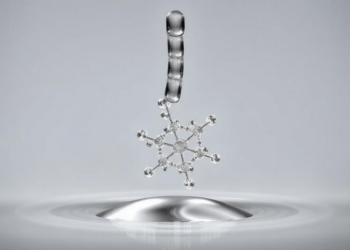
Fluorescent defects in atomically thin hexagonal boron nitride can detect and identify individual ions in liquids through spectral shifts, enabling ...
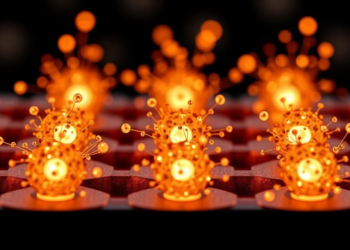
Researchers at the University of Osaka have directly observed a heavy-fermion state forming at the interface between a one-atom-thick ytterbium-copper ...

Researchers at The Hong Kong Polytechnic University have built a two-dimensional bismuth and indium selenide tunnelling transistor that beats the ...

A new density functional theory study identifies silicon-substituted titanium, zirconium, and hafnium selenide monolayers as stable, metallic, fast-diffusing anode candidates ...


Embark on a thrilling journey of discovery with Scienmag.com—your ultimate source for cutting-edge breakthroughs. Immerse yourself in a world where curiosity knows no limits and tomorrow’s possibilities become today’s reality!