

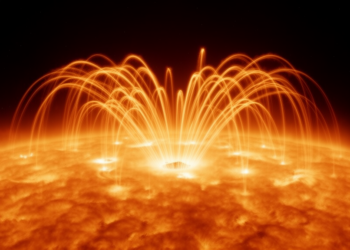
Mid-infrared observations reveal apparent magnetic field weakening in a solar flare
Using a mid-infrared solar telescope, researchers traced apparent magnetic field weakening beneath flare ribbons during an X1.5-class solar flare via ...
Using a mid-infrared solar telescope, researchers traced apparent magnetic field weakening beneath flare ribbons during an X1.5-class solar flare via ...
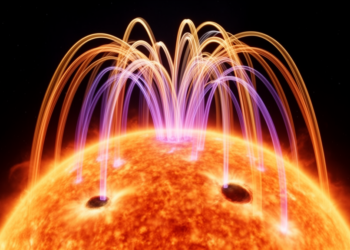
Researchers have produced the first global three-dimensional estimates of the Sun's coronal magnetic field by applying a new inversion method ...
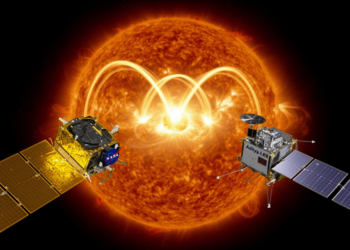
An X1.8 solar flare from active region 13848 showed four-minute quasi-periodic pulsations, with pre-flare magnetic extrapolation revealing a flux rope, ...
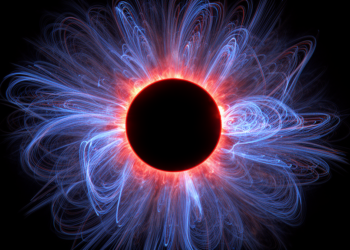
Researchers utilized high-dynamic-range multi-band linear polarimetry during the April 2024 total solar eclipse to map the complex magnetic topology of ...
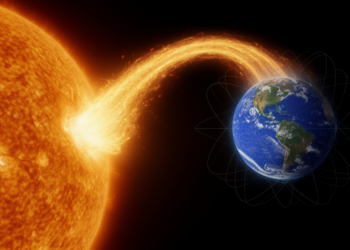
A new hybrid model combining a physics-based drag model with XGBoost machine learning reduced average forecast errors for coronal mass ...
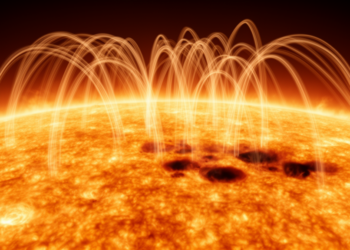
The research analyzes the early evolutionary stages of active regions to address a fundamental question in heliophysics: whether magnetic structures ...
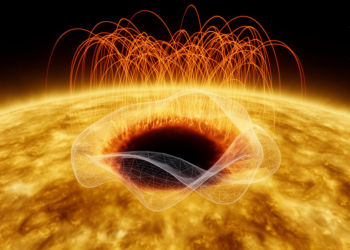
A new study in Solar Physics shows that deep convolutional neural networks can extract flare-relevant information directly from the spatial ...
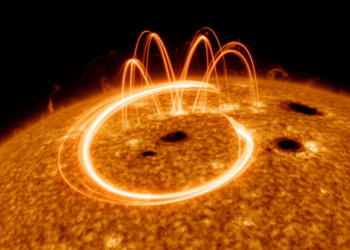
A confined C2.2 solar flare displayed dramatically different ribbon shapes at different wavelengths, revealing that complex flare morphologies do not ...

Using DKIST's Visible Spectro-Polarimeter, researchers have for the first time simultaneously tracked intensity, velocity, and magnetic-field oscillations at two chromospheric ...
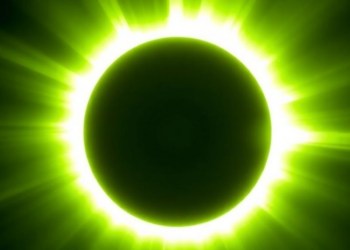
Observations from the April 2024 total solar eclipse show that the linearly polarized Fe XIV green line carries the saturated ...


Embark on a thrilling journey of discovery with Scienmag.com—your ultimate source for cutting-edge breakthroughs. Immerse yourself in a world where curiosity knows no limits and tomorrow’s possibilities become today’s reality!