

Tuesday, October 27, 2026
Science
No Result
View All Result
  • Login
  • HOME
  • SCIENCE NEWS
  • CONTACT US
  • HOME
  • SCIENCE NEWS
  • CONTACT US
No Result
View All Result
Scienmag
No Result
View All Result
Home Science News

New hybrid model sharpens predictions of when solar eruptions will strike Earth

October 27, 2026
in Science News
Teresa Odom
By Teresa Odom Scienmag Editorial Profile - Machine Learning
Reading Time: 2 mins read
0
New hybrid model sharpens predictions of when solar eruptions will strike Earth

New hybrid model sharpens predictions of when solar eruptions will strike Earth

65
SHARES
587
VIEWS
Share on FacebookShare on Twitter
ADVERTISEMENT

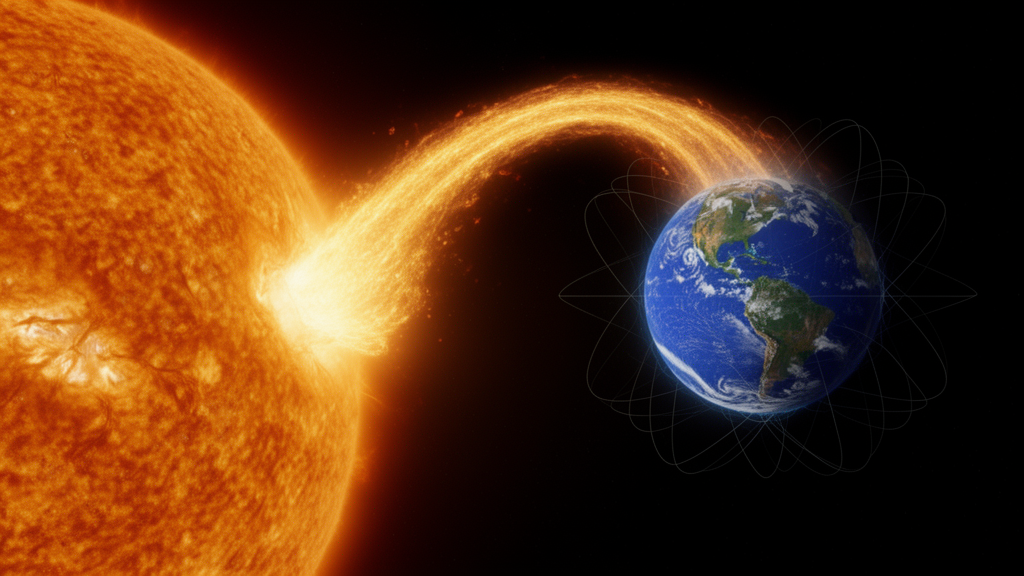
A team of researchers from Nanjing Normal University and the Chinese Academy of Sciences has now introduced Phy-XGBoost, a hybrid framework that combines a physics-based propagation model with machine learning to predict when these eruptions will arrive.

The researchers first extended this standard model into a Generalized Drag-Based Model, designed to explore potential differences in how fast and slow coronal mass ejections propagate. They then refined this generalized version into a weighted variant, which they call w-GDBM, that serves as the physical backbone of the new framework.

Because any physical model carries limitations, the team added a data-driven layer on top of the weighted model. XGBoost, a widely used machine learning algorithm, is trained to predict the residuals—the differences between the actual observed transit times and the times predicted by w-GDBM. The algorithm learns from features describing both the coronal mass ejection itself and the surrounding solar wind, allowing it to correct systematic errors that the physics model alone cannot capture.

The performance of the hybrid framework was tested across 800 random train-test splits of the data. Compared with the weighted Drag-Based Model alone, Phy-XGBoost reduced the average mean absolute error from 13.44 hours to 11.40 hours, and the average median absolute error from 11.14 hours to 8.79 hours. The researchers also compared their method with a purely data-driven XGBoost model that relied on the same features without a physical model underneath. The hybrid achieved a comparable average mean absolute error but a lower average median absolute error, suggesting that anchoring the machine learning correction in physics improves the reliability of typical predictions even when the average performance is similar.

The authors caution that these results, reported in their study accepted by Frontiers in Astronomy and Space Sciences, suggest the physics-guided machine learning framework is a promising approach to predicting coronal mass ejection arrival times rather than a finished operational forecasting system. The physical model supplies a structured first estimate grounded in the dynamics of propagation, while the machine learning component learns where that estimate tends to go wrong and adjusts it using observed conditions.

Subject of Research: A hybrid physics-guided machine learning model for predicting the arrival times of coronal mass ejections

Article Title: Constructing a new hybrid model–Phy-XGBoost to predict the arrival time of coronal mass ejections

Article References: Guan, F., Yang, Y., Xu, G., Yu, L., & Shen, F. (2026). Constructing a new hybrid model–Phy-XGBoost to predict the arrival time of coronal mass ejections. Frontiers in Astronomy and Space Sciences, 13, 1977142. https://doi.org/10.3389/fspas.2026.1977142

Image Credits: AI Generated

DOI: 10.3389/fspas.2026.1977142

Keywords: coronal mass ejections, space weather, XGBoost, machine learning, drag-based model, solar physics, forecasting, solar wind, hybrid model, transit time prediction, Constructing, hybrid

Cite Scienmag News

Teresa Odom. (October 27, 2026). New hybrid model sharpens predictions of when solar eruptions will strike Earth. Scienmag. https://scienmag.com/new-hybrid-model-sharpens-predictions-of-when-solar-eruptions-will-strike-earth/


Teresa Odom. "New hybrid model sharpens predictions of when solar eruptions will strike Earth." Scienmag, 27 October 2026, https://scienmag.com/new-hybrid-model-sharpens-predictions-of-when-solar-eruptions-will-strike-earth/. Accessed 27 October 2026.

Teresa Odom. "New hybrid model sharpens predictions of when solar eruptions will strike Earth." Scienmag. October 27, 2026. https://scienmag.com/new-hybrid-model-sharpens-predictions-of-when-solar-eruptions-will-strike-earth/

Tags: Constructingcoronal mass ejection propagationCoronal Mass Ejectionsdata-driven solar wind analysisdrag-based modelforecastingHybridhybrid modelhybrid physics-based machine learning modelhybrid space weather prediction modelsimproving accuracy of solar eruption timingMachine learningmachine learning for solar event predictionPhy-XGBoost modelresidual error correction in solar eruption predictionsolar eruption predictionsolar eruption transit time predictionsolar physicsSolar Windspace weathersun-earth space weather forecastingtransit time predictionweighted generalized drag-based modelXGBoost
Share26Tweet16
Previous Post

Artemisinin May Curb Gastric Cancer Cells by Damping ERK Signaling

Next Post

Somali fishers report warming seas and shrinking catches as adaptation support fails to arrive

Related Posts

Somali fishers report warming seas and shrinking catches as adaptation support fails to arrive
Earth Science

Somali fishers report warming seas and shrinking catches as adaptation support fails to arrive

October 27, 2026
Artemisinin May Curb Gastric Cancer Cells by Damping ERK Signaling
Medicine

Artemisinin May Curb Gastric Cancer Cells by Damping ERK Signaling

October 27, 2026
Tropical peatland microbes emerge as missing link in One Health
Biology

Tropical peatland microbes emerge as missing link in One Health

October 27, 2026
Brain–computer interface stimulation shows clearer recovery signal after stroke, review finds
Medicine

Brain–computer interface stimulation shows clearer recovery signal after stroke, review finds

October 27, 2026
Rare MSH2 Variant Linked to Three Cancers in One Lynch Syndrome Patient
Medicine

Rare MSH2 Variant Linked to Three Cancers in One Lynch Syndrome Patient

October 27, 2026
Metagenomes reveal seasonal viral communities in a Canadian shield lake
Biology

Metagenomes reveal seasonal viral communities in a Canadian shield lake

October 27, 2026
Next Post
Somali fishers report warming seas and shrinking catches as adaptation support fails to arrive

Somali fishers report warming seas and shrinking catches as adaptation support fails to arrive

  • Mothers who receive childcare support from maternal grandparents show more optimized

    Mothers who receive childcare support from maternal grandparents show more parental warmth, finds NTU Singapore study

    27656 shares
    Share 11059 Tweet 6912
  • University of Seville Breaks 120-Year-Old Mystery, Revises a Key Einstein Concept

    1061 shares
    Share 424 Tweet 265
  • Bee body mass, pathogens and local climate influence heat tolerance

    682 shares
    Share 273 Tweet 171
  • Researchers record first-ever images and data of a shark experiencing a boat strike

    546 shares
    Share 218 Tweet 137
  • Groundbreaking Clinical Trial Reveals Lubiprostone Enhances Kidney Function

    531 shares
    Share 212 Tweet 133
Science

Embark on a thrilling journey of discovery with Scienmag.com—your ultimate source for cutting-edge breakthroughs. Immerse yourself in a world where curiosity knows no limits and tomorrow’s possibilities become today’s reality!

RECENT NEWS

  • Somali fishers report warming seas and shrinking catches as adaptation support fails to arrive
  • New hybrid model sharpens predictions of when solar eruptions will strike Earth
  • Artemisinin May Curb Gastric Cancer Cells by Damping ERK Signaling
  • Tropical peatland microbes emerge as missing link in One Health

Categories

  • Agriculture
  • Anthropology
  • Archaeology
  • Athmospheric
  • Biology
  • Biotechnology
  • Blog
  • Bussines
  • Cancer
  • Chemistry
  • Climate
  • Earth Science
  • Editorial Policy
  • Marine
  • Mathematics
  • Medicine
  • Pediatry
  • Policy
  • Psychology & Psychiatry
  • Science Education
  • Science News
  • Social Science
  • Space
  • Technology and Engineering

Subscribe to Blog via Email

Enter your email address to subscribe to this blog and receive notifications of new posts by email.

Join 5,151 other subscribers

© 2025 Scienmag - Science Magazine

Welcome Back!

Login to your account below

Forgotten Password?

Retrieve your password

Please enter your username or email address to reset your password.

Log In
No Result
View All Result
  • HOME
  • SCIENCE NEWS
  • CONTACT US

© 2025 Scienmag - Science Magazine

Discover more from Science

Subscribe now to keep reading and get access to the full archive.

Continue reading