


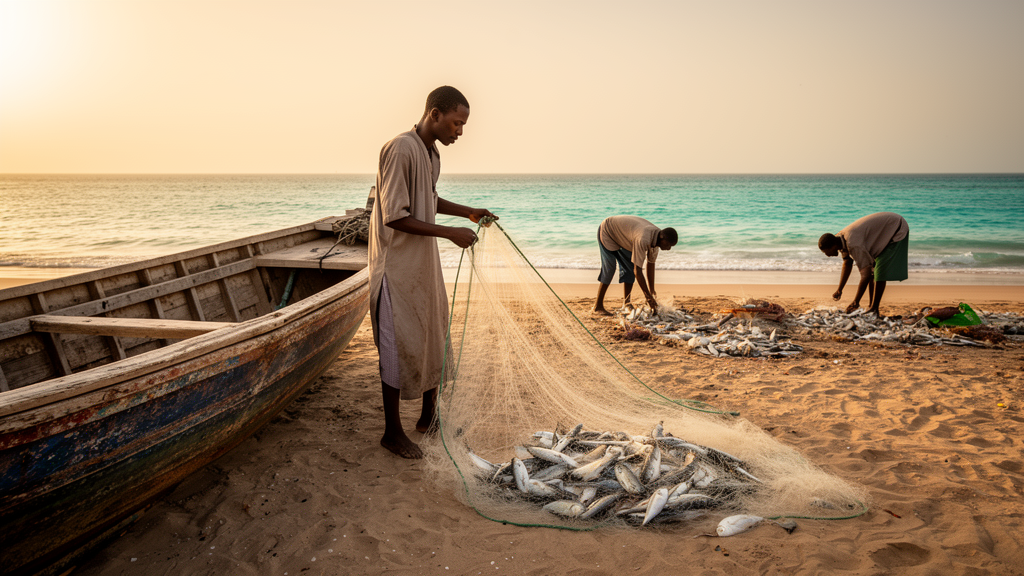
Artisanal fishers working out of two of Mogadishu’s principal fish landing sites overwhelmingly believe the climate around them is changing, and a new survey of 125 of them has produced the first peer-reviewed vulnerability assessment for fishing communities anywhere on Somalia’s Banadir coast. The study, published in Frontiers in Marine Science, combined a structured climate-perception questionnaire with the Livelihood Vulnerability Index adapted to the IPCC framework, and found that both the Abdiaziz and Hamarweyne landing sites register positive composite vulnerability scores, meaning that climate exposure outweighs the adaptive capacity of the households that depend on these waters.
The research team, led by Yusuf Hassan Mohamed of the Blue Horn Initiative with colleagues from Somali National University, interviewed 59 fishers at Abdiaziz and 66 at Hamarweyne between November 2025 and July 2026. Respondents were asked to compare current conditions with those roughly ten years earlier across five domains: fish catch, sea surface temperature, storm and extreme weather frequency, wind predictability, and the timing of the fishing seasons. Agreement that conditions had changed exceeded 75 percent of respondents at both sites for every domain except wind predictability, where the two sites diverged sharply: 94.9 percent of Abdiaziz fishers reported reduced predictability against 56.1 percent at Hamarweyne, a statistically significant difference that the authors attribute largely to gear. Abdiaziz is dominated by handline fishing, which involves short, exposed nearshore trips highly sensitive to day-to-day wind variability, while Hamarweyne fishers use more gillnet and trap gear that is left in place over longer intervals and may buffer them from short-term wind shifts.
Perceived sea surface warming was reported by 84.7 percent of Abdiaziz respondents and 80.3 percent at Hamarweyne, and declining fish catch by 81.4 percent and 75.7 percent respectively. Increased storm frequency was reported by 64.4 percent at Abdiaziz and 71.2 percent at Hamarweyne, and majorities at both sites also perceived shifts in seasonal fishing timing. When asked directly whether climate change was affecting their livelihood, 86.4 percent of Abdiaziz fishers and 80.3 percent of Hamarweyne fishers answered affirmatively. The authors note that these perceptions align with independently documented trends in the wider Western Indian Ocean, where sea surface temperatures have been rising faster than the global ocean average and climate projections indicate intensifying extreme weather and shifting monsoon circulation, although no dedicated buoy or tide-gauge network currently covers the Banadir coast itself, so the fisher-reported data cannot be locally validated against instrumental records.
The vulnerability assessment produced composite LVI-IPCC scores of 0.117 at Abdiaziz and 0.133 at Hamarweyne. Because the composite is calculated as Exposure minus Adaptive Capacity, multiplied by Sensitivity, a positive value indicates net vulnerability: at both sites, the climate stressors fishers face exceed the coping resources their households and communities can muster. The between-site difference in composite score was not statistically significant when tested at the individual-respondent level using a Mann-Whitney U test (U = 1807, p = 0.490), and neither were the underlying differences in Exposure, Sensitivity, or Adaptive Capacity considered individually. The authors are explicit that this null result should be read as the primary site-comparison finding: on present evidence, the two landing sites cannot be said to differ in overall climate vulnerability, and the nominally higher Exposure at Hamarweyne is exploratory rather than confirmatory.
One component did reach statistical significance. Livelihood Diversification scored weaker at Hamarweyne (0.782 versus 0.730 at Abdiaziz, p = 0.018), reflecting a narrower income base and heavier reliance on fishing as the sole source of household income. The socioeconomic data underline how precarious that dependence is: 82.4 percent of all respondents said fishing provided 76 to 100 percent of household income, and only 14.4 percent reported any supplementary income source at all. Abdiaziz, by contrast, carried a nominally weaker Socio-Demographic Profile component, driven by lower educational attainment and lower reported female income participation, though that difference fell just short of statistical significance at p = 0.056 and the authors treat it as a hypothesis for further testing rather than a confirmed finding.
Perhaps the most structurally significant result concerns external assistance. A total of 85.6 percent of respondents, 107 of 125, reported receiving no external adaptation support of any kind, whether from government, non-governmental organizations, or formal community programs. Only 14.4 percent reported having received some form of support, somewhat more commonly at Abdiaziz. The overwhelming majority of adaptation observed at both landing sites is therefore autonomous and self-financed, carried out by households with limited education, minimal vessel ownership, and almost no income diversification to absorb shocks.
What adaptation looks like on the ground is itself telling. Reducing the number of fishing trips was the most commonly reported strategy at both sites, and considerably more dominant at Hamarweyne, where 69.7 percent reported it against 49.2 percent at Abdiaziz. The authors flag this as potentially maladaptive: reducing effort reduces income for already financially constrained households, and without alternative livelihoods or financial safety nets, trip reduction may progressively deepen economic vulnerability rather than build adaptive capacity. Abdiaziz fishers who did adapt showed a broader repertoire, more often changing fishing locations, gear, timing, or target species, yet 35.6 percent of Abdiaziz respondents reported making no adaptation at all, more than double the 13.6 percent at Hamarweyne. The barriers fishers cited differed sharply between sites in a statistically significant pattern: at Abdiaziz, lack of alternative livelihood options and lack of institutional support dominated, with lack of capital the least-cited barrier, while at Hamarweyne lack of capital was overwhelmingly dominant at 62.1 percent. The authors argue this divergence means a single uniform intervention would poorly serve either community, with capital-access instruments the more urgent priority at Hamarweyne and livelihood diversification and institutional engagement the more urgent priority at Abdiaziz.
Open-ended responses added texture to the quantitative picture. Unpredictable storms and unsafe sea conditions were the most frequently cited challenge, followed by increased fuel costs and longer trips, declining catch and reduced income, and prolonged loss of fishing days. One Hamarweyne respondent described months when boats cannot go out at all, leaving households with neither food nor incoming money. When asked what support would help most, fishers most often requested financial assistance or micro-loans, followed by weather forecasting or early-warning systems, improved fishing gear, and cold storage facilities.
The study carries important caveats that the authors state plainly. Respondents were recruited through convenience sampling at each landing site because no formal registry of active fishers exists, so the findings should be read as descriptive of the sampled respondents rather than statistically representative of all Banadir fishers. The sample was 96.8 percent male, reflecting the near-exclusively male composition of sea-going fishing crews in the region, and included only four women, all fish traders at Hamarweyne. Because the Adaptive Capacity domain includes gender-sensitive indicators, the authors caution that the vulnerability profile generated here describes male sea-going fishers specifically, not fishing households or communities as a whole, and that post-harvest workers, predominantly women, may face a materially different balance of exposure, sensitivity, and adaptive capacity. The cross-sectional design also precludes causal inference, and all perception data are self-reported without independent meteorological validation for the Banadir coast.
Placed against the wider LVI-IPCC literature, the Banadir scores sit within the range reported for comparable small-scale, natural-resource-dependent communities, including fishing communities on Lake Victoria in Kenya and subsistence-dependent households in coastal Bangladesh and rural Guyana, though the authors stress this is broad positioning rather than validation, since composite scores are sensitive to the specific indicators and normalization ranges each study selects. Within Somalia, the findings extend the picture from the only prior comparable study, conducted in Berbera, Somaliland, which found near-universal climate perception alongside constrained adaptive capacity. The authors conclude that the specific drivers of vulnerability are highly site-dependent and cannot be assumed to generalize even between two landing sites separated by roughly 2.7 kilometers of coastline, an observation with direct implications for how granular any national adaptation strategy for Somalia’s 3,333-kilometer coast will need to be.
Subject of Research: Climate change perceptions and livelihood vulnerability among artisanal fishers on Somalia's Banadir coast
Article Title: Climate change perceptions and livelihood vulnerability of small-scale fishing communities along the Banadir Coast, Somalia
Article References: Mohamed, Y. H., Mohamud, A. I., & Nageye, A. I. (2026). Climate change perceptions and livelihood vulnerability of small-scale fishing communities along the Banadir Coast, Somalia. Frontiers in Marine Science, 13, 1962426. https://doi.org/10.3389/fmars.2026.1962426
Image Credits: AI Generated
DOI: 10.3389/fmars.2026.1962426
Keywords: Somalia, artisanal fisheries, climate change perceptions, LVI-IPCC, Mogadishu, livelihood vulnerability, Banadir coast, adaptation, Western Indian Ocean, small-scale fisheries, fishing communities, coastal adaptation
Cite Scienmag News
Gavin Prescott. (October 27, 2026). Somali fishers report warming seas and shrinking catches as adaptation support fails to arrive. Scienmag. https://scienmag.com/somali-fishers-report-warming-seas-and-shrinking-catches-as-adaptation-support-fails-to-arrive/
Gavin Prescott. "Somali fishers report warming seas and shrinking catches as adaptation support fails to arrive." Scienmag, 27 October 2026, https://scienmag.com/somali-fishers-report-warming-seas-and-shrinking-catches-as-adaptation-support-fails-to-arrive/. Accessed 27 October 2026.
Gavin Prescott. "Somali fishers report warming seas and shrinking catches as adaptation support fails to arrive." Scienmag. October 27, 2026. https://scienmag.com/somali-fishers-report-warming-seas-and-shrinking-catches-as-adaptation-support-fails-to-arrive/


