


Environmental Capacity Feedback Reshapes Eco-evolutionary Game Dynamics
A new theoretical study demonstrates how varying environmental capacity modulates strategic cooperation and evolutionary outcomes in population dynamics.
A new theoretical study demonstrates how varying environmental capacity modulates strategic cooperation and evolutionary outcomes in population dynamics.

A retrospective cohort study found that 2.1 percent of patients with Vogt-Koyanagi-Harada disease also had type 1 diabetes mellitus, frequently ...

A case report in Diagnostic Pathology describes a rare instance where heterotopic bone, extramedullary hematopoiesis, and oncocytic papillary thyroid carcinoma ...

A case report in BMC Medical Genomics describes the first detailed instance of a female infant with confirmed 47,XXX karyotype ...

A policy review finds that delayed compensation, fragmented governance and habitat loss are undermining efforts to reduce human-elephant conflict in ...

An agent-based model shows that lethal human superpredators targeting prey reduce simulated mesopredator-prey coexistence by about 31 percent, while non-lethal ...

A qualitative study of forest-fringe communities in South India argues that human-wildlife conflict unfolds as an extended trajectory shaped by ...
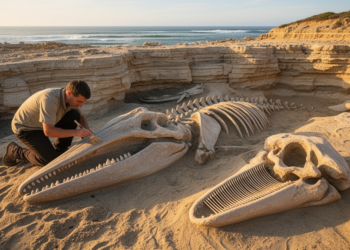
A partial skull from Japan’s Oligocene Jinnobaru Formation provides the first formal recognition of a toothed mysticete alongside the baleen-assisted ...

Agent-based simulations reveal that bacterial cell shape determines whether competing populations in confined channels fixate or coexist, with sphere-like cells ...

A new analysis in Plant and Soil shows that herbaceous plants that respond strongly to mycorrhizal fungi enjoy more favorable ...


Embark on a thrilling journey of discovery with Scienmag.com—your ultimate source for cutting-edge breakthroughs. Immerse yourself in a world where curiosity knows no limits and tomorrow’s possibilities become today’s reality!