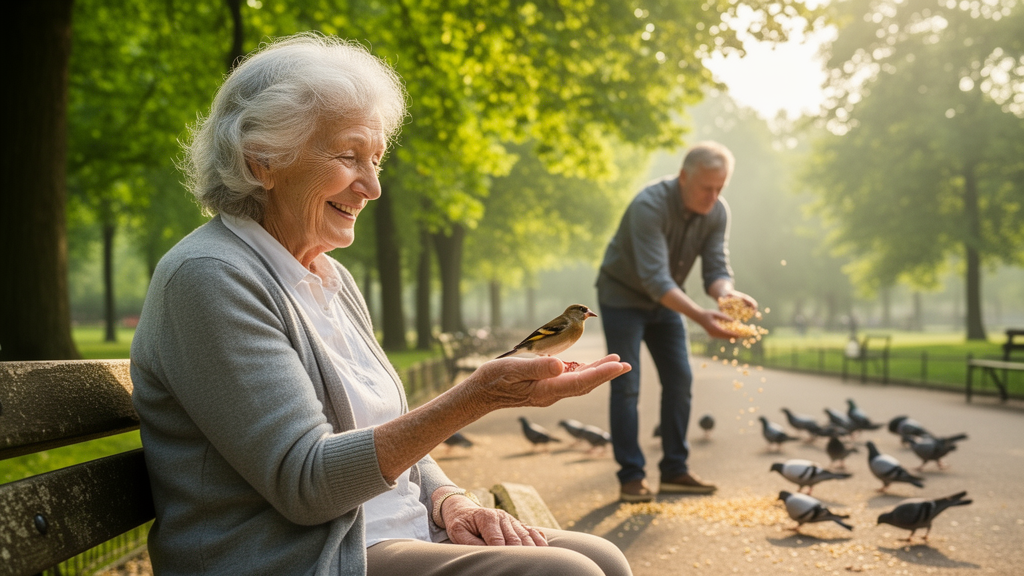
There is something quietly radical about the idea that the sound of a songbird outside your window could be a measurable health intervention. Yet a new systematic scoping review, published in Frontiers in Bird Science, argues exactly that. Led by Matthew Browning of Clemson University’s Virtual Reality & Nature Lab and a team spanning public health, psychology, and ornithology, the review synthesized 196 studies published through November 2025, encompassing more than 1.17 million participants across 54 countries and six continents. Its central conclusion is striking: interactions with birds, from listening to birdsong to watching wild birds at a feeder to caring for a companion parrot, are consistently associated with better mental health, cognitive restoration, physiological calm, and stronger connections to the natural world.
The review’s technical innovation lies in its use of “interaction patterns,” a concept borrowed from Kahn and colleagues’ work on a “nature language.” Rather than treating all human-bird contact as a single undifferentiated exposure, the researchers defined an interaction pattern as a generalizable characterization of the essential features of a human action involving birds, abstract enough to apply across situations yet specific enough to capture the meaningful structure of engagement. In its simplest linguistic form, an interaction pattern follows a verb-preposition-noun structure: watching wild birds at a feeder, listening to recorded birdsong, caring for a companion bird. This precision matters because mechanistically distinct forms of contact, such as direct intentional birdwatching versus incidental exposure to birds in one’s neighborhood, may engage different psychological and physiological pathways and therefore produce different kinds of benefits.
The methodological apparatus behind the review was correspondingly rigorous. The team followed PRISMA-ScR guidance for scoping reviews, pre-registered the protocol in PROSPERO in December 2025, and searched Web of Science, Scopus, and PubMed from database inception through November 16, 2025, using iteratively pilot-tested Boolean terms with wildcards such as bird*, avian*, and birdsong* to capture the full vocabulary of human-bird interaction. From 26,772 initial records, 196 studies survived multistage title and abstract screening. Eligible studies had to involve at least one physical, sensory, or representational interaction with birds that the general public could plausibly enact in everyday life, and had to report at least one human health or well-being outcome. Studies of industrial poultry production, veterinary science, zoonotic disease, and ecosystem services unlinked to individual human contact were excluded, as were studies where birds could not be distinguished from broader nature exposure.
Data extraction was calibrated in two phases across 11 team members using a 17-column Google Sheet with drop-down menus to limit coding drift, ultimately achieving an interrater reliability score of 97.3 percent. The extractors coded country, setting, study design, sample characteristics, interaction type and measurement, comparator presence, outcomes, timing, covariates, and funding sources. The resulting corpus was dominated by auditory exposure to birds, which appeared in 44 studies, or 22 percent of the review, followed by incidental contact with wild birds in everyday environments at 35 studies, birds in culture or media at 30, intentional birding or birdwatching at 22, and companion or captive bird interactions at 18. Study designs split almost evenly between experimental studies and observational cross-sectional surveys, with 51 percent of studies lacking any control or comparison group, a limitation the authors flag repeatedly.
The outcome landscape was equally revealing. Psychological well-being was the most studied domain, appearing in 81 studies, followed by mood at 58 and nature connectedness at 37. Cognitive restoration appeared in 31 studies and stress in 30. Physiological measurement was comparatively rare: heart rate or heart rate variability was assessed in 15 studies, brain activity in nine, blood pressure in six, and cortisol or stress hormones in only two. Nearly two-thirds of studies relied on validated self-report scales, and most benefits were measured immediately after the interaction, with longitudinal or repeated assessments occurring in just 14 percent of studies. This temporal profile suggests the field has excelled at documenting short-term restorative effects while leaving the durability of those effects largely unexamined.
When the researchers mapped specific interaction-benefit pairings, several robust clusters emerged, each supported by ten or more studies. Listening to birdsong was linked to better cognitive functioning, mental health and well-being, and physiological markers of health, including lower heart rate and reduced autonomic arousal. Birding and birdwatching, as well as incidental contact with birds in nature-rich living environments, were linked to better mental health and well-being alongside pro-environmental attitudes, behaviors, and nature connectedness. Birds encountered through media, artwork, and digital representations, as well as companion or captive birds, were linked with better mental health and well-being. The single largest volume of evidence connected birding or birdwatching with mental health and well-being, with 70 distinct findings, followed by incidental contact with wild birds at 48 findings and listening to birdsong at 34.
These patterns align remarkably well with established theory in environmental psychology. Stress reduction theory, proposed by Ulrich and colleagues, holds that nonthreatening natural stimuli trigger psychophysiological reactions that buffer against stress, involving parasympathetic activation that manifests as lower heart rate, lower blood pressure, and reduced stress hormones. The nonthreatening, often melodious harmonics of birdsong fit this mechanism precisely, signaling environmental safety and promoting relaxation. Attention restoration theory, advanced by Kaplan, suggests that urban environments demanding constant directed attention produce mental fatigue, while natural stimuli rich in “soft fascination” effortlessly hold attention without cognitive exertion, allowing the brain’s directed attention capacity to rest and replenish. The dynamic, unpredictable behavior of birds serves as a prime example of soft fascination. The biophilia hypothesis, articulated by E.O. Wilson, provides the evolutionary rationale: humans possess an innate, genetically determined tendency to seek connections with other forms of life, and birds fulfill that intrinsic need. A newer predictive processing account, integrating active inference with what Tryjanowski and Murawiec call the “predostatic mind,” proposes that birdwatching functions as a clinically relevant exercise in flexibly switching between alarm, seek, and balance modes of brain function, with possible implications for ADHD, depression, and addiction.
The practical implications for nature-based therapy are substantial. Unlike forms of nature contact requiring access to large natural spaces, birds are present in most human-dominated environments and can be incorporated into therapeutic settings with minimal resources. The authors suggest that smart bird feeders, water features, and nest boxes installed outside clinical office windows, with audio or video streams available indoors, could provide subtle restorative stimuli during therapy sessions and in waiting rooms. For older adults and institutional settings where direct nature access is limited, reminiscence-based approaches can incorporate bird-related prompts to stimulate autobiographical memories, and indoor multisensory programs such as Bird Tales can be facilitated by care staff without specialized training. The review also connects these findings to the emerging field of Ecological Medicine, a model pursuing interventions that create reciprocity, relationality, and connectedness among humans, other biota, and the environment. Because bird interactions overwhelmingly enhance environmental attitudes, which are among the strongest predictors of pro-environmental behavior, bird-based therapy may contribute to a healthier biosphere that in turn further improves human health.
Yet the review is candid about its own boundaries. The search strategy was oriented toward benefits and did not systematically target adverse outcomes such as zoonotic disease, window collisions, allergens, fear-based responses, or sleep disruption, meaning the conclusions may reflect a positive bias inherent in the published literature. Only seven findings, all associative, reported harmful relationships, and no experimental study documented negative effects. The authors also note emerging evidence of costs: a survey of over 2,400 birdwatchers documented “negative social jetlag,” with birders arising roughly 15 minutes earlier on free days and accumulating about 45 minutes of sleep deficit on birding days. Geographic coverage was thin in Central and South America and Africa, English-language indexing may have excluded regional studies, and no formal risk of bias assessment was performed, a limitation shared by prior reviews in this space. The authors call for experimental designs comparing bird species with varying acoustic features, meta-analytic quantification of specific activities’ effects on well-being, and research into underexplored interaction types such as citizen science and bird handling. As the evidence base matures, the humble act of noticing a bird may come to be recognized not as a pastime but as a precise, accessible, and theoretically grounded component of human health care.
Subject of Research: A systematic scoping review mapping human-bird interaction patterns and their associations with human health and well-being.
Article Title: The human health and well-being benefits of birds: a systematic scoping review of interaction patterns
Article References: Browning, M. H. E. M., McAnirlin, O., Miller, W., Beard, H., Breed, M. W., Rubalcava, S. E., Engelman, C., Hatami, N., Jaggi, A., Maynard, A., Merker, H., Morassafar, S., Siepker, K. L., Shin, S., Vinas-Rogers, M., Zhang, K., & Pollack, L. (2026). The human health and well-being benefits of birds: a systematic scoping review of interaction patterns. Frontiers in Bird Science, 5, Article 1871909. https://doi.org/10.3389/fbirs.2026.1871909
Image Credits: AI Generated
DOI: 10.3389/fbirs.2026.1871909
Keywords: birds, birdwatching, birdsong, mental health, well-being, nature contact, scoping review, ecological medicine, nature-based therapy, pro-environmental behavior, cognitive restoration, companion birds
Cite Scienmag News
Margaret Porter. (October 17, 2026). Systematic review maps how bird interactions boost human health and well-being. Scienmag. https://scienmag.com/systematic-review-maps-how-bird-interactions-boost-human-health-and-well-being/
Margaret Porter. "Systematic review maps how bird interactions boost human health and well-being." Scienmag, 17 October 2026, https://scienmag.com/systematic-review-maps-how-bird-interactions-boost-human-health-and-well-being/. Accessed 17 October 2026.
Margaret Porter. "Systematic review maps how bird interactions boost human health and well-being." Scienmag. October 17, 2026. https://scienmag.com/systematic-review-maps-how-bird-interactions-boost-human-health-and-well-being/