


A systematic review and field-based case study found that passive acoustic monitoring can identify invasive animals, including American bullfrogs at five of 11 lakes monitored in southwestern Germany. The study, published in Environmental Monitoring and Assessment, reviewed 26 relevant publications and evaluated low-cost recorders, automated classification and manual validation at 11 water bodies near Karlsruhe.
The review was based on a Scopus search conducted on 6 November 2025 using terms related to invasive species and acoustic monitoring while excluding the non-invasive term. The search returned 143 papers, from which the researchers screened 44 potentially relevant abstracts and assessed their full texts. They retained 26 studies that directly examined passive acoustic monitoring of invasive animals.
The earliest study in the retained dataset was published in 2012, and the number of publications increased in more recent years. Amphibians accounted for 11 studies, birds and fish for five each, arthropods for three, and mammals and reptiles for one each. Research was concentrated in the USA and Australia, with fewer studies from Europe, Asia and South America and none identified from Africa. The geographic pattern partly reflected repeated studies of cane toads in Australia and barred owls in the USA.
The literature showed that acoustic monitoring was moving from exploratory sound characterization toward automated detection, machine learning, long-term monitoring and large-scale networks. Automated or semi-automated detection appeared in 17 of the 26 studies, and manual or expert validation was reported in 18, with four more using behavioural, experimental, laboratory or methodological validation. In amphibian studies, distinctive and relatively stereotyped mating calls supported automated identification. Other examples included deep-learning classifiers for cane toads, real-time monitoring of barred owls, acoustic classification of invasive fish and a model developed from 3,500 field-recorded common brushtail possum vocalizations in New Zealand.
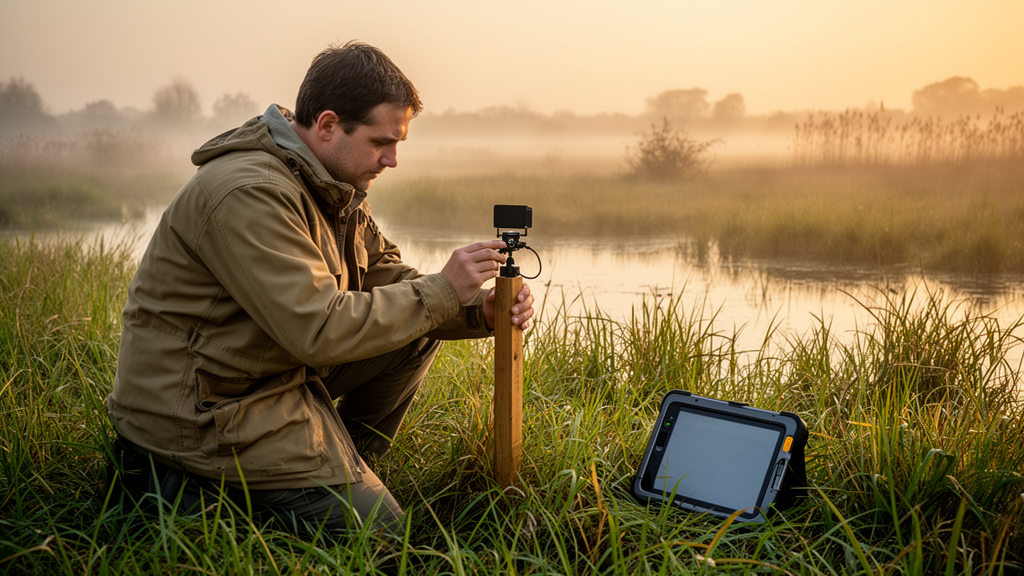
For the case study, the researchers deployed 20 AudioMoth recorders at 11 water bodies in the Upper Rhine region. The devices were placed less than five metres from shorelines and programmed to record for 55 seconds every minute from two hours before sunset until three hours after sunset at a sampling frequency of 48 kHz. Simultaneous recordings covered 16 days from 13 to 29 June 2025, corresponding with the regional peak of bullfrog vocal activity and breeding season. Visual shoreline surveys were also conducted where possible, and all available iNaturalist records in the study region were compiled.
The 1,600 recorded hours were analysed with BirdNET Analyzer V2.4, which produced 56,298 three-second snippets identified as containing bullfrog calls. The researchers randomly selected 500 segments spanning confidence scores from 0.25 to 1.00 and assessed spectrograms and audio. Of these, 485 were judged correct and 15 incorrect. Logistic regression estimated that identifications with confidence scores above 0.703 had a 99% probability of being correct, with a 95% confidence interval for the threshold of 0.602 to 0.932.
Applying a multi-step classification process, the study classified 10 of the 20 recorders as having detected bullfrogs and thereby confirmed presence at five of the 11 monitored lakes. Recorders with more than 100 detections above the threshold were classified directly. For lower counts, the researchers examined the 15 highest-scoring detections; these were classified as positive if all exceeded the upper limit of the confidence interval, while uncertain cases were checked manually by listening to the audio. Tadpoles were observed at five sites, which were also the only sites with available citizen-science bullfrog records in the region.
Two lakes with confirmed bullfrog presence were within one kilometre of the protected nature reserves Altrhein Kleiner Bodensee and Altrhein-Königsee. The case study nevertheless has bounded scope: it covered one 16-day recording period, 11 lakes and two confirmed presence locations, and failure to confirm calls at the other lakes did not establish that bullfrogs were absent. Detection also depended on animals vocalizing during the deployment period. Across the broader literature, suitability varied among taxa, with acoustic monitoring most applicable to species producing frequent, distinctive and predictable sounds and less comprehensive for weakly vocal or non-vocal animals.
The authors concluded that passive acoustic monitoring has strong potential to support repeated and scalable invasive-species surveillance, particularly when automated identification is paired with transparent validation, defined thresholds, manual checks and integration with visual surveys and citizen science. It can help confirm persistence at known sites, identify likely breeding activity through repeated mating calls and prioritize follow-up in areas with limited resources. The review did not establish a uniform detection rate across species or environments, and the case study demonstrates feasibility rather than a comprehensive estimate of monitoring accuracy across all invasive animals.
Subject of Research: Evaluation of passive acoustic monitoring for detecting invasive animal species through literature synthesis and an American bullfrog field case study.
Article Title: Passive acoustic monitoring as a tool for early detection of invasive animal species: a systematic review and a case study
Article References: Becker, D., Kasten, M. K., Weber, T., Grass, I., & Hiller, T. (2026). Passive acoustic monitoring as a tool for early detection of invasive animal species: a systematic review and a case study. Environmental Monitoring and Assessment, 198(9), Article 1003. https://doi.org/10.1007/s10661-026-15873-2
Image Credits: AI Generated
DOI: 10.1007/s10661-026-15873-2
Keywords: passive acoustic monitoring, invasive species, American bullfrog, automated species detection, BirdNET, AudioMoth, systematic review, early detection, biodiversity monitoring, Passive, acoustic, monitoring
Cite Scienmag News
Violet Maxwell. (October 20, 2026). Systematic review and German field case study assess acoustic monitoring for invasive animals. Scienmag. https://scienmag.com/systematic-review-and-german-field-case-study-assess-acoustic-monitoring-for-invasive-animals/
Violet Maxwell. "Systematic review and German field case study assess acoustic monitoring for invasive animals." Scienmag, 20 October 2026, https://scienmag.com/systematic-review-and-german-field-case-study-assess-acoustic-monitoring-for-invasive-animals/. Accessed 20 October 2026.
Violet Maxwell. "Systematic review and German field case study assess acoustic monitoring for invasive animals." Scienmag. October 20, 2026. https://scienmag.com/systematic-review-and-german-field-case-study-assess-acoustic-monitoring-for-invasive-animals/


