A new systematic map has catalogued the full body of research on how large herbivores affect the climate in European terrestrial habitats, and its central finding is striking: the evidence base is far thinner and far more uneven than many conservation and rewilding decisions assume. The map, published in the journal Environmental Evidence, identified 316 articles containing 565 individual studies, and it shows that most of what we know concerns cattle and sheep in agricultural settings rather than the wild and semi-wild herbivores increasingly being introduced for nature recovery.
The work was carried out by Jennifer Ramsay, Thomas Ings, Christopher Sandom, Russell Stevens, Edward Imber, David Christopher Hopkinson and Helen C. Wheeler, following a pre-published protocol. The team searched both peer-reviewed and grey literature using a predefined search string across a range of bibliographic databases, search engines and websites. Results were screened in two stages, first by title and abstract and then at full text, with articles excluded unless they met eligibility criteria covering terrestrial habitats in Europe, large herbivores, and climate impacts.
The motivation for the map lies in a growing policy and practice challenge. Land management practices have significant impacts on biodiversity and climate change processes, and conservation and rewilding practitioners are increasingly seeking to enhance ecosystem functions and carbon sequestration at the same time, encouraged by climate policies such as the European Green Deal. Ecosystem restoration involving large herbivores of ten kilograms or more has attracted growing interest in recent years, but the climate impacts of these animals are complex, spanning greenhouse gas emissions, carbon storage, wildfire and albedo, with effects that can cool or warm the climate and that vary with species, herd density, season and habitat.
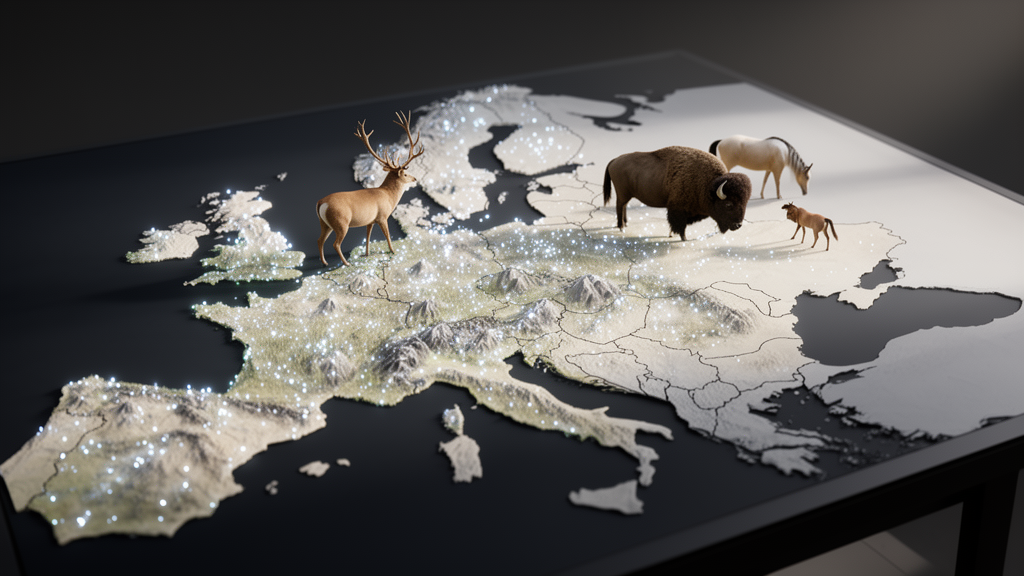
Geographically, the research landscape is heavily skewed. Most studies were conducted in Northern Europe, accounting for 63 percent of the total, with the largest single research cluster in the United Kingdom. Eastern Europe had the fewest studies, at just 6 percent. That imbalance means the map’s conclusions about where evidence exists, and where it does not, carry direct weight for practitioners working in under-studied regions.
The species focus is equally narrow. Cattle were included in 54 percent of studies and sheep in 34 percent, with reindeer the next most studied at 7 percent. Every other type of large herbivore appeared in fewer than 5 percent of studies, although the list is long: goats, equines, various wild cervids, European bison, pigs, wild boars, chamois, water buffaloes, beavers and even tortoises. The map’s authors note that this concentration on domestic livestock in agricultural contexts leaves a substantial gap for other large herbivores and for natural and semi-natural habitats.
The climate outcomes studied also cluster tightly. Soil carbon was the most frequently examined, appearing in 34 percent of studies, followed by nitrous oxide emissions at 33 percent, carbon dioxide flux or emissions at 21 percent, and enteric methane emissions at 17 percent. Only 6 percent of studies combined multiple climate-related effects to estimate net emissions, a figure the authors highlight as a particular problem, because determining whether a given herbivore choice delivers a net climate benefit requires accounting for multiple greenhouse gases alongside carbon sequestration.
The map’s conclusions are framed as a warning for policy and practice. The research gaps for other large herbivores and for natural and semi-natural habitats make it difficult for conservation and rewilding practitioners to assess the climate implications of their choices about which animals to use in land management. The paucity of studies addressing net greenhouse gas emissions presents further challenges for determining which choices are likely to have net climate benefits, with implications that the authors say extend particularly to nature-based carbon offsetting projects.
As a systematic map rather than a synthesis of effect sizes, the study does not itself quantify how strongly any herbivore influences any climate process. Its contribution is to document what research exists, where it is concentrated, and where the clusters and gaps lie, while also identifying the potential for further quantitative analyses. The authors address the primary question of what research exists on the climate effects of large herbivores in Europe, and their answer is a substantial but lopsided literature.
The practical message is that research to fill these gaps would aid decision-making in both nature recovery and climate change mitigation. Until more studies cover wild herbivores, semi-natural habitats and net emissions accounting, practitioners weighing the climate consequences of reintroducing or managing large animals in Europe must do so against an evidence base dominated by cattle and sheep on farmland.
Subject of Research: A systematic map of research on the climate effects of large herbivores in European terrestrial habitats
Article Title: Research on climate effects of large herbivores in Europe: a systematic map
Article References: Ramsay, J., Ings, T., Sandom, C., Stevens, R., Imber, E., Hopkinson, D. C., & Wheeler, H. C. (2026). Research on climate effects of large herbivores in Europe: a systematic map. Environmental Evidence. https://doi.org/10.1186/s13750-026-00392-x
Image Credits: AI Generated
DOI: 10.1186/s13750-026-00392-x
Keywords: systematic map, large herbivores, climate change, rewilding, carbon sequestration, greenhouse gases, soil carbon, methane, nitrous oxide, Europe, conservation, Environmental Evidence
Cite Scienmag News
Margaret Porter. (October 28, 2026). Systematic map reveals major gaps in climate research on Europe’s large herbivores. Scienmag. https://scienmag.com/systematic-map-reveals-major-gaps-in-climate-research-on-europes-large-herbivores/
Margaret Porter. "Systematic map reveals major gaps in climate research on Europe’s large herbivores." Scienmag, 28 October 2026, https://scienmag.com/systematic-map-reveals-major-gaps-in-climate-research-on-europes-large-herbivores/. Accessed 28 October 2026.
Margaret Porter. "Systematic map reveals major gaps in climate research on Europe’s large herbivores." Scienmag. October 28, 2026. https://scienmag.com/systematic-map-reveals-major-gaps-in-climate-research-on-europes-large-herbivores/