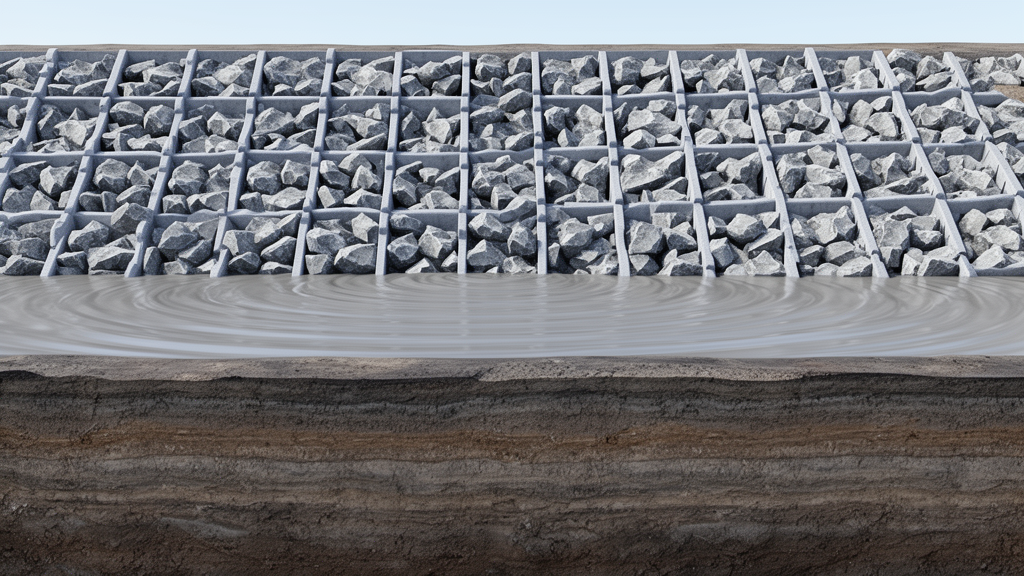
A three-dimensional numerical modeling study of an upstream tailings dam in China reports that inserting a grid of coarse mine waste rock into the tailings deposit can substantially reduce earthquake-induced deformation, lower steady pore-water pressure, and raise the post-earthquake factor of safety. The study, published in Frontiers in Earth Science, also finds that the spacing of the transverse waste rock inclusions matters: denser grids delivered the greatest absolute safety benefit, but a 40-meter spacing achieved the best balance between seismic performance and the volume of waste rock that must be placed.
Tailings dams are unusual structures. They serve simultaneously as water-retaining embankments and as the disposal site for the fine-grained slurry left over from mineral processing. In China, wet disposal and upstream construction are common, and fine tailings can remain highly saturated for long periods. If such a dam fails, saturated tailings can travel downstream as a high-velocity slurry. Accident records identify earthquakes as an important external trigger of tailings impoundment instability, which is why the research team, led by Mingqiang Sheng of Nanchang University, sought a reinforcement method that improves drainage and seismic resistance at the same time.
The investigated facility is an upstream tailings dam used mainly for tungsten-processing tailings, with a design height of 42.0 meters, a total storage capacity of 1.218 million cubic meters, and a Grade IV classification. The site has a seismic fortification intensity of VII and a design basic ground acceleration of 0.10g. The researchers built FLAC3D models of the dam in four configurations: one unreinforced and three reinforced with grid-pattern waste rock inclusions, or WRIs, at transverse center-to-center spacings of 30, 40, and 50 meters. Each transverse inclusion rises in trapezoidal lifts 3 meters high, 6 meters wide at the top, and 12 meters wide at the base, while two longitudinal waste rock strips, each 6 meters wide, run along the dam’s major axis. Together the transverse and longitudinal elements form a continuous spatial framework within the tailings.
Waste rock differs from tailings in ways that matter for dam behavior. Waste rock is also far stiffer and stronger, with a friction angle of 42 degrees matching the starter dam, a cohesion of 50 kilopascals slightly exceeding the starter dam's 40 kilopascals, and both far exceeding the soft tailings. The authors note that previous field observations, laboratory tests, and numerical studies have confirmed that waste rock has greater permeability, stiffness, and shear strength than tailings, which can accelerate consolidation and improve global stability.
The modeling sequence proceeded in stages: gravity equilibration, steady-state seepage analysis, dynamic analysis under a fixed pore-pressure field, post-earthquake static re-equilibration, and finally stability evaluation using the FLAC3D strength-reduction method. Four ground-motion records from the PEER database—El Centro, Taft, Loma Prieta, and Chi-Chi—were selected for their differing frequency content, energy, and duration, then uniformly scaled to a peak ground acceleration of 0.10g. The first natural frequencies of the four models ranged from 1.63 to 1.83 hertz, and the records were chosen so that their dominant frequencies straddled that range. Notably, the Taft record, with a dominant frequency of 1.36 hertz just below the natural-frequency range and the highest Arias intensity and longest significant duration, produced the largest deformation in every model, while the Loma Prieta record, with a dominant frequency of 2.66 hertz above that range and lower energy, produced the smallest.
The seepage results show how strongly the waste rock grid reshapes the internal water regime. The maximum pore-water pressure in the unreinforced dam was 388.45 kilopascals. With WRIs at 50-, 40-, and 30-meter spacings, that maximum fell to 296.39, 261.39, and 240.91 kilopascals—reductions of 23.7, 32.7, and 38.0 percent, respectively. The mean phreatic-surface elevation beneath the platform dropped from about 35.00 meters in the unreinforced dam to 27.78, 24.90, and 22.23 meters. The researchers attribute this to water flowing from the tailings toward nearby waste rock paths, passing through the connected transverse–longitudinal intersections, and draining toward the low-elevation boundary of the starter dam. Because the longitudinal strips do not enter the starter dam or bedrock, water still passes through downstream tailings to reach the drainage outlet, which is why the phreatic surface recovers between adjacent inclusions and why the benefit does not scale linearly: tightening the spacing from 50 to 40 meters lowered the maximum pore pressure by 35.00 kilopascals, but the further step from 40 to 30 meters added only 20.48 kilopascals of reduction.
The dynamic results reveal a striking dual effect. Relative to the unreinforced dam, the reinforced models reduced the four-motion mean peak horizontal displacement by 42.2 to 54.6 percent, and the four-motion mean absolute permanent displacement fell from 15.66 millimeters to 2.89, 2.96, and 4.09 millimeters for the 30-, 40-, and 50-meter models—reductions of 73.9 to 81.6 percent. Yet at the same time, local acceleration amplification increased. The four-motion mean maximum amplification factor along the vertical monitoring line rose from 3.21 in the unreinforced dam to 3.81, 4.63, and 4.15 in the 30-, 40-, and 50-meter models, an increase of 18.9 to 44.4 percent. The authors suggest that stiffness and density contrasts between waste rock and tailings altered wave impedance and propagation paths, increasing local acceleration near the framework and in the upper dam even as the grid restrained global lateral deformation. Because the acceleration monitoring line lay between the longitudinal strips, the larger amplification cannot be attributed to monitoring points located directly within waste rock.
Post-earthquake stability also improved. Under the conditions of the study, the post-earthquake, statically re-equilibrated factors of safety were 2.551–2.555 for the unreinforced dam and 3.487–3.559 for the reinforced models, with mean increases of 39.2, 39.1, and 36.8 percent for the 30-, 40-, and 50-meter spacings. The authors caution that these factors of safety mainly represent the shear-resistance margin of the re-equilibrated dam under a prescribed pore-pressure field rather than stability under instantaneous earthquake inertia, and they had limited sensitivity to record frequency content. The dynamic analyses also did not simulate earthquake-induced excess pore-pressure generation, cyclic strength degradation, or liquefaction, so the drainage benefit primarily reflects improvement in the initial effective-stress state.
To weigh safety against construction demand, the team developed an engineering efficiency index that combines pore-pressure control, displacement reductions, stability improvement, and local dynamic response, penalized by the adverse acceleration increase and normalized by waste rock volume. The 30-, 40-, and 50-meter schemes required 245,394, 203,252, and 182,214 cubic meters of waste rock, respectively. The 40-meter scheme’s benefit of 0.513 was only 3.9 percent below the 30-meter value, yet its efficiency index of 0.422 was the highest of the three. Sensitivity checks showed the ranking depends on how strongly local acceleration is penalized: at penalty coefficients of 0.4 and 0.5, the 50-meter scheme becomes the most efficient.
The authors emphasize that the findings apply to comparisons using the prescribed material parameters, an assumed continuous connection between waste rock and tailings through shared gridpoints, and fixed steady-state pore-pressure fields. No separate interface elements were modeled, so slip, opening, or separation at actual contacts was not considered, and the framework-restraint effect is conditional on that assumption. Without control models containing only transverse or only longitudinal inclusions, the separate contributions of drainage and mechanical restraint cannot be quantified independently. The 40-meter spacing is a relatively preferred option only among the three compared schemes under the stated weighting, and engineering applicability, the authors write, requires further evaluation using site monitoring data and models that represent dynamic pore-pressure evolution, cyclic degradation, and actual interface behavior.
Subject of Research: Numerical modeling of grid-pattern waste rock inclusions for seismic reinforcement and spacing optimization of an upstream tailings dam
Article Title: Dynamic response and spacing optimization of a tailings dam reinforced with grid-pattern waste rock inclusions under representative ground motions
Article References: Sheng, M., Chen, S., Hu, D., Rao, J., Dai, H., Liu, J., & Liu, Z. (2026). Dynamic response and spacing optimization of a tailings dam reinforced with grid-pattern waste rock inclusions under representative ground motions. Frontiers in Earth Science, 14, Article 1983117. https://doi.org/10.3389/feart.2026.1983117
Image Credits: AI Generated
DOI: 10.3389/feart.2026.1983117
Keywords: tailings dam, waste rock inclusions, seismic reinforcement, FLAC3D modeling, pore-water pressure, ground motions, spacing optimization, permanent displacement, factor of safety, acceleration amplification, drainage, mine waste
Cite Scienmag News
Violet Maxwell. (October 28, 2026). Waste Rock Grids Reinforce Tailings Dams Against Earthquake Damage, Modeling Study Finds. Scienmag. https://scienmag.com/waste-rock-grids-reinforce-tailings-dams-against-earthquake-damage-modeling-study-finds/
Violet Maxwell. "Waste Rock Grids Reinforce Tailings Dams Against Earthquake Damage, Modeling Study Finds." Scienmag, 28 October 2026, https://scienmag.com/waste-rock-grids-reinforce-tailings-dams-against-earthquake-damage-modeling-study-finds/. Accessed 4 November 2026.
Violet Maxwell. "Waste Rock Grids Reinforce Tailings Dams Against Earthquake Damage, Modeling Study Finds." Scienmag. October 28, 2026. https://scienmag.com/waste-rock-grids-reinforce-tailings-dams-against-earthquake-damage-modeling-study-finds/