


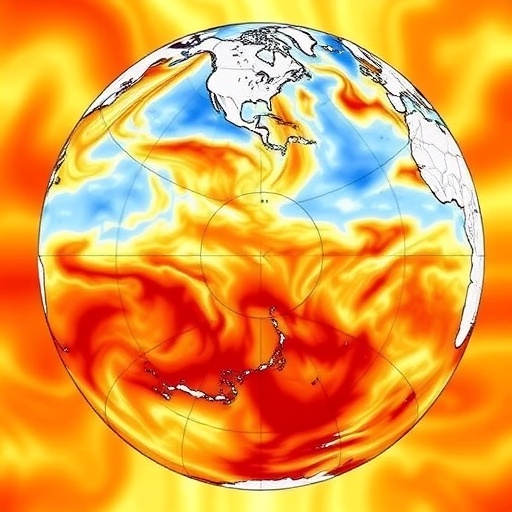
In a groundbreaking new study set to redefine our understanding of past climate events, scientists have uncovered compelling evidence of synchronous subsurface ocean warming across western boundary regions in both hemispheres during Heinrich Stadial 1 (HS1). This revelation adds a pivotal piece to the complex puzzle of abrupt climate shifts that have long puzzled the scientific community. The research, led by Stirpe, Allen, and Sikes and published in Communications Earth & Environment, leverages novel paleoceanographic proxies to reveal the intricate interplay between ocean dynamics and climate forcing during one of the most enigmatic intervals of the last glacial period.
Heinrich Stadial 1, occurring approximately 17,000 to 15,000 years ago, is characterized by profound disruptions in atmospheric and oceanic circulation patterns, often linked to massive iceberg discharges into the North Atlantic. Traditionally, research has focused on surface ocean temperature changes or atmospheric reconstructions to infer the broader climatic consequences. However, this new study takes a significant leap by focusing on subsurface ocean temperatures, revealing that warming occurred simultaneously in western boundary currents—powerful, poleward-flowing ocean currents such as the Gulf Stream in the North Atlantic and the Kuroshio Current in the North Pacific, as well as their southern hemisphere counterparts.
The detection of synchronous warming at subsurface depths challenges the conventional narrative that these regions primarily experienced cooling or limited changes during HS1 due to the influx of fresher, colder meltwater. Instead, the data suggest a more complex thermal evolution, where subsurface waters were not only insulated but actively warmed, potentially altering vertical stratification and nutrient cycles. This phenomenon implicates critical feedback processes within oceanic heat transport systems that may have amplified or modulated climatic responses on regional and global scales.
Crucial to the study’s success was the application of innovative geochemical proxies extracted from deep-sea sediment cores collected along key western boundary currents. These proxies, including foraminiferal Mg/Ca ratios and isotopic compositions, provided temperature estimates with unprecedented spatial and temporal resolution. By combining these measurements with state-of-the-art climate models, the research team reconstructed a coherent picture of heat distribution beneath the ocean surface, revealing synchronous warming pulses occurring in concert with iceberg discharge events.
One of the key insights from this research is the implication for ocean circulation patterns during HS1. The subsurface warming observed suggests enhanced advection of warmer tropical waters toward higher latitudes, possibly linked to shifts in wind-driven currents or changes in the Atlantic Meridional Overturning Circulation (AMOC). These shifts would have had cascading effects on regional climate regimes, sea ice extent, and marine ecosystems, helping to explain some of the rapid climatic changes documented in terrestrial and marine archives during this timeframe.
Moreover, the study brings to light the interconnectedness of oceanic processes across hemispheres. Previous hypotheses often treated hemispheric responses as isolated events; however, synchronous subsurface warming in both hemispheres’ western boundary currents highlights the ocean’s capacity for rapid heat redistribution on a global scale. This realization urges a re-examination of how coupled ocean-atmosphere systems operated during abrupt climate episodes and their role in transitioning between glacial and interglacial conditions.
The team also explored the implications of subsurface warming for biogeochemical cycles, particularly focusing on oxygen minimum zones and nutrient regeneration. Warming at intermediate depths would have influenced the solubility of gases and the metabolic rates of marine organisms, potentially reshaping ocean productivity patterns. These changes could have further impacted atmospheric greenhouse gas concentrations, linking oceanic temperature dynamics directly to broader climate feedback loops.
Importantly, this study offers new perspectives relevant to current and future climate change scenarios. Understanding how subsurface ocean temperatures respond to abrupt deglacial events provides critical analogs for assessing the stability and variability of modern ocean currents under anthropogenic forcing. The synchronous nature of warming documented during HS1 warns of the speed and extent at which oceans can redistribute heat, with significant ramifications for coastal climates and marine ecosystems worldwide.
Advanced climate modeling employed in this study underscores the necessity of incorporating subsurface ocean dynamics into predictive frameworks. Many contemporary models focus on surface temperature anomalies, yet subsurface conditions can dictate the long-term stability of ocean circulation. This research advocates for a more integrated approach that captures vertical thermal gradients and their interaction with changing atmospheric forcings to improve future climate projections.
Another remarkable aspect is the methodological rigor underpinning these findings. By synthesizing multiple lines of proxy evidence across ocean basins, the researchers managed to overcome some of the pervasive uncertainties associated with paleoceanographic reconstructions. This multidimensional approach enhances confidence in their conclusions and sets a new standard for future investigations into past oceanic conditions.
Furthermore, these findings have relevance beyond the pure scientific realm, offering tangible lessons for policy makers. The rapid, synchronous ocean warming seen during HS1 exemplifies the non-linear nature of climate systems and the potential for abrupt transitions that can disrupt ecosystems and human societies. Understanding these processes from the geological record equips decision-makers with a clearer picture of what might befall the planet if current warming trends persist unchecked.
Intriguingly, the research also revitalizes discussion about the possible teleconnections driven by ocean-atmosphere feedback during glacial intervals. The coupling between subsurface ocean heat and atmospheric circulation modes, including the Intertropical Convergence Zone and monsoonal systems, could provide clues to the spatial patterns of dry and wet periods observed in paleoclimatic records worldwide during HS1.
Looking ahead, the authors urge for expanded ocean drilling programs targeting additional western boundary current systems and finer-resolution sediment archives, which could further elucidate the timing and mechanisms of subsurface warming events. A more comprehensive global dataset will allow researchers to refine models and extend findings to other key intervals marked by rapid climate transitions.
This study ultimately challenges long-standing paradigms about ocean thermal structure during major climate upheavals and highlights the ocean’s undeniable role as both a driver and responder to abrupt climate change. The discovery of synchronous subsurface ocean warming within western boundary regions of both hemispheres during HS1 enriches our understanding of the Earth system’s past dynamics and accentuates the urgency of unraveling continuing ocean responses to current climatic perturbations.
Cite Scienmag News
Violet Maxwell. (July 2, 2026). Synchronous Subsurface Ocean Warming in Both Hemispheres. Scienmag. https://scienmag.com/synchronous-subsurface-ocean-warming-in-both-hemispheres/
Violet Maxwell. "Synchronous Subsurface Ocean Warming in Both Hemispheres." Scienmag, 2 July 2026, https://scienmag.com/synchronous-subsurface-ocean-warming-in-both-hemispheres/. Accessed 3 September 2026.
Violet Maxwell. "Synchronous Subsurface Ocean Warming in Both Hemispheres." Scienmag. July 2, 2026. https://scienmag.com/synchronous-subsurface-ocean-warming-in-both-hemispheres/


