


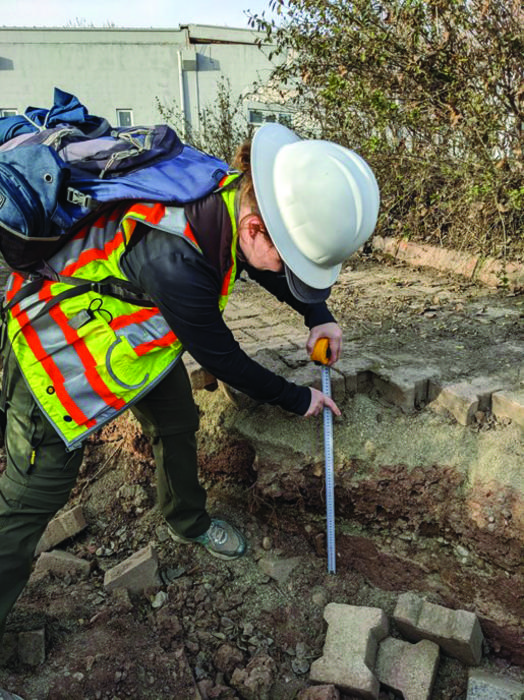
SAN ANTONIO — June 3, 2024 — Southwest Research Institute will enhance models to strengthen the earthquake resilience of America’s transportation infrastructure and improve public safety in earthquake-prone areas. As part of a contract with the U.S. Federal Highway Administration (FHWA), an SwRI-led team will update and improve liquefaction models. Liquefaction occurs during an earthquake when intense shaking causes soil to temporarily act more like a fluid, losing its capacity to support roads and structures.
“For highways specifically, sometimes state and local authorities don’t have the luxury of choosing a different location to build to avoid areas that are potentially vulnerable to liquefaction,” said SwRI Senior Research Engineer Dr. Kristin Ulmer, the principal investigator of the project.
Over the next five years, an SwRI-led team will expand upon past work performed for the Next Generation Liquefication (NGL) project. The NGL project is a community-driven collaboration with an open-source database of earthquake and liquefaction case histories from around the world.
“We will build on past NGL work to develop predictive models to better understand where liquefaction is most likely to occur and determine its impacts,” said Ulmer.
Liquefaction is a dangerous phenomenon that can cause catastrophic loss of life and disruptions to supply chains. To better identify at-risk areas and infrastructure, the team will update predictive models to discover whether costly mitigation strategies are necessary to prevent serious damage in the event of an earthquake.
“That’s the goal — improving public safety and providing the most useful and up-to-date tools to evaluate earthquake-related hazards to America’s roads, bridges and tunnels,” said Ulmer.
The SwRI team will collaborate with researchers from The University of California, Los Angeles, and Oregon State University on this project.
This project is sponsored by Structures and Geotechnical Programs of the FHWA Office of Bridges and Structures.
For more information, visit https://www.swri.org/industry/center-nuclear-waste-regulatory-analyses-cnwra/next-generation-liquefaction-ngl-consortium.

Credit: Southwest Research Institute
SAN ANTONIO — June 3, 2024 — Southwest Research Institute will enhance models to strengthen the earthquake resilience of America’s transportation infrastructure and improve public safety in earthquake-prone areas. As part of a contract with the U.S. Federal Highway Administration (FHWA), an SwRI-led team will update and improve liquefaction models. Liquefaction occurs during an earthquake when intense shaking causes soil to temporarily act more like a fluid, losing its capacity to support roads and structures.
“For highways specifically, sometimes state and local authorities don’t have the luxury of choosing a different location to build to avoid areas that are potentially vulnerable to liquefaction,” said SwRI Senior Research Engineer Dr. Kristin Ulmer, the principal investigator of the project.
Over the next five years, an SwRI-led team will expand upon past work performed for the Next Generation Liquefication (NGL) project. The NGL project is a community-driven collaboration with an open-source database of earthquake and liquefaction case histories from around the world.
“We will build on past NGL work to develop predictive models to better understand where liquefaction is most likely to occur and determine its impacts,” said Ulmer.
Liquefaction is a dangerous phenomenon that can cause catastrophic loss of life and disruptions to supply chains. To better identify at-risk areas and infrastructure, the team will update predictive models to discover whether costly mitigation strategies are necessary to prevent serious damage in the event of an earthquake.
“That’s the goal — improving public safety and providing the most useful and up-to-date tools to evaluate earthquake-related hazards to America’s roads, bridges and tunnels,” said Ulmer.
The SwRI team will collaborate with researchers from The University of California, Los Angeles, and Oregon State University on this project.
This project is sponsored by Structures and Geotechnical Programs of the FHWA Office of Bridges and Structures.
For more information, visit https://www.swri.org/industry/center-nuclear-waste-regulatory-analyses-cnwra/next-generation-liquefaction-ngl-consortium.
Cite Scienmag News
Violet Maxwell. (June 3, 2024). SwRI-led team to bolster earthquake readiness for U.S. Federal Highway Administration. Scienmag. https://scienmag.com/swri-led-team-to-bolster-earthquake-readiness-for-u-s-federal-highway-administration/
Violet Maxwell. "SwRI-led team to bolster earthquake readiness for U.S. Federal Highway Administration." Scienmag, 3 June 2024, https://scienmag.com/swri-led-team-to-bolster-earthquake-readiness-for-u-s-federal-highway-administration/. Accessed 3 September 2026.
Violet Maxwell. "SwRI-led team to bolster earthquake readiness for U.S. Federal Highway Administration." Scienmag. June 3, 2024. https://scienmag.com/swri-led-team-to-bolster-earthquake-readiness-for-u-s-federal-highway-administration/

