

Wednesday, July 8, 2026
Science
No Result
View All Result
  • Login
  • HOME
  • SCIENCE NEWS
  • CONTACT US
  • HOME
  • SCIENCE NEWS
  • CONTACT US
No Result
View All Result
Scienmag
No Result
View All Result
Home Science News Technology and Engineering

SwRI breaks ground on new hypersonic engine research facility

June 17, 2024
in Technology and Engineering
Reading Time: 3 mins read
0
SwRI breaks ground on new hypersonic engine research facility
68
SHARES
614
VIEWS
Share on FacebookShare on Twitter
ADVERTISEMENT

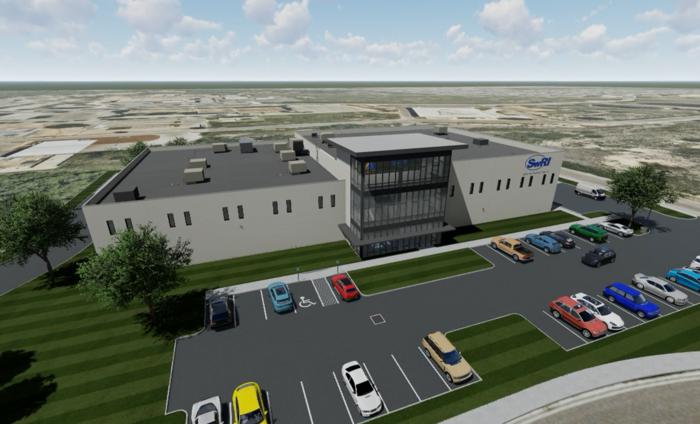
SAN ANTONIO — June 17, 2024 —Southwest Research Institute (SwRI) today celebrated the groundbreaking of the Center for Accelerating Materials and Processes (CAMP), a new facility that will support research and development for tomorrow’s high-speed aerospace engines.

“This project will help ensure the U.S. is a leader in high-speed propulsion research and development,” said Dr. Barron Bichon, director of SwRI’s Materials Engineering Department. “SwRI is committed to advancing this vital technology on behalf of Texas and the nation.”

Market forces including growth in global defense, air travel, delivery and transportation needs are driving the demand for high-speed engines. Initial projects in the new CAMP facility will focus on demonstrating faster, more efficient techniques for manufacturing high-speed propulsion systems.

Once construction on the new two-story, 36,600 square-foot facility is complete, SwRI will begin evaluating new materials and processes designed to produce a high-speed engine in a considerably shorter amount of time than current production timelines.

“This new facility will see the development of innovative technology that reflects SwRI’s mission of serving humankind,” said Dr. Ben Thacker, vice president of SwRI’s Mechanical Engineering Division. “Advancing high-speed propulsion systems propels us toward a future with stronger defense capabilities and greater global connectivity.”

One of the CAMP facility’s initial projects will involve procuring and installing manufacturing process test equipment. Under a contract from the Office of the Secretary of Defense’s Manufacturing Science and Technology Program, SwRI engineers will demonstrate how the facility will reduce production times and costs. The Institute will invest $34 million in the construction of the CAMP facility.

For more information, visit https://www.swri.org/technical-divisions/mechanical-engineering.

CAMP RESEARCH FACILITY

Credit: Southwest Research Institute

SAN ANTONIO — June 17, 2024 —Southwest Research Institute (SwRI) today celebrated the groundbreaking of the Center for Accelerating Materials and Processes (CAMP), a new facility that will support research and development for tomorrow’s high-speed aerospace engines.

“This project will help ensure the U.S. is a leader in high-speed propulsion research and development,” said Dr. Barron Bichon, director of SwRI’s Materials Engineering Department. “SwRI is committed to advancing this vital technology on behalf of Texas and the nation.”

Market forces including growth in global defense, air travel, delivery and transportation needs are driving the demand for high-speed engines. Initial projects in the new CAMP facility will focus on demonstrating faster, more efficient techniques for manufacturing high-speed propulsion systems.

Once construction on the new two-story, 36,600 square-foot facility is complete, SwRI will begin evaluating new materials and processes designed to produce a high-speed engine in a considerably shorter amount of time than current production timelines.

“This new facility will see the development of innovative technology that reflects SwRI’s mission of serving humankind,” said Dr. Ben Thacker, vice president of SwRI’s Mechanical Engineering Division. “Advancing high-speed propulsion systems propels us toward a future with stronger defense capabilities and greater global connectivity.”

One of the CAMP facility’s initial projects will involve procuring and installing manufacturing process test equipment. Under a contract from the Office of the Secretary of Defense’s Manufacturing Science and Technology Program, SwRI engineers will demonstrate how the facility will reduce production times and costs. The Institute will invest $34 million in the construction of the CAMP facility.

For more information, visit https://www.swri.org/technical-divisions/mechanical-engineering.


Share27Tweet17
Previous Post

Scientists develop 3D printed vacuum system that aims to trap dark matter

Next Post

On robust cross-view consistency in self-supervised monocular depth estimation

Related Posts

Return exactly one rewritten English science news headline for the original title below. Maximum 12 words. Output plain text only. Do not use HTML, Markdown, quotes, labels, explanations, bullets, numbering, or multiple options. Original title: Research spotlight: A new standard to better align implantable brain devices with users’ needs
Technology and Engineering

Return exactly one rewritten English science news headline for the original title below. Maximum 12 words. Output plain text only. Do not use HTML, Markdown, quotes, labels, explanations, bullets, numbering, or multiple options. Original title: Research spotlight: A new standard to better align implantable brain devices with users’ needs

July 8, 2026
Return exactly one rewritten English science news headline for the original title below. Maximum 12 words. Output plain text only. Do not use HTML, Markdown, quotes, labels, explanations, bullets, numbering, or multiple options. Original title: KRICT solves internal cracking in sulfide all-solid-state batteries with elastic ion-conductive polymer
Technology and Engineering

Return exactly one rewritten English science news headline for the original title below. Maximum 12 words. Output plain text only. Do not use HTML, Markdown, quotes, labels, explanations, bullets, numbering, or multiple options. Original title: KRICT solves internal cracking in sulfide all-solid-state batteries with elastic ion-conductive polymer

July 8, 2026
Return exactly one rewritten English science news headline for the original title below. Maximum 12 words. Output plain text only. Do not use HTML, Markdown, quotes, labels, explanations, bullets, numbering, or multiple options. Original title: Beyond recognition: advancing early prediction of pediatric sepsis
Technology and Engineering

Return exactly one rewritten English science news headline for the original title below. Maximum 12 words. Output plain text only. Do not use HTML, Markdown, quotes, labels, explanations, bullets, numbering, or multiple options. Original title: Beyond recognition: advancing early prediction of pediatric sepsis

July 8, 2026
Return exactly one rewritten English science news headline for the original title below. Maximum 12 words. Output plain text only. Do not use HTML, Markdown, quotes, labels, explanations, bullets, numbering, or multiple options. Original title: KAIST develops core display technology that prevents image distortion even when stretched
Technology and Engineering

Return exactly one rewritten English science news headline for the original title below. Maximum 12 words. Output plain text only. Do not use HTML, Markdown, quotes, labels, explanations, bullets, numbering, or multiple options. Original title: KAIST develops core display technology that prevents image distortion even when stretched

July 8, 2026
Return exactly one rewritten English science news headline for the original title below. Maximum 12 words. Output plain text only. Do not use HTML, Markdown, quotes, labels, explanations, bullets, numbering, or multiple options. Original title: Cheaper catalytic system turns captured carbon into ethanol
Technology and Engineering

Return exactly one rewritten English science news headline for the original title below. Maximum 12 words. Output plain text only. Do not use HTML, Markdown, quotes, labels, explanations, bullets, numbering, or multiple options. Original title: Cheaper catalytic system turns captured carbon into ethanol

July 7, 2026
Return exactly one rewritten English science news headline for the original title below. Maximum 12 words. Output plain text only. Do not use HTML, Markdown, quotes, labels, explanations, bullets, numbering, or multiple options. Original title: Ferreira group kicking off a revolution in computer numerical control for manufacturing
Technology and Engineering

Return exactly one rewritten English science news headline for the original title below. Maximum 12 words. Output plain text only. Do not use HTML, Markdown, quotes, labels, explanations, bullets, numbering, or multiple options. Original title: Ferreira group kicking off a revolution in computer numerical control for manufacturing

July 7, 2026
Next Post
On robust cross-view consistency in self-supervised monocular depth estimation

On robust cross-view consistency in self-supervised monocular depth estimation

  • Mothers who receive childcare support from maternal grandparents show more

    Mothers who receive childcare support from maternal grandparents show more parental warmth, finds NTU Singapore study

    27656 shares
    Share 11059 Tweet 6912
  • University of Seville Breaks 120-Year-Old Mystery, Revises a Key Einstein Concept

    1061 shares
    Share 424 Tweet 265
  • Bee body mass, pathogens and local climate influence heat tolerance

    682 shares
    Share 273 Tweet 171
  • Researchers record first-ever images and data of a shark experiencing a boat strike

    546 shares
    Share 218 Tweet 137
  • Groundbreaking Clinical Trial Reveals Lubiprostone Enhances Kidney Function

    531 shares
    Share 212 Tweet 133
Science

Embark on a thrilling journey of discovery with Scienmag.com—your ultimate source for cutting-edge breakthroughs. Immerse yourself in a world where curiosity knows no limits and tomorrow’s possibilities become today’s reality!

RECENT NEWS

  • Postpartum bonding problems tied to abnormal neural processing of infant emotions
  • Salmonella protein SopB curbs early inflammation to slow disease progression
  • Embodied cognition yields interpretable trajectory predictions for autonomous systems.
  • Multi-metal cooperation drives lung cancer chemoresistance, reversed by MiADMSA

Categories

  • Agriculture
  • Anthropology
  • Archaeology
  • Athmospheric
  • Biology
  • Biotechnology
  • Blog
  • Bussines
  • Cancer
  • Chemistry
  • Climate
  • Earth Science
  • Editorial Policy
  • Marine
  • Mathematics
  • Medicine
  • Pediatry
  • Policy
  • Psychology & Psychiatry
  • Science Education
  • Social Science
  • Space
  • Technology and Engineering

Subscribe to Blog via Email

Success! An email was just sent to confirm your subscription. Please find the email now and click 'Confirm Follow' to start subscribing.

Join 5,147 other subscribers

© 2025 Scienmag - Science Magazine

Welcome Back!

Login to your account below

Forgotten Password?

Retrieve your password

Please enter your username or email address to reset your password.

Log In
No Result
View All Result
  • HOME
  • SCIENCE NEWS
  • CONTACT US

© 2025 Scienmag - Science Magazine
