

Thursday, September 3, 2026
Science
No Result
View All Result
  • Login
  • HOME
  • SCIENCE NEWS
  • CONTACT US
  • HOME
  • SCIENCE NEWS
  • CONTACT US
No Result
View All Result
Scienmag
No Result
View All Result
Home Science News Chemistry

Sustainable and reversible 3D printing method uses minimal ingredients and steps

August 1, 2024
in Chemistry
Denise Maddox
By Denise Maddox Scienmag Editorial Profile - Mechanical Engineering
Reading Time: 3 mins read
0
Sustainable and reversible 3D printing method uses minimal ingredients and
66
SHARES
601
VIEWS
Share on FacebookShare on Twitter
ADVERTISEMENT

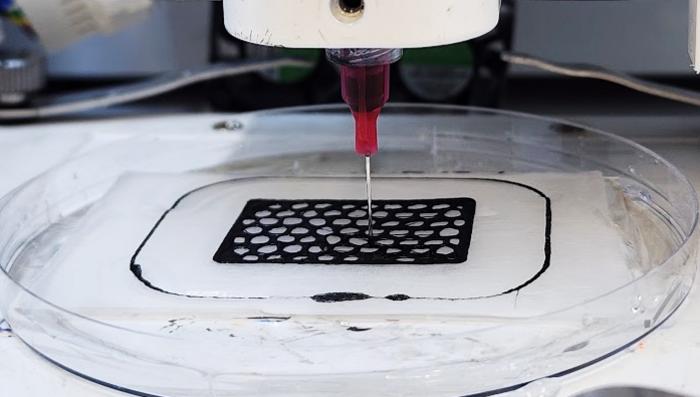
A new 3D printing method developed by engineers at the University of California San Diego is so simple that it uses a polymer ink and salt water solution to create solid structures. The work, published in Nature Communications, has the potential to make materials manufacturing more sustainable and environmentally friendly.

Sustainable 3D printing - 1

Credit: Donghwan Ji

A new 3D printing method developed by engineers at the University of California San Diego is so simple that it uses a polymer ink and salt water solution to create solid structures. The work, published in Nature Communications, has the potential to make materials manufacturing more sustainable and environmentally friendly.

The process uses a liquid polymer solution known as poly(N-isopropylacrylamide), or PNIPAM for short. When this PNIPAM ink is extruded through a needle into a calcium chloride salt solution, it instantly solidifies as it makes contact with the salt water. Researchers used this process to print solid structures with ease.

This rapid solidification is driven by a phenomenon called the salting-out effect, where the salt ions draw water molecules out of the polymer solution due to their strong attraction to water. This removal of water causes the hydrophobic polymer chains in the PNIPAM ink to densely aggregate, creating a solid form.

“This is all done under ambient conditions, with no need for additional steps, specialized equipment, toxic chemicals, heat or pressure,” said study senior author Jinhye Bae, a professor in the Aiiso Yufeng Li Family Department of Chemical and Nano Engineering at the UC San Diego Jacobs School of Engineering.

Traditional methods for solidifying polymers typically require energy-intensive steps and harsh substances. In contrast, this new process harnesses the simple interaction between PNIPAM and salt water at room temperature to achieve the same result, but without the environmental cost.

Plus, this process is reversible. The solid structures produced can be easily dissolved in fresh water, reverting to their liquid form. This allows the PNIPAM ink to be reused for further printing. “This offers a simple and environmentally friendly approach to recycle polymer materials,” said Bae.

To demonstrate the versatility of their method, the researchers printed structures out of PNIPAM inks containing other materials. For example, they printed an electrical circuit using an ink made of PNIPAM mixed with carbon nanotubes, which successfully powered a light bulb. This printed circuit could also be dissolved in fresh water, showcasing the potential for creating water-soluble and recyclable electronic components.

Bae and her team envision that this simple and reversible 3D printing technique could contribute to the development of environmentally friendly polymer manufacturing technologies.

Paper: “Sustainable 3D printing by reversible salting-out effects with aqueous salt solutions.” Co-authors include Donghwan Ji, Joseph Liu, Jiayu Zhao, Minghao Li and Yumi Rho, UC San Diego; and Hwanshoo Shing and Tae Hee Han, Hanyang University, Korea.

This work was supported by the National Science Foundation through the UC San Diego Materials Research Science and Engineering Center (MRSEC, grant DMR-2011924) and the Basic Science Research Program through the National Research Foundation of Korea funded by the Ministry of Education (grant RS-2023-00241263).

Disclosures: Jinhye Bae, Joseph Liu and Donghwan Ji filed a patent for this work through the UC San Diego Office of Innovation and Commercialization. The authors declare no competing interests.


Journal

Nature Communications

DOI

10.1038/s41467-024-48121-7

Article Title

Sustainable 3D printing by reversible salting-out effects with aqueous salt solutions

Article Publication Date

9-May-2024

Subject of Research: Chemistry

Article Title: Sustainable and reversible 3D printing method uses minimal ingredients and steps

Article References: Original research article

Image Credits: AI Generated

DOI: Not provided

Keywords: Not provided

Cite Scienmag News

Denise Maddox. (August 1, 2024). Sustainable and reversible 3D printing method uses minimal ingredients and steps. Scienmag. https://scienmag.com/sustainable-and-reversible-3d-printing-method-uses-minimal-ingredients-and-steps/

Denise Maddox. "Sustainable and reversible 3D printing method uses minimal ingredients and steps." Scienmag, 1 August 2024, https://scienmag.com/sustainable-and-reversible-3d-printing-method-uses-minimal-ingredients-and-steps/. Accessed 3 September 2026.

Denise Maddox. "Sustainable and reversible 3D printing method uses minimal ingredients and steps." Scienmag. August 1, 2024. https://scienmag.com/sustainable-and-reversible-3d-printing-method-uses-minimal-ingredients-and-steps/

Share26Tweet17
Previous Post

Study examines effect of fish oil in older adults’ brains

Next Post

Advances in 3D organ bioprinting: A step towards personalized medicine and solving organ shortages

Related Posts

Layered double hydroxides in sustained antibiotic delivery: a bibliometric review
Chemistry

Layered double hydroxides in sustained antibiotic delivery: a bibliometric review

September 3, 2026
Catalysts Turn Biorefinery Waste Into Tomorrow’s Fertilisers
Chemistry

Catalysts Turn Biorefinery Waste Into Tomorrow’s Fertilisers

September 3, 2026
Yeast strains differ in dough gas cell stability and bread crumb structure
Chemistry

Yeast strains differ in dough gas cell stability and bread crumb structure

September 3, 2026
Waste Palm Seed Extract Yields Powerful Supercapacitor Electrode Material
Chemistry

Waste Palm Seed Extract Yields Powerful Supercapacitor Electrode Material

September 3, 2026
Benzophenone-Grafted Acrylic Adhesives Quadruple Shear Strength Through Post-Polymerization Modification
Chemistry

Benzophenone-Grafted Acrylic Adhesives Quadruple Shear Strength Through Post-Polymerization Modification

September 3, 2026
Acacia Gum and Bentonite Give Starch Bioplastics a Major Strength Boost
Chemistry

Acacia Gum and Bentonite Give Starch Bioplastics a Major Strength Boost

September 3, 2026
Next Post
Advances in 3D organ bioprinting: A step towards personalized medicine

Advances in 3D organ bioprinting: A step towards personalized medicine and solving organ shortages

  • Mothers who receive childcare support from maternal grandparents show more optimized

    Mothers who receive childcare support from maternal grandparents show more parental warmth, finds NTU Singapore study

    27656 shares
    Share 11059 Tweet 6912
  • University of Seville Breaks 120-Year-Old Mystery, Revises a Key Einstein Concept

    1061 shares
    Share 424 Tweet 265
  • Bee body mass, pathogens and local climate influence heat tolerance

    682 shares
    Share 273 Tweet 171
  • Researchers record first-ever images and data of a shark experiencing a boat strike

    546 shares
    Share 218 Tweet 137
  • Groundbreaking Clinical Trial Reveals Lubiprostone Enhances Kidney Function

    531 shares
    Share 212 Tweet 133
Science

Embark on a thrilling journey of discovery with Scienmag.com—your ultimate source for cutting-edge breakthroughs. Immerse yourself in a world where curiosity knows no limits and tomorrow’s possibilities become today’s reality!

RECENT NEWS

  • Depth-graded W/Si multilayers boost silicon pore optics for WXPT mission
  • Velocity surfaces method speeds analysis of Earth–Moon transfer orbit controllable sets
  • Mindfulness Program Quality Key to Teen Mental and Metabolic Health
  • Bayesian adaptive testing with variable lengths and new stopping rules

Categories

  • Agriculture
  • Anthropology
  • Archaeology
  • Athmospheric
  • Biology
  • Biotechnology
  • Blog
  • Bussines
  • Cancer
  • Chemistry
  • Climate
  • Earth Science
  • Editorial Policy
  • Marine
  • Mathematics
  • Medicine
  • Pediatry
  • Policy
  • Psychology & Psychiatry
  • Science Education
  • Social Science
  • Space
  • Technology and Engineering

Subscribe to Blog via Email

Enter your email address to subscribe to this blog and receive notifications of new posts by email.

Join 5,151 other subscribers

© 2025 Scienmag - Science Magazine

Welcome Back!

Login to your account below

Forgotten Password?

Retrieve your password

Please enter your username or email address to reset your password.

Log In
No Result
View All Result
  • HOME
  • SCIENCE NEWS
  • CONTACT US

© 2025 Scienmag - Science Magazine

Discover more from Science

Subscribe now to keep reading and get access to the full archive.

Continue reading