


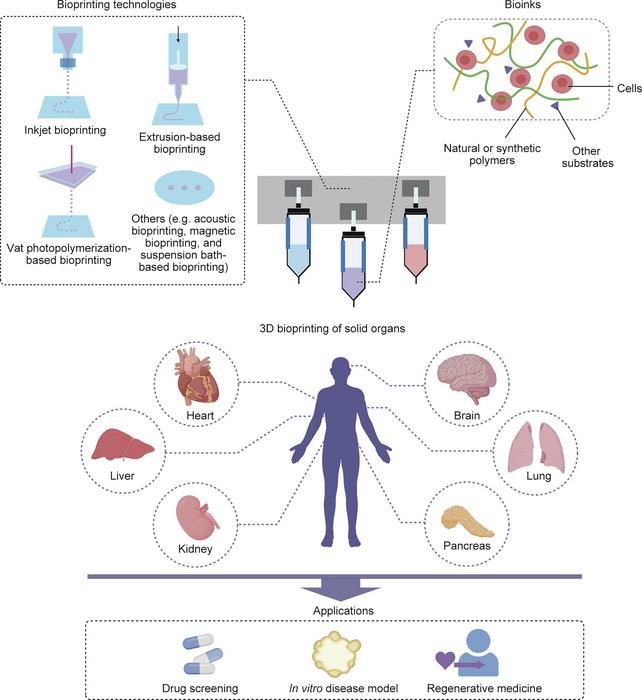
In a latest review published in Engineering, an international team of scientists from China and the United States has presented a comprehensive analysis of the latest advancements in 3D organ bioprinting. This innovative technology holds the potential to revolutionize regenerative medicine and tackle some of the most pressing issues in organ transplantation.

Credit: BioRender, Canada
In a latest review published in Engineering, an international team of scientists from China and the United States has presented a comprehensive analysis of the latest advancements in 3D organ bioprinting. This innovative technology holds the potential to revolutionize regenerative medicine and tackle some of the most pressing issues in organ transplantation.
Organ damage or failure, whether resulting from injury, disease, or aging, poses a significant challenge due to the body’s limited natural regenerative capabilities. Traditional organ transplantation, while lifesaving, is fraught with difficulties including donor shortages and the risk of immune rejection. This has spurred a quest for cutting-edge solutions, among which 3D bioprinting of organs on demand stands out as a promising avenue.
The review meticulously explores state-of-the-art bioprinting technologies, with a particular focus on bioinks and cell types crucial for successful organ fabrication. Bioinks, which are essential for constructing the complex structures of organs, and the selection of appropriate cells play a pivotal role in the bioprinting process. The scientists delve into the latest advancements in bioprinting various solid organs, including the heart, liver, kidney, and pancreas. They emphasize the critical importance of vascularization—creating the network of blood vessels necessary for organ function—and the integration of different cell types during the bioprinting process.
A key highlight of the review is the discussion on the challenges and future directions for the clinical translation of bioprinted organs. While the technology has shown great promise in preclinical studies, translating these successes into clinical applications involves overcoming significant hurdles. The review underscores the necessity for rigorous testing and regulatory validation to ensure the safety and reliability of bioprinted organs. Ensuring that these organs are not only functionally effective but also safe for patients is paramount.
In addition to technical challenges, the review also addresses ethical considerations surrounding organ bioprinting. Issues such as cell sourcing and the implications of modifying human biology are examined. Balancing the transformative potential of bioprinting with these ethical concerns presents a complex challenge that demands careful consideration.
Despite these challenges, the review paints an optimistic picture of the future. Bioprinting technology is seen as a major leap forward in biomedical sciences, with the potential to create replacement organs tailored to individual patients. This includes not only replicating the external anatomy of organs but also integrating the internal blood vessels and complex networks essential for their function. Such advancements could significantly mitigate organ shortages and provide personalized treatment options, fundamentally transforming organ transplantation and personalized medicine.
The review concludes with a forward-looking perspective on the potential of bioprinting to expand healthcare opportunities. By addressing both technical and ethical challenges, the field of bioprinting is poised to make significant strides toward meeting the needs of patients more effectively. The promise of this technology holds the potential to revolutionize the way we approach organ transplantation and personalized medicine, opening up new possibilities for patient care and treatment.
As the field continues to advance, the insights provided by this review will be instrumental in guiding future research and development in organ bioprinting. The excitement surrounding this technology reflects a shared vision of a future where organ shortages are alleviated and personalized treatments become a reality for patients around the world.
The paper “Progress in Organ Bioprinting for Regenerative Medicine,” authored by Xiang Wang, Di Zhang, Yogendra Pratap Singh, Miji Yeo, Guotao Deng, Jiaqi Lai, Fei Chen, Ibrahim T. Ozbolat, Yin Yu. Full text of the open access paper: https://doi.org/10.1016/j.eng.2024.04.023. For more information about the Engineering, follow us on X (https://twitter.com/EngineeringJrnl) & like us on Facebook (https://www.facebook.com/EngineeringJrnl).
Article Title
Progress in Organ Bioprinting for Regenerative Medicine
Article Publication Date
14-Jun-2024
Cite Scienmag News
Gregory Coleman. (August 1, 2024). Advances in 3D organ bioprinting: A step towards personalized medicine and solving organ shortages. Scienmag. https://scienmag.com/advances-in-3d-organ-bioprinting-a-step-towards-personalized-medicine-and-solving-organ-shortages/
Gregory Coleman. "Advances in 3D organ bioprinting: A step towards personalized medicine and solving organ shortages." Scienmag, 1 August 2024, https://scienmag.com/advances-in-3d-organ-bioprinting-a-step-towards-personalized-medicine-and-solving-organ-shortages/. Accessed 5 September 2026.
Gregory Coleman. "Advances in 3D organ bioprinting: A step towards personalized medicine and solving organ shortages." Scienmag. August 1, 2024. https://scienmag.com/advances-in-3d-organ-bioprinting-a-step-towards-personalized-medicine-and-solving-organ-shortages/

