

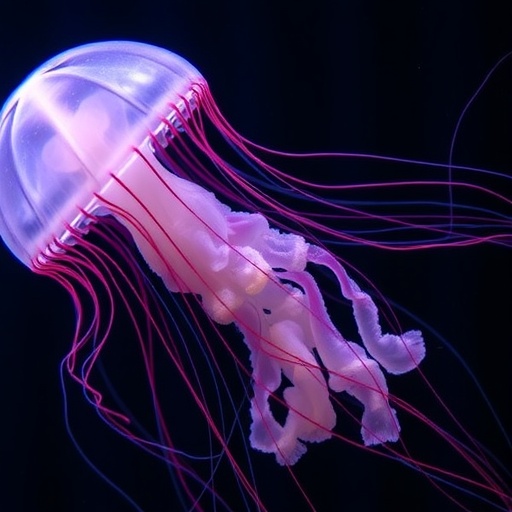
In a groundbreaking discovery reshaping our understanding of marine food webs, researchers at the University of Southern Denmark have unveiled a novel trophic interaction between benthic polychaete worms and pelagic gelatinous predators. Traditionally, polychaetes—segmented marine worms—are known for their sedentary lifestyles, dwelling within protective burrows along the seafloor. However, during the warm summer months surrounding the full moon, two species, Alitta succinea and Platynereis dumerilii, embark on a remarkable spawning migration, emerging en masse into the open water column. This ephemeral swarm becomes an abundant, high-energy resource, attracting a variety of predators, including now, unexpectedly, certain jellyfish and an invasive ctenophore species.
This revelatory behavior was documented through meticulous year-long observations by a multidisciplinary team led by biologist and postdoctoral researcher Hannah Yeo, who together with colleagues Laura Ferreira, Erik Kristensen, Anders Garm, and Jamileh Javidpour, has published their findings in the prestigious journal Hydrobiologia. Their study chronicles 56 instances where polychaetes were found within the digestive tracts of two gelatinous zooplankton species: the native moon jellyfish (Aurelia aurita) and the invasive comb jelly (Mnemiopsis leidyi). Among 166 A. aurita sampled, nearly a third contained at least one polychaete, while of 71 M. leidyi individuals, three harbored these worms internally—remarkable evidence of a previously undocumented predator-prey relationship.
Polychaete swarming and the resultant predation by gelatinous fauna not only highlight an intriguing behavioral adaptation but redefine energy dynamics across ecological boundaries. Typically, energy and nutrients flow one-directionally from surface waters to the benthos, with organic detritus sinking to nourish bottom-dwelling organisms. This new evidence reverses that paradigm: benthic spawning events fueled by moon phases drive a vertical transfer of biomass upward as worms ascend into the pelagic environment, becoming prey to gelatinous predators. This benthic-pelagic trophic link, hitherto unnoticed, demonstrates how episodic events can forge substantial connections between discrete marine realms.
The study highlights the high metabolic turnover within jellyfish digestive processes, with polychaetes digested within hours of ingestion. This rapid assimilation necessitated the use of stable isotope analyses to confirm genuine nutrient uptake rather than passive gut passage. By analyzing tissue isotopic signatures, the researchers conclusively demonstrated that polychaete-derived nutrients contribute substantively to jellyfish biomass. This insight validates polychaetes as bona fide nutritional resources, offering a seasonal boon of concentrated energy during summer months that may underpin jellyfish population dynamics.
The implications extend beyond native species to the invasive Mnemiopsis leidyi, notorious for its disruptive impacts on Baltic and other temperate ecosystems. As an opportunistic feeder, Mnemiopsis’s ability to exploit swarming polychaetes presents an adaptive advantage that could exacerbate its ecological dominance. The nocturnal foraging behavior of Mnemiopsis coincides precisely with polychaete swarming, suggesting that the true extent of this predation has been underestimated due to diurnal sampling limitations. This adaptive feeding flexibility underscores the invasive species’ potential threat to indigenous food webs by accessing diverse and temporally variable prey sources.
By illuminating this bidirectional energy exchange, the work calls for revised ecosystem models that incorporate benthic origin resources fueling pelagic trophic webs. Traditional models emphasizing continuous downward transfer of organic material must now accommodate episodic upward fluxes mediated by spawning behaviors and gelatinous predation. Such insights are critical for accurately predicting ecosystem resilience, especially in the face of climate change-driven shifts in species distributions, phenology, and invasive species proliferation.
Furthermore, this discovery enriches our appreciation for the ecological roles of gelatinous zooplankton, often marginalized in marine trophic studies. Their feeding habits are more complex and nuanced than previously assumed, involving exploitation of benthic prey during transient life-history events. Recognizing these dimensions enriches understanding of marine biodiversity and trophic interdependence, highlighting the intricate linkages that sustain ecosystem functioning.
The methodology underpinning this research was rooted in careful field sampling and advanced biochemical assays. Specimens were collected from Kerteminde Fjord and Kertinge Nor, Danish coastal inlets known for rich biodiversity and dynamic ecological interactions. Using both gross morphological examination and isotopic tracing, the team provided a robust, multi-dimensional validation of their observations. This integrated approach exemplifies best practices in marine ecological research and sets a precedent for further explorations into benthic-pelagic interactions.
From a broader scientific perspective, these findings invite fresh inquiries into the evolutionary drivers of gelatinous feeding strategies and their ecological consequences. What selective pressures favor polychaete consumption? How might this predation influence polychaete population dynamics and subsequent spawning events? Could such feeding behaviors shift in prevalence or intensity under changing environmental conditions? Each question opens avenues for impactful research that bridges behavioral ecology, marine physiology, and ecosystem science.
Equally consequential are the conservation and management considerations raised by this study. The role of invasive gelatinous species as vectors of benthic nutrient cycling may necessitate updated monitoring frameworks and intervention strategies to mitigate ecosystem imbalance. Understanding how native and non-native species partition resources and interact trophically can inform adaptive management plans prioritizing biodiversity preservation and fisheries sustainability.
In summary, the revelation that jellyfish and invasive ctenophores actively prey upon swarming polychaetes signals a paradigm shift in marine trophic ecology. This benthic-pelagic coupling underscores the fluidity of energy pathways and the intricate dependencies that animate coastal ecosystems. As gelatinous zooplankton emerge as pivotal players in this dynamic, their ecological and evolutionary significance become ever more critical to marine science, warranting intensified scrutiny and nuanced appreciation.
Subject of Research: Animals
Article Title: Polychaete capture by native jellyfish and invasive ctenophore reveals a novel benthic–pelagic trophic link
News Publication Date: 4-Mar-2026
Web References: https://link.springer.com/article/10.1007/s10750-026-06174-3
Image Credits: Hannah Yeo/SDU
Keywords: Marine biology, Predation, Benthic-pelagic coupling, Jellyfish feeding behavior, Polychaete spawning, Gelatinous zooplankton, Invasive species, Trophic interactions


