


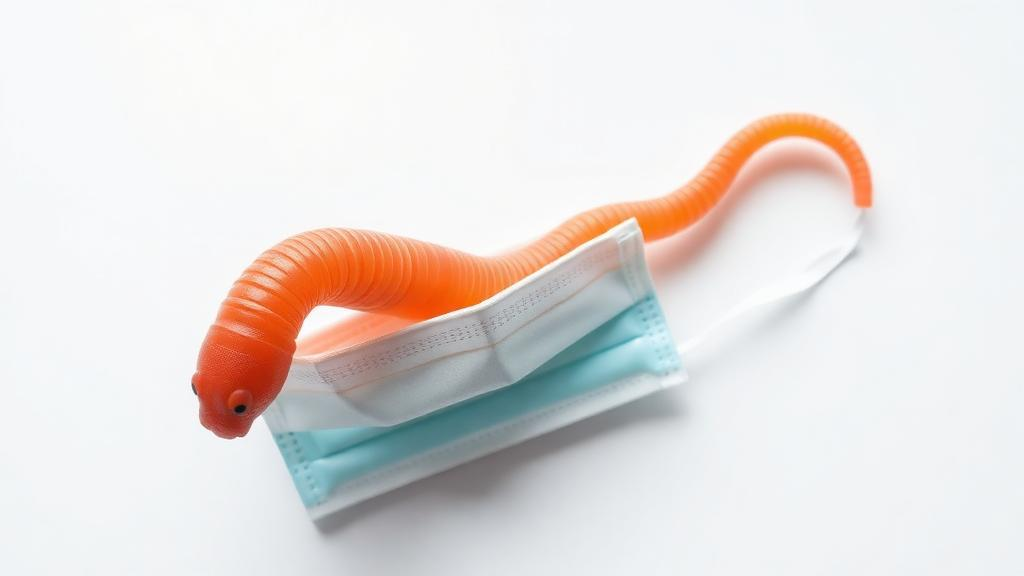
At the height of the COVID-19 pandemic, disposable face masks became one of the most ubiquitous objects on Earth, and one of the most stubborn. An estimated 12 billion masks were discarded every month at the peak of their use, and most are made of polypropylene, a plastic that can persist in the environment for decades. Now, a team of researchers in China has shown that an unglamorous creature, the larvae of the superworm Zophobas atratus, can break down this pandemic-era waste, and that the secret lies not in the insect itself but in the community of microbes living in its gut.
The study, published in the journal Advanced Biotechnology, is the first to report that the gut microbiome of Zophobas atratus larvae can degrade disposable face masks. The researchers, led by Chunlan Mao of the Northwest Institute of Eco-Environment and Resources at the Chinese Academy of Sciences together with colleagues at Lanzhou University, measured a consumption rate of 60 milligrams of dry mask material per day for every 50 larvae, a figure they describe as a high degrading rate for the middle layer of the mask. That middle layer, the melt-blown polypropylene core that provides most of a mask’s filtration, turned out to be the larvae’s favorite part of the mask by far.
The experimental design was straightforward but meticulous. Larvae averaging about 27 milligrams each were placed in food-grade containers at a density of roughly half a larva per square centimeter and kept in a constant-temperature chamber at 25 degrees Celsius and 65 percent humidity. Five groups were compared: starved larvae, larvae fed wheat bran, and larvae fed separately with the outer, middle, and inner layers of a commercially purchased disposable mask. Over 12 days, the larvae consumed 356.7 milligrams of the middle layer per 50 animals, compared with only 16.7 milligrams of the outer layer, while the inner layer actually gained mass because the insects’ fecal material adhered strongly to its surface.
Survival rates told an equally interesting story. Larvae fed the middle layer survived at 95.3 percent, nearly matching the 96.7 percent survival of larvae eating their normal wheat bran diet, which suggests the mask material was genuinely digested and utilized rather than merely chewed and discarded. Larvae fed the outer and inner layers also maintained survival rates of 79 and 85 percent respectively. Body weight told a different story: bran-fed larvae gained 80.5 milligrams collectively, while mask-fed groups lost weight, a consequence the researchers attribute to the fact that polypropylene contains only hydrogen and carbon and lacks the nitrogen and other nutrients insects need for growth.
To confirm that chemical degradation, not just mechanical fragmentation, was taking place, the team turned to a battery of spectroscopic and thermal techniques. Fourier-transform infrared spectroscopy of the frass from mask-fed larvae revealed a distinct new peak near 1700 reciprocal centimeters, the signature of carbonyl groups formed by oxidation of the polymer backbone. The spectra also showed broadened absorption between 3000 and 3500 reciprocal centimeters associated with hydroxyl stretching, further evidence that oxygen had been incorporated into the plastic. Thermogravimetric analysis showed that frass from mask-fed larvae decomposed differently from intact mask material, indicating the presence of new organic matter rather than simply unchanged polypropylene fragments.
Perhaps the most striking physical evidence came from water contact angle measurements, which quantify how hydrophobic a surface is. The intact mask measured a contact angle of about 136 degrees, typical of a highly water-repellent plastic. The frass of mask-fed larvae measured only 73.55 degrees, a dramatic drop in hydrophobicity. This matters because hydrophobic polymer surfaces resist the adsorption of polymer-degrading enzymes; making the surface more wettable exposes the carbon-carbon bonds of the polypropylene chain to enzymatic attack. The decrease in hydrophobicity is therefore both a marker of biodegradation and a mechanism that enables it to continue.
The decisive proof that gut microbes, rather than the larvae’s own digestive machinery, were doing the work came from an antibiotic suppression experiment. The researchers fed larvae wheat bran treated with gentamicin sulfate for ten days, reducing their gut bacterial counts by two orders of magnitude, then offered them masks. The result was stark: survival fell from 95.3 percent to 48.3 percent, mask consumption dropped significantly, and the frass no longer showed the carbonyl and hydroxyl peaks that signal oxidation. Larvae stripped of their gut microbiome simply lost the ability to depolymerize the mask, confirming that degradation is gut microbiome-dependent, a pattern consistent with earlier work on polystyrene and polyethylene breakdown in the same species.
Sequencing of the 16S rRNA gene revealed how the microbial community reorganized itself in response to the plastic diet. Proteobacteria, which made up 57.57 percent of the gut community in bran-fed larvae, rose to between 79 and 85 percent in larvae eating any of the three mask layers, while Firmicutes declined sharply. At the genus level, the researchers identified Hafnia, Corynebacterium, Xenorhabdus, and Providencia as the functional bacteria most strongly associated with mask degradation, with Hafnia and Corynebacterium showing particularly high abundance. Several of these genera have prior records in plastic degradation: Hafnia has documented plastic-degrading capability, and Corynebacterium and Pseudomonas have been linked to the breakdown of synthetic polymers such as polyethylene and polystyrene.
Untargeted metabolomics using liquid chromatography-mass spectrometry added a metabolic dimension to the picture. Compared with bran-fed larvae, mask-fed larvae showed 46 significantly upregulated and 59 downregulated metabolites, and pathway analysis pointed to the cytochrome P450 system, steroid hormone biosynthesis, and biotin metabolism as the pathways most disrupted by the mask diet. Predictive analysis of functional genes using PICRUSt2 found that genes for cytochrome P450 enzymes, esterases, and peroxidases were significantly enriched in mask-fed larvae, with esterases and peroxidases reaching statistical significance. The authors suggest that reactive oxygen species generated in the gut micro-environment, together with these oxidative enzyme systems, coordinate the initial oxidation of the otherwise inert polymer, though they caution that mask ingestion appears to impose metabolic stress on the larvae, and that the long-term costs of a plastic-only diet remain unknown.
Finally, the team isolated seven bacterial strains from the guts of mask-fed larvae and screened them for biofilm formation on mask membranes. The most successful colonizer, identified as Stenotrophomonas sp. strain M212, formed dense biofilms and etched pits and cavities into the mask surface under scanning electron microscopy, while the uninoculated control remained smooth. X-ray photoelectron spectroscopy showed that the oxygen content of the mask surface rose from 2.18 percent to 5.82 percent after exposure to the strain, and infrared spectroscopy detected new carbon-oxygen and hydroxyl stretches, hallmarks of oxidative biodegradation. The strain also reduced the hydrophobicity of the mask surface, priming it for further attack. Together, the larval feeding trials, the antibiotic suppression test, the multi-omics characterization, and the isolation of a degrading strain close the loop: the gut microbiome of Zophobas atratus, and Stenotrophomonas sp. M212 in particular, can genuinely oxidize and depolymerize disposable face masks. The researchers emphasize that important questions remain, including whether larvae can sustain normal growth on masks alone, what individual roles each functional bacterium plays, and how in vitro degradation might be optimized, but the work opens a biologically grounded path toward treating one of the pandemic’s most visible legacies of plastic pollution.
Subject of Research: Biodegradation of disposable polypropylene face masks by the gut microbiome of Zophobas atratus larvae
Article Title: Responses of gut microbial community and metabolic function to disposable face mask of Zophobas atratus larvae
Article References: Mao, C., Zhang, K., Tursunay, M., Ji, J., & Li, X. (2026). Responses of gut microbial community and metabolic function to disposable face mask of Zophobas atratus larvae. Advanced Biotechnology, 4(1), Article 1. https://doi.org/10.1007/s44307-025-00092-6
Image Credits: AI Generated
DOI: 10.1007/s44307-025-00092-6
Keywords: superworms, Zophobas atratus, disposable face masks, polypropylene, biodegradation, gut microbiome, Hafnia, Corynebacterium, Stenotrophomonas, cytochrome P450, microplastics, plastic pollution
Cite Scienmag News
Morgan Morrow. (October 2, 2026). Superworm Gut Microbes Devour Disposable Face Masks, Study Finds. Scienmag. https://scienmag.com/superworm-gut-microbes-devour-disposable-face-masks-study-finds/
Morgan Morrow. "Superworm Gut Microbes Devour Disposable Face Masks, Study Finds." Scienmag, 2 October 2026, https://scienmag.com/superworm-gut-microbes-devour-disposable-face-masks-study-finds/. Accessed 5 October 2026.
Morgan Morrow. "Superworm Gut Microbes Devour Disposable Face Masks, Study Finds." Scienmag. October 2, 2026. https://scienmag.com/superworm-gut-microbes-devour-disposable-face-masks-study-finds/


