

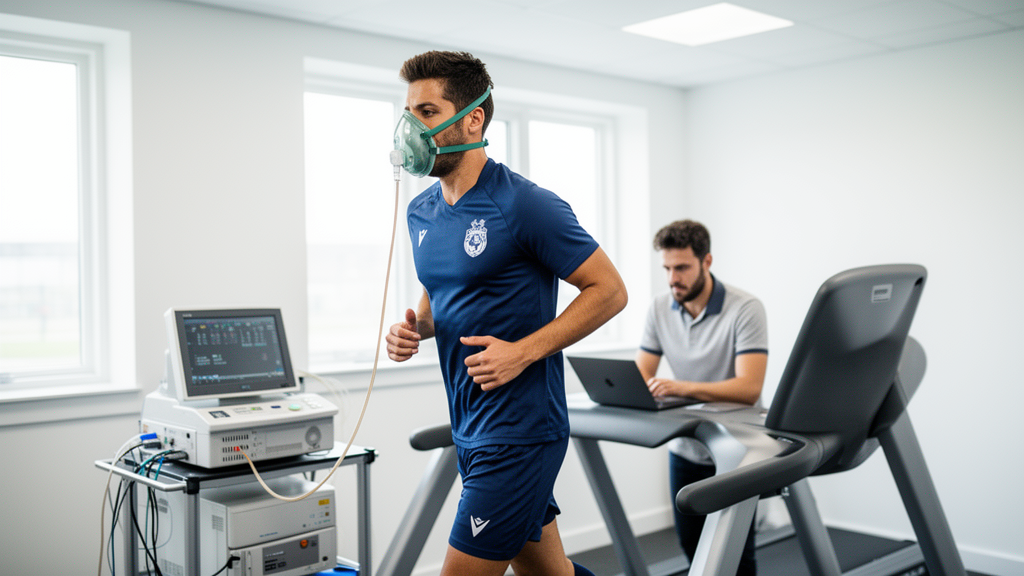
When a professional soccer player steps onto a treadmill in a sports medicine laboratory, the most celebrated number is usually the one recorded at the very end of the test: the maximal running speed reached at voluntary exhaustion, or the peak heart rate achieved in the final seconds of an all-out effort. A new study of 206 professional male players argues that this obsession with maximal values may be misplaced. The research, published in Frontiers in Sports and Active Living, shows that physiological variables measured at a standardized submaximal point during an incremental treadmill test differentiate playing positions far more consistently than maximal exercise variables, while still remaining strongly tied to maximal performance.
The study was conducted by a Hungarian research team led by Ágnes Sziva of the University of Pécs, working with colleagues at The Lundquist Institute for Biomedical Innovation at Harbor-UCLA Medical Center and the University of Győr. The investigators performed a retrospective cross-sectional analysis of routine performance screening data collected between 2018 and 2025 from four Hungarian clubs competing in the first and second divisions. All 206 participants were professional adult male outfield players, distributed almost evenly among 66 defenders, 74 midfielders, and 66 forwards, with a mean age of 23.3 years. Goalkeepers were deliberately excluded because their endurance profiles are known to differ fundamentally from those of outfield players.
The testing protocol was a two-phase incremental treadmill ramp with the grade fixed at 0 percent throughout. After at least five minutes of seated rest, during which baseline heart rate and capillary blood lactate were recorded, players warmed up at 5 and then 10 kilometers per hour. Treadmill speed was then increased by 1 kilometer per hour every two minutes, with 60-second standing breaks for fingertip capillary blood sampling, until blood lactate exceeded the fixed reference concentration of 4 millimoles per liter. This concentration, traditionally used to define the onset of blood lactate accumulation, served as the standardized submaximal benchmark of the study. Beyond that point, the protocol shifted into its second phase, with speed rising 1 kilometer per hour every minute without breaks until voluntary exhaustion.
From this single test, the researchers extracted a parallel set of external and internal markers. The external marker was running speed: the velocity at the 4-millimole-per-liter lactate reference, interpolated linearly between the two surrounding stages, and the maximal speed at exhaustion, defined as the highest speed maintained for at least 15 seconds. The internal marker was heart rate, recorded continuously at one-second intervals with a Polar chest strap and verified against a simultaneous 12-lead exercise ECG where signal artifacts were suspected. Heart rate at the 4-millimole reference point was calculated by straight-line parallelism from the interpolated speed, and both submaximal values were also expressed as relative indices: speed at 4 millimoles as a percentage of maximal speed, and heart rate at 4 millimoles as a percentage of heart rate reserve, the difference between maximal and resting heart rate.
The headline result concerns midfielders. At the submaximal 4-millimole reference point, midfielders reached the highest values of any outfield position on every principal variable. Their speed at the lactate reference averaged 15.6 kilometers per hour, significantly higher than the 15.0 of defenders and the 14.8 of forwards. Their heart rate at the same point averaged 177.2 beats per minute, again exceeding both other groups. The relative indices told the same story: midfielders sustained 77.6 percent of their maximal speed at the lactate reference, compared with 75.1 percent in forwards, and operated at 87.1 percent of their heart rate reserve, the highest of the three positions. Post hoc comparisons confirmed that these differences were significant after Bonferroni adjustment.
At maximal exercise, by contrast, the positional picture dissolved. Maximal running speed did not differ significantly between positions, and maximal heart rate showed only an inconsistent difference, with midfielders higher than defenders but not distinguishable from forwards. Crucially, when the researchers fitted general linear models adjusting for age, body mass index, club, competitive division, testing phase, and testing year, the positional effects remained significant for submaximal speed and submaximal heart rate but vanished for maximal speed and maximal heart rate. The submaximal variables, in other words, carried positional information that was robust to confounding, while the maximal variables did not.
The correlation analyses added a second layer of interpretation. Across the whole cohort, absolute heart rate at the 4-millimole reference correlated only moderately with absolute speed at the same point. But when both variables were expressed relative to individual maxima, the relationship strengthened dramatically: heart rate at the lactate reference as a percentage of heart rate reserve correlated very largely with speed at the lactate reference as a percentage of maximal speed. This indicates that standardized relative markers of internal cardiovascular strain and external running load describe closely related physiological characteristics regardless of playing position. The authors caution, however, that because both relative indices are normalized to values from the same incremental test, the magnitude of this association may be partly influenced by mathematical coupling, and sensitivity analyses using the underlying non-normalized variables showed weaker associations.
The submaximal markers also remained closely tied to maximal performance. Speed at the 4-millimole reference showed a large correlation with maximal treadmill speed across the entire sample and within each positional group, while heart rate at the lactate reference correlated very largely with maximal heart rate. Running speed corresponding to 80 percent of heart rate reserve, a heart-rate-reserve-based treadmill marker, likewise correlated largely with maximal running speed. These findings demonstrate that physiologically meaningful information obtained at submaximal intensity is strongly related to maximal treadmill performance, despite requiring far less exercise intensity and less testing time.
A multinomial logistic regression analysis sharpened the practical contrast between the two variable families. A model using only the submaximal speed and heart rate at the 4-millimole reference was significantly associated with playing position, correctly classifying 46.6 percent of players. A model using only maximal speed and maximal heart rate did not reach statistical significance and classified only 43.2 percent. Adding the maximal variables to the submaximal model produced only a marginal improvement in explanatory power and classification accuracy, suggesting that within this cohort the submaximal responses carried essentially all of the positional information that the maximal variables could provide, and more.
The physiological logic behind the midfielders’ superior submaximal profile is straightforward. Midfielders typically cover the greatest total running distance during matches and have previously been reported to exhibit greater aerobic capacity and cardiovascular adaptation than defenders and forwards. The study’s authors note that treadmill speed at the anaerobic lactate threshold has repeatedly shown stronger correlation with the training status of soccer players than maximal oxygen uptake alone, and that training-related changes in speed and heart rate are more detectable at submaximal threshold levels than at maximal exercise. Because maximal treadmill testing is time-consuming and difficult to integrate into demanding professional training schedules, the fixed 4-millimole-per-liter lactate reference offers a standardized physiological benchmark that facilitates direct comparison between players and repeated assessment over time, making it potentially valuable for routine monitoring in elite team sports.
The study has limitations that temper its conclusions. The broad positional classification into defenders, midfielders, and forwards may not capture the specific physiological demands of individual roles within those categories. The cross-sectional design precludes assessment of physiological change over time, and the absence of match-derived data limits translation to competitive performance. Only male players were included, respiratory gas exchange was not measured, and the fixed 4-millimole reference does not account for inter-individual differences in lactate threshold physiology. Testing was partially performed at the beginning of the preseason, which may not represent peak aerobic fitness. Nevertheless, the central message stands: running speed and heart rate measured at a standardized submaximal lactate reference differentiated playing positions in professional soccer more consistently than maximal exercise variables, while remaining strongly associated with maximal performance, supporting a combined assessment of submaximal and maximal treadmill-derived measures for physiological profiling of elite players.
Subject of Research: Physiological characterization using standardized submaximal treadmill responses in professional male soccer players
Article Title: Physiological characterization using standardized submaximal treadmill responses in professional male soccer players
Article References: Sziva, Á., Pórszász, J., Kívés, Z., & Szelid, Z. (2026). Physiological characterization using standardized submaximal treadmill responses in professional male soccer players. Frontiers in Sports and Active Living, 8, Article 1979307. https://doi.org/10.3389/fspor.2026.1979307
Image Credits: AI Generated
DOI: 10.3389/fspor.2026.1979307
Keywords: Physiological, characterization, standardized, submaximal, treadmill, responses, professional, male, soccer, players, scientific research
Cite Scienmag News
Scienmag. (October 17, 2026). Submaximal treadmill test reveals midfielders have strongest aerobic profiles in pro soccer. https://scienmag.com/submaximal-treadmill-test-reveals-midfielders-have-strongest-aerobic-profiles-in-pro-soccer/
Scienmag. "Submaximal treadmill test reveals midfielders have strongest aerobic profiles in pro soccer." Scienmag, 17 October 2026, https://scienmag.com/submaximal-treadmill-test-reveals-midfielders-have-strongest-aerobic-profiles-in-pro-soccer/. Accessed 17 October 2026.
Scienmag. "Submaximal treadmill test reveals midfielders have strongest aerobic profiles in pro soccer." Scienmag. October 17, 2026. https://scienmag.com/submaximal-treadmill-test-reveals-midfielders-have-strongest-aerobic-profiles-in-pro-soccer/


