


For over a century, the Sabiá virus has covertly circulated within Brazilian ecosystems, manifesting as a rare but fatal etiologic agent of acute hemorrhagic and neurological syndromes. This enigmatic virus has been linked to four known fatal cases in São Paulo state since 1990, yet its silent persistence and molecular evolution have only recently been elucidated through groundbreaking genomic research. The latest findings demonstrate that the virus has undergone significant genetic mutations over approximately 142 years of circulation, complicating detection efforts and highlighting the urgency of refining diagnostic methodologies to anticipate and mitigate future outbreaks.
The Sabiá virus belongs to the Arenaviridae family, a group notorious for zoonotic transmission and severe pathological outcomes in humans. Despite its identification three decades ago, limited case numbers and misdiagnoses have hindered comprehensive molecular surveillance. A new study published in PLOS Neglected Tropical Diseases integrates advanced genomic techniques to characterize viral strains recovered from cases spanning 2019 and 2020, revealing substantial genomic divergence from historical reference sequences. These insights illuminate the evolutionary trajectory of the virus and underscore the necessity for updated molecular tools to detect currently circulating strains accurately.
Previously, the diagnostic framework for the Sabiá virus was anchored on the reference genome isolated during the initial 1990 case in Cotia, São Paulo. Primers and molecular assays developed from this prototype were designed to detect conserved genomic regions. However, the recent study identifies mutations in the primer-binding sites, which directly impair the sensitivity of extant molecular diagnostics. Addressing this gap, researchers engineered new primers targeting conserved regions of the evolved viral genome, subsequently validating their efficacy in collaboration with the Adolpho Lutz Institute, São Paulo’s leading infectious disease diagnostic laboratory. This advancement enables more reliable detection of Sabiá virus infections in clinical and surveillance contexts.
The research was spearheaded by the Brazil-UK Joint Center for Arbovirus Discovery, Diagnostics, Genomics, and Epidemiology (CADDE), exemplifying international scientific collaboration. The center harnessed complementary expertise from the University of São Paulo Medical School (FM-USP) and Imperial College London. Their integrative approach combined metagenomic sequencing, phylogenetics, and bioinformatics to characterize viral genomic evolution comprehensively. Ingra Morales Claro, who conducted this investigation during her Ph.D. studies under a FAPESP scholarship, played a pivotal role in developing a rapid metagenomic pipeline capable of uncovering rare, unexpected pathogens from clinical samples without requiring prior genomic knowledge.
Metagenomics emerged as a critical methodology in detecting the elusive Sabiá virus, especially for recent fatal cases initially misdiagnosed as yellow fever. In the 2020 Sorocaba case, the virus was identified only through unbiased sequencing of blood samples, where traditional targeted assays failed. This unbiased technique leverages high-throughput sequencing to capture the entire nucleic acid content of a sample, enabling detection of pathogen sequences regardless of prior suspicion. Such capabilities are indispensable for emerging infectious diseases whose genomic profiles may shift rapidly, evading conventional diagnostic tests.
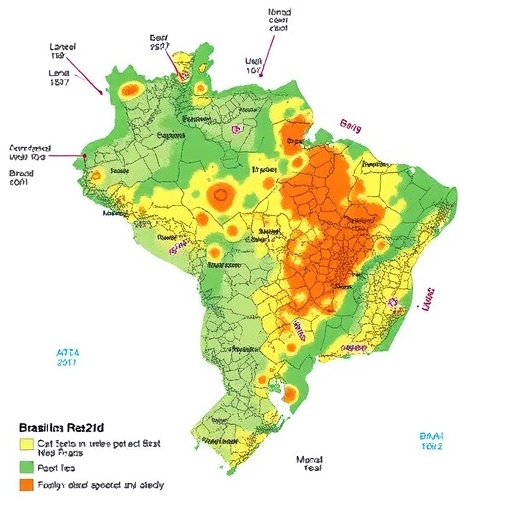
Phylogenetic analyses suggest that the virus’s presence in Brazil predates its initial human detection in 1990 by several decades, pointing to silent enzootic cycles within animal reservoirs. Although the definitive reservoir remains unidentified, wild rodents are suspected to play a central role, interfacing with humans in rural and forested environments conducive to spillover events. The geographic distribution of cases, including municipalities of Cotia, Espírito Santo do Pinhal, Sorocaba, and Assis, exemplifies the virus’s sustained circulation across diverse ecological niches.
Molecular scrutiny also revealed mutations affecting the viral glycoproteins responsible for receptor binding, which mediate host cell entry. These adaptive changes have implications for viral infectivity, transmission potential, and immune evasion strategies. Understanding these evolutionary dynamics is paramount for anticipating viral behavior and tailoring effective therapeutic or prophylactic interventions. Moreover, these mutations potentially contribute to the clinical manifestations observed, encompassing hemorrhagic fever and neurological compromise, underscoring the virus’s pathogenic capacity.
The Sabiá virus is classified among the Brazilian viral pathogens bearing the highest biosafety risks, particularly due to its capacity for aerosol transmission in laboratory environments. Consequently, handling active viral isolates mandates Biosafety Level 4 (BSL-4) containment, a capability currently unavailable in South America. To address this critical gap, Brazil is constructing Orion, its first BSL-4 laboratory at the Brazilian Center for Research in Energy and Materials (CNPEM) in Campinas, slated to become operational by 2030. Presently, live virus reference strains are maintained in secure facilities in the United States, underscoring the global nature of pathogen containment efforts.
The significance of genomic surveillance is further exemplified by the CADDE center’s contributions to tracking other emerging pathogens, such as the SARS-CoV-2 Gamma variant, Zika virus, and mpox virus. By integrating viral discovery with epidemiological mapping, these initiatives have enhanced the understanding of viral emergence patterns and transmission dynamics in Brazil and beyond. Such infrastructure and expertise were instrumental in elucidating the evolutionary path of the Sabiá virus and establishing updated diagnostic protocols.
This research also underscores the broader implications of viral evolution within zoonotic reservoirs, emphasizing the need for sustained molecular surveillance to preempt and respond to public health threats posed by neglected tropical pathogens. Given the potential for future outbreaks and the current diagnostic challenges, timely identification and characterization of emerging viral variants remain critical components of global health security. The Sabiá virus serves as a compelling reminder of the hidden dangers lurking in understudied viral populations and the necessity of innovative technologies to unveil them.
In conclusion, the genomic characterization of the Sabiá virus sheds light on its long-term circulation, genetic diversification, and implications for diagnostic refinement. The enhanced molecular detection methods developed through this research hold promise for improved surveillance and clinical management of infections caused by this neglected, yet highly virulent pathogen. Continuous monitoring and comprehensive understanding of viral evolution within reservoirs and human hosts remain indispensable for mitigating the risks posed by emerging infectious diseases in Brazil and worldwide.
News Publication Date: 20-Feb-2026
Web References:
- PLOS Neglected Tropical Diseases Article
- Brazil-UK Joint Center for Arbovirus Discovery, Diagnostics, Genomics, and Epidemiology (CADDE)
- FAPESP – São Paulo Research Foundation
References:
- Claro IM et al., “Genomic characterization of Sabiá virus in Brazil, 2019–2020: Implications for diagnostics, virus evolution, and receptor binding,” PLOS Neglected Tropical Diseases, DOI: 10.1371/journal.pntd.0014008, 2026.
- Faria NR et al., “Evolution and transmission dynamics of yellow fever virus in Brazil,” Nature Microbiology, 2026.
Cite Scienmag News
Kristina Jarvis. (May 20, 2026). Study Reveals Sabiá Virus Has Circulated and Mutated in Brazil for 142 Years. Scienmag. https://scienmag.com/study-reveals-sabia-virus-has-circulated-and-mutated-in-brazil-for-142-years/
Kristina Jarvis. "Study Reveals Sabiá Virus Has Circulated and Mutated in Brazil for 142 Years." Scienmag, 20 May 2026, https://scienmag.com/study-reveals-sabia-virus-has-circulated-and-mutated-in-brazil-for-142-years/. Accessed 3 September 2026.
Kristina Jarvis. "Study Reveals Sabiá Virus Has Circulated and Mutated in Brazil for 142 Years." Scienmag. May 20, 2026. https://scienmag.com/study-reveals-sabia-virus-has-circulated-and-mutated-in-brazil-for-142-years/


