


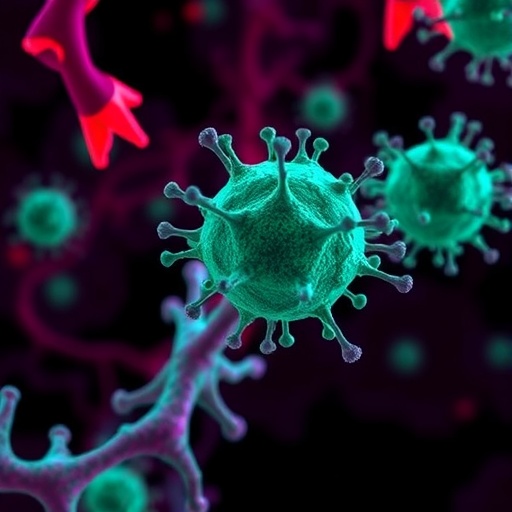
Kaposi sarcoma is not simply a tumour made of abnormal blood vessels. It is a complex tissue ecosystem in which infected cells, immune cells, endothelial cells, inflammatory signals and the surrounding matrix continually influence one another. A new study published in the British Journal of Cancer reports that this ecosystem is shaped in important ways by human herpesvirus 8, also known as Kaposi sarcoma-associated herpesvirus or KSHV. The work provides an in-depth characterisation of the tumour microenvironment in both HIV-associated and classic Kaposi sarcoma, highlighting viral control of local immune regulation.
Kaposi sarcoma develops when HHV-8-infected cells acquire tumour-like properties and stimulate the formation of abnormal vascular networks. The disease can occur in people living with HIV, where immune suppression and HIV-associated inflammation may accelerate tumour development, but it also appears in classic form, most often in older adults and in particular geographic regions. Although both forms are driven by the same virus, their clinical settings are different. Comparing them offers researchers a way to distinguish immune changes linked to HHV-8 from those caused primarily by HIV infection, ageing or systemic immune suppression.
The tumour microenvironment is central to that comparison. Cancer cells do not act in isolation; they exchange chemical signals with neighbouring cells through cytokines, chemokines, growth factors and cell-surface receptors. In Kaposi sarcoma, these interactions can support blood-vessel growth, recruit inflammatory cells and create conditions that allow infected tumour cells to persist. The new analysis indicates that HHV-8 is a major organiser of this local environment, influencing how immune cells are distributed and how they function within the tumour rather than merely serving as the initiating infection.
HHV-8 has a sophisticated biological programme that alternates between latent and lytic phases. During latency, the virus maintains its genome in infected cells while producing a restricted set of proteins that help the cell survive and evade immune attack. During lytic reactivation, a broader group of viral genes is expressed, generating new virus and altering the surrounding tissue through inflammatory and angiogenic signals. Viral proteins and non-coding RNAs can interfere with antigen presentation, antiviral signalling and programmed cell death. These mechanisms may create an immunologically abnormal niche in which tumour growth and viral persistence reinforce one another.
The study’s emphasis on both HIV-associated and classic disease is particularly significant because the two settings may contain overlapping, but not identical, immune landscapes. HIV infection can reduce the number and effectiveness of important T-cell populations, while antiretroviral therapy may partially restore systemic immune function without completely normalising tissues affected by cancer. Classic Kaposi sarcoma, by contrast, arises without HIV-driven immune depletion, yet it can still display local immune dysfunction. The comparison therefore suggests that HHV-8 itself has a distinct capacity to remodel immune activity inside the tumour.
A detailed view of this environment can reveal why immune cells that are capable of recognising infected or malignant cells fail to eliminate them. Tumours may contain cytotoxic lymphocytes, macrophages and other immune populations, but their presence does not necessarily mean they are active. Persistent exposure to viral and tumour-derived signals can produce functional exhaustion, alter cell differentiation or encourage regulatory pathways that suppress attack. At the same time, inflammatory cells may release factors that promote vascular remodelling and tumour survival. Kaposi sarcoma thus illustrates how inflammation can be both an attempted defence and a resource exploited by cancer.
These findings have implications for treatment strategy. Current management of Kaposi sarcoma may include antiretroviral therapy for people with HIV, chemotherapy, local treatment and, in selected cases, immune-based approaches. If HHV-8-dependent signals help establish an immunosuppressive microenvironment, therapies aimed only at rapidly dividing tumour cells may leave important drivers of disease untouched. Mapping the interaction between viral proteins, immune checkpoints, endothelial cells and inflammatory mediators could help identify combinations that block tumour support while restoring effective immune surveillance.
The research also underscores why tissue-level analysis matters. Blood tests can describe systemic immune status, but they cannot fully show which cells are physically adjacent within a lesion, what signals they are receiving or whether immune cells have entered a productive anti-tumour state. Modern tumour profiling can integrate cellular composition with gene-expression patterns and spatial organisation, allowing scientists to examine the microenvironment as a structured biological system. Such approaches are especially valuable for virus-associated cancers, where a small population of infected cells may influence many uninfected neighbouring cells.
For viral oncology, Kaposi sarcoma remains an important model of how chronic infection can transform tissue biology without relying on a single genetic alteration in the conventional sense. The new findings place HHV-8 at the centre of a regulatory network linking viral persistence, immune modulation, inflammation and abnormal vessel formation. They also reinforce the idea that the differences between HIV-associated and classic Kaposi sarcoma cannot be explained solely by the presence or absence of HIV. Understanding how the virus reshapes its surroundings may ultimately lead to more precise treatments that target both the tumour and the biological environment that allows it to endure.
Cite Scienmag News
Nathaniel Bowman. (August 5, 2026). Study reveals HHV-8-driven immune regulation in HIV-associated and classic Kaposi sarcoma. Scienmag. https://scienmag.com/study-reveals-hhv-8-driven-immune-regulation-in-hiv-associated-and-classic-kaposi-sarcoma/
Nathaniel Bowman. "Study reveals HHV-8-driven immune regulation in HIV-associated and classic Kaposi sarcoma." Scienmag, 5 August 2026, https://scienmag.com/study-reveals-hhv-8-driven-immune-regulation-in-hiv-associated-and-classic-kaposi-sarcoma/. Accessed 3 September 2026.
Nathaniel Bowman. "Study reveals HHV-8-driven immune regulation in HIV-associated and classic Kaposi sarcoma." Scienmag. August 5, 2026. https://scienmag.com/study-reveals-hhv-8-driven-immune-regulation-in-hiv-associated-and-classic-kaposi-sarcoma/


