


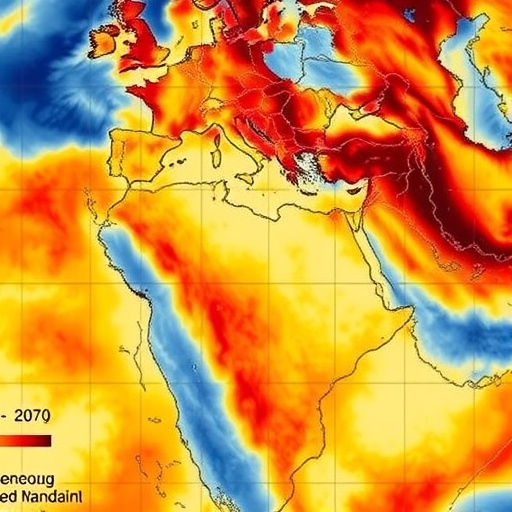
In an era marked by escalating climate extremes, recent research sheds light on a critical shortcoming in the world’s premier climate models, particularly regarding their ability to anticipate severe heatwaves. A groundbreaking study led by Andre Klif, Professors Chaim I. Garfinkel and Dorita Rostkier-Edelstein, alongside Dr. Assaf Hochman, at the Hebrew University of Jerusalem has revealed that while these models adeptly simulate extreme heat events once they manifest, they fall short in capturing the crucial atmospheric precursors that emerge days before such episodes. This shortfall could hamper efforts to provide early warnings and mitigate the impacts of heatwaves across vulnerable regions like the Eastern Mediterranean and Middle East.
As global temperatures climb, record-breaking heatwaves have become more frequent and severe, exerting profound stress on ecosystems, public health, and infrastructure. The Eastern Mediterranean and Middle East, in particular, represent one of the fastest warming hotspots globally. Understanding how these extreme heat events develop is essential not only for climate scientists but also for policymakers and disaster preparedness agencies. The new research, published in the journal Weather and Climate Extremes, undertakes a detailed, process-based evaluation of eleven state-of-the-art climate models employed in the latest IPCC assessments to assess their proficiency in reproducing both heatwave events and the atmospheric dynamics that lead up to them.
A central observation from the study is that current climate models generally succeed at simulating the characteristics and intensities of heatwaves themselves. However, when delving into the meteorological processes that trigger these extremes, the picture changes drastically. The models frequently exhibit a delayed or muted response to critical atmospheric signals antecedent to the onset of heatwaves. This discrepancy indicates that the models may not fully incorporate the complex chain of interactions between regional and large-scale atmospheric circulations responsible for initiating heat extremes.
This research underscores the importance of process-oriented model evaluation. Rather than focusing solely on the ultimate temperature peaks during heatwaves, it scrutinizes the atmospheric buildup—the sequence of evolving circulation patterns, pressure systems, and wind shifts—that paves the way for these episodes. The team’s findings illuminate that significant heatwave precursors often originate thousands of kilometers away, involving teleconnections that span continents. For the Eastern Mediterranean, synoptic-scale patterns over Europe, Turkey, South Asia, and parts of Africa create a conduit that channels warm air masses into the region days before temperatures soar.
One particularly critical driver identified is a strengthening of the high-pressure ridge over Turkey, a feature that acts as a linchpin in heatwave progression by promoting atmospheric stability and descending air that suppresses cloud formation. Models that depict this high-pressure ridge with greater fidelity also tend to reproduce the intensity of observed heatwaves more accurately. Yet, many models falter in consistently resolving this feature, which jeopardizes their capacity to simulate reliable heatwave onset conditions.
Intriguingly, the study reveals a robust link between the South Asian monsoon system and subsequent heatwaves in the Mediterranean basin. The intricate interplay between tropical monsoon dynamics and mid-latitude atmospheric circulation emerges as a critical factor, yet none of the examined models fully capture this interaction. This gap highlights an important area where the coupling between tropical and extratropical systems remains insufficiently represented in climate projections, potentially limiting predictive skill in regions far removed from monsoon activity.
The implications of these modeling limitations stretch beyond academic curiosity. Heatwaves impose mounting threats to public health, agriculture, energy systems, and water availability. In regions like the Middle East and Eastern Mediterranean, where heat extremes are intensifying, failure to anticipate these events days in advance constrains effective adaptation and response strategies. Enhanced early-warning capabilities hinge on an improved understanding and simulation of atmospheric precursors to extreme heat.
Yet, the authors emphasize that these deficiencies do not invalidate current climate projections of heatwave frequency or severity. Instead, the study advocates for a refined evaluation framework that scrutinizes the physical mechanisms embedded within climate models rather than relying solely on aggregate temperature outcomes. By shifting toward a process-based assessment, researchers and model developers can identify specific weaknesses in atmospheric dynamics representations and direct efforts toward improving those.
A process-based evaluation framework proposed by the study offers a promising pathway. This approach integrates detailed analyses of atmospheric circulation, pressure fields, and teleconnection patterns alongside heatwave temperature metrics. Implementation of such a framework could enhance both long-term climate projection robustness and operational forecasting tools, potentially allowing earlier and more reliable identification of hazardous heatwaves.
Increasing the predictive fidelity of early atmospheric signals would mark a significant advancement for societies facing mounting heat stress. As climate change amplifies the frequency, duration, and intensity of heatwaves globally, the need for models that can detect subtle atmospheric shifts days ahead becomes critical. This capability is pivotal not only for reducing heatwave-related mortality but also for securing energy systems and safeguarding agriculture in vulnerable regions.
Fundamentally, this research highlights the delicate complexity underlying extreme weather events. Heatwaves are not isolated phenomena but rather emerge from intricate atmospheric cascades spanning vast geographical domains. Accurately capturing these cascades in climate models demands continuous refinement in representing atmospheric physics, improved spatial and temporal resolutions, and better integration of teleconnections between tropical and extratropical systems.
In conclusion, while current climate modeling efforts have made significant strides in depicting heatwave statistics, their ability to trace and anticipate the physical processes driving these extremes remains imperfect. By embracing a process-focused evaluation paradigm, the scientific community can bolster model accuracy, foster improved predictive capabilities, and ultimately contribute to more effective responses to the growing threat of extreme heat under climate change.
News Publication Date: 2-Jun-2026
Web References: http://dx.doi.org/10.1016/j.wace.2026.100918
References: Published in Weather and Climate Extremes, DOI: 10.1016/j.wace.2026.100918
Cite Scienmag News
Russell Cooper. (June 16, 2026). Study Reveals Climate Models Overlook Early Warning Signs of Lethal Middle East Heatwaves. Scienmag. https://scienmag.com/study-reveals-climate-models-overlook-early-warning-signs-of-lethal-middle-east-heatwaves/
Russell Cooper. "Study Reveals Climate Models Overlook Early Warning Signs of Lethal Middle East Heatwaves." Scienmag, 16 June 2026, https://scienmag.com/study-reveals-climate-models-overlook-early-warning-signs-of-lethal-middle-east-heatwaves/. Accessed 5 September 2026.
Russell Cooper. "Study Reveals Climate Models Overlook Early Warning Signs of Lethal Middle East Heatwaves." Scienmag. June 16, 2026. https://scienmag.com/study-reveals-climate-models-overlook-early-warning-signs-of-lethal-middle-east-heatwaves/


