


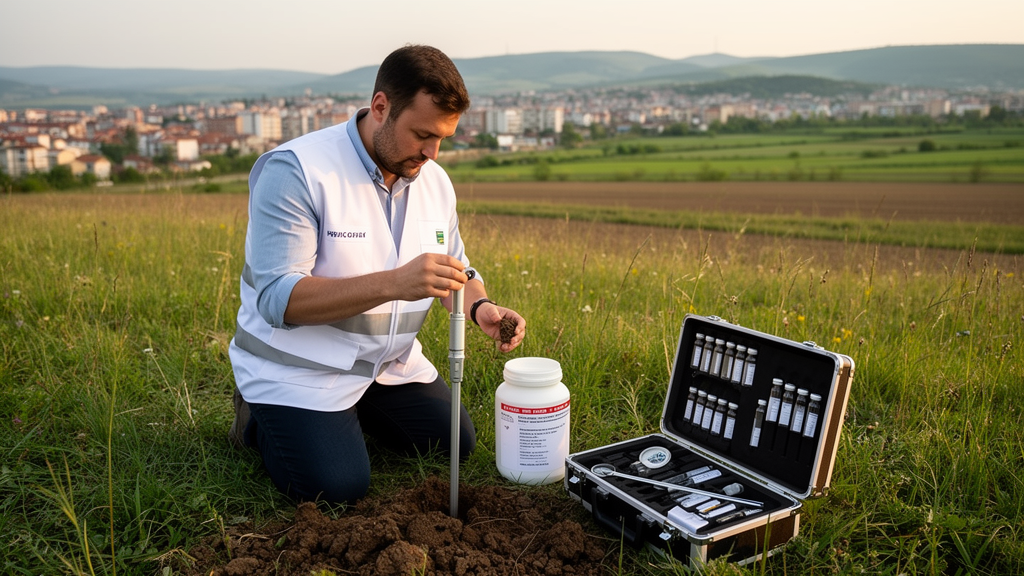
A field assessment of soil in Bulgaria’s Sofia region found that lead was the most widespread contaminant in surface soils, with 24 of 30 sampled plots exceeding the permissible concentration of 45 mg/kg. The study, which analyzed soils collected in 2011, also identified differences in soil quality among green, industrial, residential and urban-agriculture zones. Urban-agriculture areas had the strongest overall potential for soil quality, green zones ranked next, and residential and industrial areas received poorer assessments.
The authors described anthropogenic pressure as medium across all four zones, indicating that pollution was not confined to a single land use. The results provide a spatial assessment of soil condition and heavy-metal accumulation within Sofia’s urban and peri-urban territory, but they do not establish that soil quality has changed over time. The investigation was designed to evaluate the regulating ecosystem service of “soil quality” across four functional zones.
Green areas included park territories, while the industrial and residential categories represented their respective urban functions. A fourth category covered arable land on Sofia’s outskirts used for urban agriculture. The study area was Sofia’s 492 km² administrative territory, including the main settlement and surrounding peri-urban land.
Its multidisciplinary approach combined quantitative soil measurements with geographic information system analysis and spatial interpolation. The researchers linked soil indicators to the territorial functions used in Bulgaria’s methodology for assessing and mapping urban ecosystems and their services, then calculated separate zone-level evaluations for soil quality and anthropogenic pressure. Soils were sampled at 30 experimental plots distributed across the city and its surroundings in 2011.
The plot design was based on the ICP Forest Level I network, whose 16-by-16 km grid was reduced to 3-by-3 km cells. Each plot covered 0.1 hectare and was assigned to one functional zone. Five coring points were used for each plot at depths of 0–10, 10–30 and 30–50 cm, although the analysis presented here concentrated on the uppermost 10 cm.
This layer was selected for heavy-metal assessment because it can receive inputs from human activity, while deeper soil may also reflect the composition of parent material. Laboratory measurements covered texture, pH, organic carbon, total nitrogen, cation-exchange capacity and four metals. Texture was determined by pipette titration with hydrochloric acid, pH was measured potentiometrically, carbon was assessed with the Turin method, total nitrogen with the Kjeldahl method and cation-exchange capacity with the method attributed to Chuljian.
Copper, zinc, lead and iron were extracted using a 1:3 nitric-acid-to-hydrochloric-acid treatment under ISO 1146, after which concentrations were determined by atomic absorption spectrophotometry. The study assessed pH, carbon, nitrogen and CEC as soil-quality indicators, while copper, zinc, lead and iron concentrations represented anthropogenic pressure. Values were classified into five score categories from 1, the worst assessment, to 5, with intervals also compared with the safety and maximum permissible concentrations specified in Bulgaria’s Regulation No. 3 for harmful substances in soils.
To estimate values outside the sampled plots, the researchers used inverse distance weighted interpolation with a power coefficient of one for every parameter. Under this method, an unsampled location receives a weighted average from nearby observations, with greater weight assigned to closer points. The interpolated values were converted into separate raster layers and combined with polygons representing the four functional zones.
Zonal statistics were then used to compare soil indicators and pollution scores among the zones. This spatial approach allowed the study to compare broad patterns across the metropolitan area, although the result necessarily depends on the distribution and density of the original 30 plots. The reported scores are zone-level assessments derived from interpolated measurements, not direct observations made at every location within each zone.
Lead produced the clearest pollution signal. Its concentration ranged from 35 to 130 mg/kg, and 24 of the 30 plots exceeded the 45 mg/kg permissible concentration. Four plots were on the verge of the maximum permissible concentration of 130 mg/kg.
Lower lead accumulation occurred only in limited parts of the urban-agriculture zone. The zone-level analysis rated lead poorly, which reduced the overall anthropogenic-pressure evaluation. Copper followed a different pattern: values remained below the 60 mg/kg safety concentration, with the lowest measurement, 9.34 mg/kg, recorded in an industrial zone and the highest accumulation found in residential areas.
Green-zone values were generally between 20 and 25 mg/kg. Concentrations were higher in northwestern Sofia, where deeper layers also contained elevated copper, suggesting that underlying geology may be relevant to the observed pattern. Zinc concentrations ranged from 52 to 130 mg/kg and remained below the safety concentration, although the values were predominantly high.
Every functional zone contained both low and high measurements, and the study did not identify a specific distribution pattern. Most peri-urban agricultural sites had lower zinc values, except for two locations directly beside industrial areas. Iron ranged from 10,270 to 29,650 mg/kg.
The highest value occurred in residential territory and the lowest in industrial and green zones, but the ranges overlapped and no consistent spatial pattern could be distinguished. Iron remained within the applicable limits and was assessed as indicating relatively low pollution. Taken together, the metal results did not reveal a simple division between industrial, residential and green land: many measurements occupied similar ranges across functional zones.
The broader soil-quality indicators showed a clearer geographic contrast than the metals. Surface-soil pH ranged from 6.37 to 8.41, corresponding to neutral-to-alkaline conditions, with the highest pH in southeastern Sofia. Total carbon was low to very low relative to the surrounding natural soils and reached its lowest values in the east.
Peri-urban soils had the highest carbon concentrations, while green and residential areas had broadly similar values. Cation-exchange capacity ranged from 27.71 to 56.4 meq/100 g, with lower values in the east and values above 30 meq/100 g in the peri-urban territory. Total nitrogen followed much the same distribution as carbon, pH and CEC.
The consistent pattern was poorer characteristics in eastern Sofia and better characteristics in the peri-urban area, although the study did not identify a clearly defined spatial pattern within each of the four functional zones. Aggregation of pH, carbon, nitrogen and CEC produced a zonal assessment in which urban agriculture had good potential for soil quality, green zones had medium potential, and residential and industrial zones had relatively poor quality. The eastern parts of Sofia were associated with the lowest values on the mapped indicators.
Anthropogenic pressure was classified as medium in all functional zones, showing that elevated human-related contamination affected urban and peri-urban areas across the region rather than one zone alone. Green and urban-agriculture areas still received better combined evaluations than residential and industrial areas, but the authors emphasized that the separation between zones was small. Their conclusion was that green infrastructure and peri-urban land have comparatively strong potential to sustain soil quality, while pollution already affects the capacity attributed to urban parks.
The study identifies urban soil as a sensitive indicator of the condition of Sofia’s urban ecosystem, with historical contamination linked to intensive urbanization, heavy industry, transport and local heating. The authors also noted the possible contribution of older quarrying and metallurgy to the continuing presence of metals in surface soils. These historical activities were presented as possible contributors, not as sources conclusively identified for every measured location.
The assessment also highlighted the role of soil in ecosystem services such as flood mitigation, urban heat-island buffering, pollutant capture, physical support for infrastructure, urban food growing, access to greenspace, nutrient cycling and carbon storage. Based on the sampled evidence, the authors argued for management approaches that give greater attention to soil condition in urban green spaces and urban forestry, together with clearer legal and planning provisions for soil-related ecosystem services. The study did not test particular management practices, measure human exposure, or evaluate changes in soil condition after any intervention.
Subject of Research: Urban soil quality and heavy-metal distribution across functional zones in Sofia, Bulgaria
Article Title: Study on soil quality in different functional zones of Sofia region
Article References: Todorova, E., & Zhiyanski, M. (2023). Study on soil quality in different functional zones of Sofia region. One Ecosystem, 8, Article e101381. https://doi.org/10.3897/oneeco.8.e101381
Image Credits: AI Generated
Keywords: urban soil quality, lead contamination, heavy metals, Sofia, urban agriculture, green zones, spatial interpolation, soil pollution, ecosystem services, Bulgaria, soil, quality
Cite Scienmag News
Alan Morgan. (October 20, 2026). Study on soil quality in different functional zones of Sofia region. Scienmag. https://scienmag.com/study-on-soil-quality-in-different-functional-zones-of-sofia-region/
Alan Morgan. "Study on soil quality in different functional zones of Sofia region." Scienmag, 20 October 2026, https://scienmag.com/study-on-soil-quality-in-different-functional-zones-of-sofia-region/. Accessed 20 October 2026.
Alan Morgan. "Study on soil quality in different functional zones of Sofia region." Scienmag. October 20, 2026. https://scienmag.com/study-on-soil-quality-in-different-functional-zones-of-sofia-region/


