


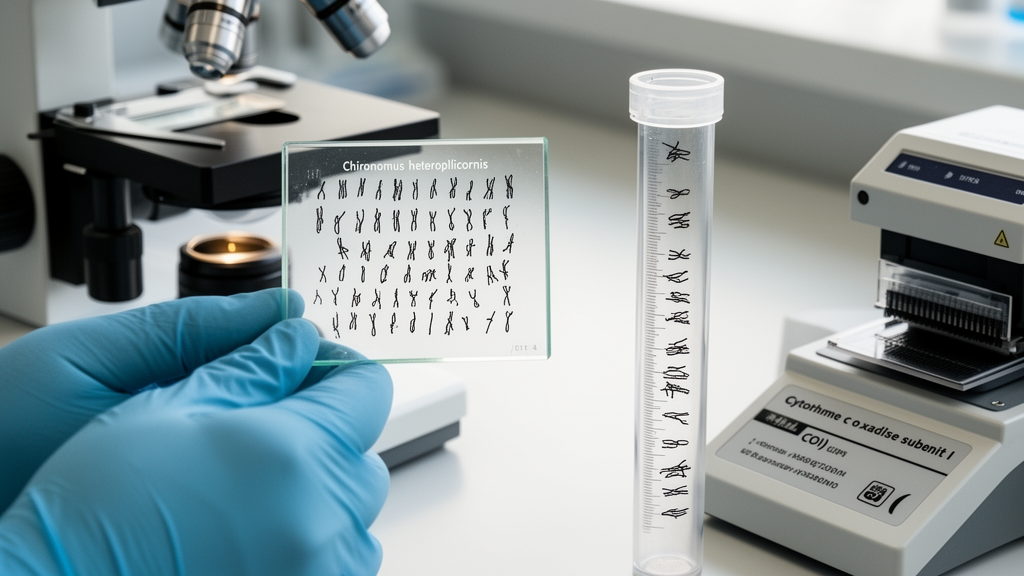
Chironomus heteropilicornis was recorded for the first time from Russia’s Gydan Peninsula in a study combining chromosome analysis, larval morphology and mitochondrial DNA barcoding. Researchers examined four fourth-instar larvae collected from an unnamed lake and identified three chromosome banding patterns, including a newly described hpiB2 sequence. A 617-nucleotide cytochrome c oxidase subunit I, or COI, sequence from one larva placed the Gydan material in a geographically defined cluster with Georgia and Scandinavia. The small sample limits conclusions about population-wide diversity, but the findings extend the documented distribution of the species and characterize a previously unstudied population of the Chironomus pilicornis group.
The larvae were collected on 4 August 2018 from a small bay overgrown with sedge in an unnamed lake in Tazovskiy District, Yamalo-Nenets Autonomous Region. The collection site was at 70°24′51.54″ N, 76°06′42.08″ E, at a depth of 0.8 metre with a bottom composed of silt and detritus. Water temperature was 10.5 °C and mineralization was 0.06 ppm. Chironomus specimens were estimated at 700 individuals per square metre, representing 67% of the total number of benthic animals, and their estimated biomass was 6.6 grams per square metre, or 38% of the total. Earlier sampling had not recorded Chironomus larvae in the peninsula’s lakes during a 2012 survey of macrozoobenthos distribution, while a later study reported C. heterodentatus from two unnamed inundated lakes.
All four larvae were used for karyotype analysis by the ethanol-orcein technique. Preparations were examined with a Micromed-6C light microscope fitted with a 100× oil-immersion objective and a ToupCam 5.1 camera. The head capsule of one larva was mounted in Fora-Berlese solution so that the mentum, ventromental plates, mandibles and antenna could be assessed. The larva had a dark-yellow head capsule and a black-brown mentum with sharp teeth. Its central tooth had small additional teeth, while the third through fifth teeth were nearly equal in size and lighter than the first two. The ventromental plates had small outer hooks and 64–84 striae. The antenna’s basal segment was cone-shaped and measured 119–167 micrometres, and the mandibular teeth showed the black and brown coloration recorded in earlier morphological descriptions.
The chromosome set was 2n = 8, with the arms arranged as AB, CD, EF and G in the Chironomus “thummi” cytocomplex. The AB and CD chromosomes were metacentric, EF was submetacentric and G was telocentric. No additional B chromosomes were detected in the examined larvae. Nucleoli were observed in arms B, D, E and G, and Balbiani rings occurred in arms B and G. The homologous G arms usually lay close together or were tightly paired. These features, together with the larval structures, supported identification as C. heteropilicornis, a member of the pilicornis group that also includes Chironomus pilicornis.
Three different karyotypes occurred among the four Gydan larvae, indicating variation in the B and C chromosome arms. Nine banding sequences were observed in the population, including hpiB2, which was reported for the first time. The B arm carried hpiB1 in homozygous and heterozygous combinations and hpiB2 in a heterozygous combination; their reported frequencies were 0.875 and 0.125, respectively. The C arm contained hpiC1 and hpiC2, both found in homozygous states, with frequencies of 0.750 and 0.250. The remaining arms carried hpiA2, hpiD1, hpiE1, hpiF3 and hpiG1. Four combinations—hpiA2.2, hpiC1.1, hpiD1.1 and hpiE1.1—were present in every larva. The hpiF3 sequence was also present in all four specimens, whereas the same combination had been found in homozygous state in only 9% to 22.5% of specimens in the studied Yakutian populations.
The Gydan chromosomes resembled the karyotype reported from the Netherlands, although the authors noted that comparable local conditions, including temperature, could be relevant because inversion patterns in Chironomus may depend on characteristics of individual water bodies and the physiological condition of the organisms. The Gydan animals also had notably large nucleoli in the D and E arms. The hpiA2 sequence occurred only in the homozygous state in the Gydan sample, a pattern also reported in all 33 specimens examined from Georgia. The new hpiB2 sequence was present in one of the four Gydan larvae, so its frequency within the wider species population remains unknown. With only four specimens, the observations cannot define the full extent of chromosomal polymorphism at the collection site.
For DNA analysis, total DNA was extracted from one of the larvae already studied karyologically. The COI gene was amplified with the primers LCO1490 and HCO2198 in a 25-microlitre reaction containing one unit of Taq polymerase. The amplification included an initial 94 °C step for three minutes, followed by 30 cycles of 94 °C for 15 seconds, 50 °C for 45 seconds and 72 °C for 60 seconds, with a final eight-minute extension at 72 °C. Products were visualized on 1% agarose gels, purified with ethanol and 3 M ammonium acetate, and sequenced on both strands with an Applied Biosystems 3500 DNA sequencer. The resulting 617-nucleotide barcode contained 25% adenine, 36% thymine, 18% guanine and 21% cytosine and was deposited in GenBank as MZ450155.
Comparative analyses included 41 COI sequences from GenBank and the Barcode of Life Data Systems. These represented Chironomus species from several regions, including C. heteropilicornis from Norway and Georgia and C. pilicornis from Sweden, Canada and Greenland; Ptychoptera minuta was used as the outgroup. Sequences were aligned with the MUSCLE algorithm in MEGA6, and pairwise Kimura two-parameter distances were calculated with codon-position preferences. A Bayesian analysis in MrBayes 3.2.6 used the settings applied in the earlier Georgian study, with one million iterations, 1,000 burn-in iterations and a general-time-reversible model incorporating invariant sites and gamma-distributed rates.
The Gydan COI sequence differed from Georgian C. heteropilicornis by 1.8% and from Norwegian sequences by 1.1–1.3%. It was also 1.1% different from the Swedish C. pilicornis sequence, while the Canadian and Greenland C. pilicornis samples differed by 5.3%. For comparison, the study cited approximately 3% as a commonly used interspecific threshold for Chironomus COI sequences. The Bayesian tree separated the pilicornis group into two geographic clusters: Canada and Greenland formed one cluster, while Georgia, Scandinavia and Gydan formed another with a posterior support value of 0.98. Two Scandinavian C. pilicornis sequences, BSCHI735-17 and BSCHI736-17, appeared within the latter cluster alongside C. heteropilicornis sequences. The authors identified species misidentification or hybridization with mitochondrial introgression as possible explanations, but the available data could not distinguish between them.
Hybridization followed by mitochondrial introgression is a possible mechanism for the mixed Scandinavian records, and interspecific crosses have been reported among related Chironomus species. C. heteropilicornis and C. pilicornis have also been recorded sympatrically at a site in southern Finland, supporting the possibility of contact between the two species. Nevertheless, the interpretation remains conditional. The study did not examine the karyotype of C. pilicornis from Canada, and the Gydan dataset contained only four larvae. The Canada–Greenland cluster also lacked sufficient sampling to determine whether it represents a separate species. On the basis of the available chromosome and COI data, the authors positioned the Gydan population between the Georgian, Yakutian and Scandinavian populations within the European-associated cluster. A firm phylogeographic reconstruction was not possible because COI sequences from Yakutia and other Asian regions were unavailable.
Subject of Research: Karyotypic and mitochondrial variation in Chironomus heteropilicornis from Russia’s Gydan Peninsula
Article Title: Karyotype and COI gene sequence of Chironomus heteropilicornis Wülker, 1996 ( Diptera , Chironomidae ) from the Gydan Peninsula, Russia
Article References: Bolshakov, V. V., Prokin, A. A., & Artemenko, S. V. (2021). Karyotype and COI gene sequence of Chironomus heteropilicornis Wülker, 1996 (Diptera, Chironomidae) from the Gydan Peninsula, Russia. Comparative Cytogenetics, 15(4), 447-458. https://doi.org/10.3897/compcytogen.v15i4.73135
Image Credits: AI Generated
DOI: 10.3897/CompCytogen.v15i4.73135
Keywords: Chironomus heteropilicornis, Gydan Peninsula, chromosome banding, COI DNA barcoding, mitochondrial DNA, phylogenetic analysis, chironomid midges, cytogenetics, population genetics, Russia, Karyotype, gene
Cite Scienmag News
Juliet Wilcox. (October 20, 2026). Karyotype and COI sequence of Chironomus heteropilicornis from Gydan Peninsula. Scienmag. https://scienmag.com/karyotype-and-coi-sequence-of-chironomus-heteropilicornis-from-gydan-peninsula/
Juliet Wilcox. "Karyotype and COI sequence of Chironomus heteropilicornis from Gydan Peninsula." Scienmag, 20 October 2026, https://scienmag.com/karyotype-and-coi-sequence-of-chironomus-heteropilicornis-from-gydan-peninsula/. Accessed 20 October 2026.
Juliet Wilcox. "Karyotype and COI sequence of Chironomus heteropilicornis from Gydan Peninsula." Scienmag. October 20, 2026. https://scienmag.com/karyotype-and-coi-sequence-of-chironomus-heteropilicornis-from-gydan-peninsula/


