


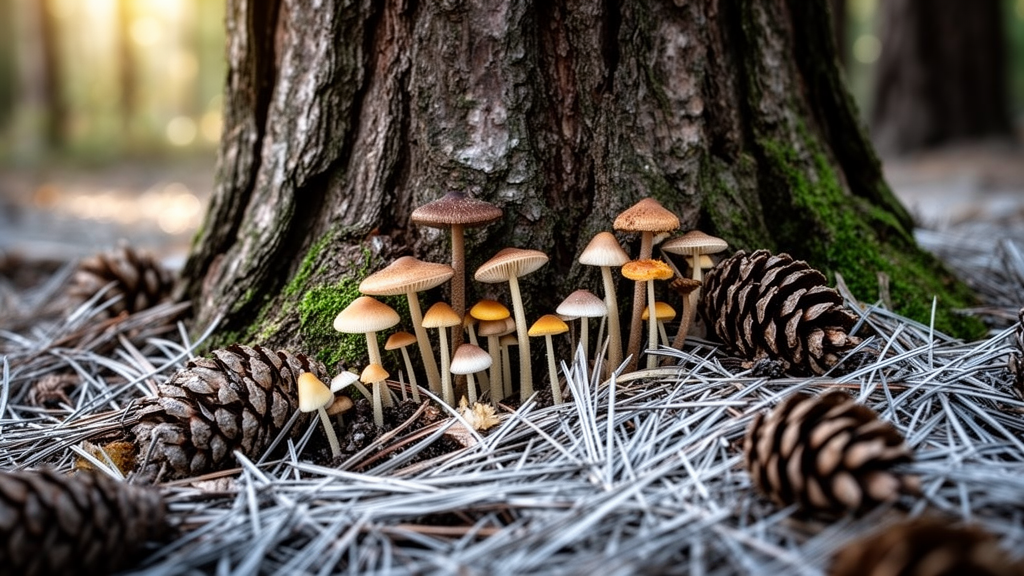
A survey of more than 800 fungal isolates from shoots of three healthy pine species in China identified three previously unknown genera and nine new species within Capnodiales sensu lato. The research also used fossil calibrations to estimate the age of the broader fungal order at approximately 241.9 million years ago, placing its crown in the Middle Triassic. Published in IMA Fungus, the study combines formal descriptions, morphological characterization, seven-locus phylogenetics and divergence-time analysis.
The isolates came from Pinus densiflora, P. thunbergii and P. elliottii. Researchers characterized the fungi morphologically and analyzed a concatenated sequence dataset comprising seven loci: the internal transcribed spacer regions, the large subunit nuclear ribosomal RNA gene, and the protein-coding genes RNA polymerase II subunit B, actin, calmodulin, beta-tubulin and elongation factor 1-alpha. Three new genera were proposed: Botryoconidia in Dissoconiaceae, Longisporomyces in Extremaceae and Helianthoconium in Mycosphaerellaceae.
Each was represented by a new species—Botryoconidia globosus, Longisporomyces filisporum and Helianthoconium helianthosporum. The study additionally described six new species in existing genera: Neocatenulostroma endophyticum, Rachicladosporium pennatum, Sphaerulina nanjingensis, Toxicocladosporium fusiforme, Zasmidium guttulatum and Zasmidium longisporum. The authors provided comprehensive descriptions of the newly recognized endophytic taxa, adding both generic and species-level records for the order.
Fossil-calibrated analyses dated the crown of Capnodiales at about 241.9 million years ago, with a 95% highest posterior density interval of 239.23–243.18 million years. The researchers also estimated that several major subclades began diversifying during the Jurassic. Their estimated crown ages were 169.56 million years ago for Capnodiales sensu stricto, 148.60 million years ago for Cladosporiales and 187.18 million years ago for Mycosphaerellales.
These are model-based divergence estimates expressed with posterior uncertainty, rather than direct dates for individual fungal lineages. The study’s scope was taxonomic and phylogenetic: it examined isolates recovered from healthy pine shoots, established new names for previously undescribed taxa and reconstructed relationships using the combined seven-locus dataset. Its divergence analysis further placed the new taxa within a time-calibrated framework for Capnodiales sensu lato.
By documenting three genera and nine species from sampled pine hosts, the work expands the recognized diversity of this fungal order and provides a formal basis for studying the morphology, phylogenetic placement and evolutionary history of the newly described endophytes.
Subject of Research: Taxonomy, phylogeny and divergence timing of endophytic fungi within Capnodiales from pine hosts
Article Title: Novel endophytic fungi from Pinus: introducing three new genera and six new species within Capnodiales (Ascomycota, Dothideomycetes) sensu lato
Article References: Zhang, X.-Y., Zhang, Q.-Y., Li, D.-W., Sun, J.-Z., & Fan, B. (2025). Novel endophytic fungi from Pinus: introducing three new genera and six new species within Capnodiales (Ascomycota, Dothideomycetes) sensu lato. IMA Fungus, 16, Article e175931. https://doi.org/10.3897/imafungus.16.175931
Image Credits: AI Generated
DOI: 10.3897/imafungus.16.175931
Keywords: Capnodiales, endophytic fungi, pine trees, fungal taxonomy, phylogenetics, new species, new genera, Ascomycota, Dothideomycetes, fossil calibration, Novel, endophytic
Cite Scienmag News
Roger Howard. (October 20, 2026). Pine-associated fungi yield three new genera and nine species. Scienmag. https://scienmag.com/pine-associated-fungi-yield-three-new-genera-and-nine-species/
Roger Howard. "Pine-associated fungi yield three new genera and nine species." Scienmag, 20 October 2026, https://scienmag.com/pine-associated-fungi-yield-three-new-genera-and-nine-species/. Accessed 20 October 2026.
Roger Howard. "Pine-associated fungi yield three new genera and nine species." Scienmag. October 20, 2026. https://scienmag.com/pine-associated-fungi-yield-three-new-genera-and-nine-species/


