


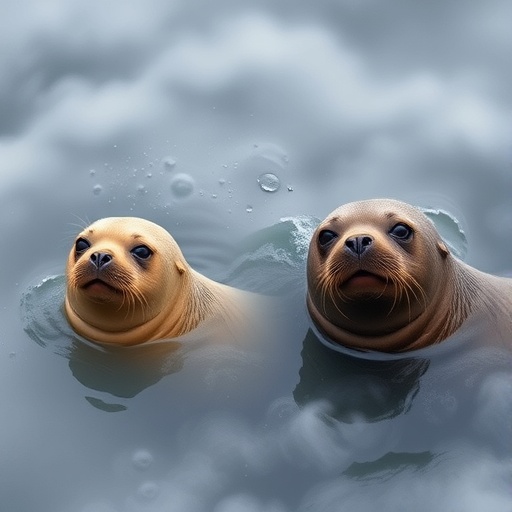
Open water swimming, at first glance, might seem like a boundless, liberating experience. Yet, paradoxically, it can evoke a sensation akin to confinement. This feeling arises when the water’s turbidity reduces visibility to mere centimeters, denying swimmers a clear view of their environment. Despite these visual limitations, harbour seals (Phoca vitulina) navigate the often murky and complex coastal waters of their habitat with remarkable ease. While these seals rely on a suite of sensory adaptations—notably their highly sensitive and mobile whiskers—it has long been suspected that their vision may still play an essential role. A new study led by Frederike Hanke at the University of Rostock in Germany has unveiled how these marine mammals harness a visual phenomenon known as optic flow to determine their direction of movement, even when everything around them appears clouded and indistinct.
Optic flow refers to the pattern of apparent motion experienced on the retina as an observer moves through their environment. For harbour seals, swimming through particulate-rich, turbid waters creates a dynamic visual landscape: tiny particles, sediment, and organic matter stream past their eyes, forming a fluid tapestry of motion. Hanke and her team hypothesized that even in poor visibility, seals might extract directional cues from these optic flow patterns to orient themselves efficiently. The implications of such a mechanism suggest a nuanced integration of sensory information that enables these animals to overcome their challenging underwater environment.
To investigate this proposition, the researchers devised an innovative experimental setup marrying cutting-edge computer simulations with the cooperative engagement of trained harbour seals. Their approach centered around replicating the complex optic flow fields a seal would encounter in three distinct underwater scenarios. The first simulation mimicked the experience of cruising through open water, represented visually by blocks of dots streaming directly toward the animal. The second recreated the seabed passing beneath with a plane of dots rushing upward, while the third simulated the sea surface flowing overhead. These visual stimuli were projected on large screens, challenging the seals to identify subtle differences in perceived heading direction.
Three seals—Nick, Luca, and Miro—participated in the experiments, each trained to indicate perceived movement direction by touching one of two red balls positioned to their left or right. The animals received tasty sprats as rewards, facilitating motivation and engagement in the task. Notably, while Nick and Luca quickly adapted to the gaming-like set-up, Miro required more time to master the task, highlighting the diversity of learning styles even among these intelligent creatures. Hanke observed that despite initial difficulties, Miro’s open-mindedness allowed him to adapt fully, underscoring the seals’ cognitive flexibility.
During extensive trials, the optic flow stimuli simulated heading directions variably offset by specific angles—ranging from 2 to 22 degrees to the left or right—to test the seals’ sensitivity to subtle directional shifts. The animals’ responses were meticulously recorded and analyzed to determine their accuracy in discerning the simulated heading direction solely from the optic flow patterns. While not perfect—reflecting their status as sentient beings rather than mechanical entities—the seals demonstrated a precise capacity to interpret optic flow cues within this controlled environment.
These findings are transformative because they elucidate how vision, often thought limited in turbid underwater habitats, is indeed leveraged by harbour seals to negotiate their surroundings effectively. Even under subdued lighting and pronounced cloudiness, the dynamic visual information generated by moving particles offers sufficient spatial cues to gauge heading direction. This ability works in concert with other sensory modalities such as mechanosensation via whiskers, creating a comprehensive sensory map that guides the seals’ movements through complex aquatic environments.
The utilization of optic flow also brings to light broader biological principles regarding motion perception and spatial orientation under challenging sensory conditions. Seals exemplify how evolution can shape sensory systems to capitalize on minimal visual information, transforming what seems like visual noise into meaningful signals essential for survival. This visual processing likely underpins critical behaviors including navigation, foraging, and predator avoidance, enabling these mammals to thrive in visually obscured marine settings.
Remarkably, the research team envisions extending their investigations to explore whether harbour seals can not only decode direction from optic flow but also use it to estimate distance traveled during dives—a vital component for navigation and spatial memory underwater. If confirmed, this would parallel mechanisms found in other vertebrates and insects, establishing optic flow as a universal cue for path integration and voyage estimation across taxa.
The methodical approach combining ethological training paradigms with immersive, controlled simulations serves as a model for sensory biology research. It bridges gaps between field observations and laboratory-based mechanistic understanding, yielding insights that are both ecologically relevant and experimentally rigorous. Moreover, the collaborative effort among neurological, behavioral, and marine biology experts epitomizes interdisciplinary research’s power to unravel complex biological phenomena.
The study, published in the Journal of Experimental Biology, stands as a testament to the underestimated sophistication of marine mammal sensory systems. It advances our comprehension of how animals interpret and exploit subtle environmental cues to orient in three-dimensional, murky arenas where human vision falters. Such knowledge bears significance for conservation biology by informing habitat management and elucidating how environmental changes affecting water clarity—such as pollution and sediment disruptions—may impact these species’ sensory ecology and survival strategies.
In an era where underwater technologies often aim to mimic biological systems, uncovering how seals use optic flow offers inspiration for designing autonomous underwater vehicles and robotic systems capable of navigating turbid waters without reliance on GPS or sonar alone. Nature’s solutions to sensory challenges frequently inform technological innovations, with this research poised to contribute to bio-inspired engineering.
Harbour seals’ capacity to transform sparse visual data into reliable navigation cues reshapes our appreciation of their sensory world. Where humans perceive limitation, these marine mammals extract opportunity, exemplifying evolutionary ingenuity. Hanke and colleagues open a new chapter in understanding aquatic vision, underscoring that even the faintest flicker of visual information in murky waters can illuminate the course ahead for these remarkable animals.
Cite Scienmag News
Violet Maxwell. (May 29, 2025). Study of Seals Shows How Cloudy Water Enhances Their Sense of Direction. Scienmag. https://scienmag.com/study-of-seals-shows-how-cloudy-water-enhances-their-sense-of-direction/
Violet Maxwell. "Study of Seals Shows How Cloudy Water Enhances Their Sense of Direction." Scienmag, 29 May 2025, https://scienmag.com/study-of-seals-shows-how-cloudy-water-enhances-their-sense-of-direction/. Accessed 3 September 2026.
Violet Maxwell. "Study of Seals Shows How Cloudy Water Enhances Their Sense of Direction." Scienmag. May 29, 2025. https://scienmag.com/study-of-seals-shows-how-cloudy-water-enhances-their-sense-of-direction/


