


A new study from the Pohang University of Science and Technology (POSTECH) indicates that fine particulate matter, which is less than 2.5 µm in diameter (PM2.5), is increasingly impacting the rapidly aging Korean population. Due to this population aging, PM2.5-related premature deaths are projected to be more than three times higher by 2050 than they are today if PM2.5 exposure persists.

Credit: POSTECH
A new study from the Pohang University of Science and Technology (POSTECH) indicates that fine particulate matter, which is less than 2.5 µm in diameter (PM2.5), is increasingly impacting the rapidly aging Korean population. Due to this population aging, PM2.5-related premature deaths are projected to be more than three times higher by 2050 than they are today if PM2.5 exposure persists.
A research team of Professor Hyung Joo Lee and MSc student Na Rae Kim from the Division of Environmental Science and Engineering at POSTECH has projected the number of deaths by 2050 based on the combined effects of PM2.5 and the aging population. They also suggested the concentration of PM2.5 needed to maintain the current PM2.5-related health burden. The study was recently published in the online edition of “Environmental Research”, an international journal in the environmental field.
Particles come in various categories based on their size, including total suspended particles (TSP), PM10, and PM2.5. Among these, PM2.5, the smallest particles, can penetrate deep into the lungs and contribute to a range of health issues. The elderly, those aged 65 and above, are particularly susceptible. As Korea’s population ages rapidly, researchers anticipate a growing health burden.
Professor Hyung Joo Lee’s team initially calculated the average concentration of PM2.5 over a three-year span using data from 2019 to 2021. They incorporated data from both pre- and post-pandemic periods to ensure an accurate assessment of PM2.5‘s impact, mitigating substantial pandemic-related effects. From 2019 to 2021, the average PM2.5 concentration in Korea stood at approximately 20 µg/m³, surpassing the Ministry of Environment’s annual air quality standard of 15 µg/m³ and significantly exceeding the World Health Organization’s (WHO) recommended level of 5 µg/m³. Additionally, the team utilized projected population data, revealing a surge in the elderly population from 16 percent in 2020 to an estimated 40 percent by 2050.
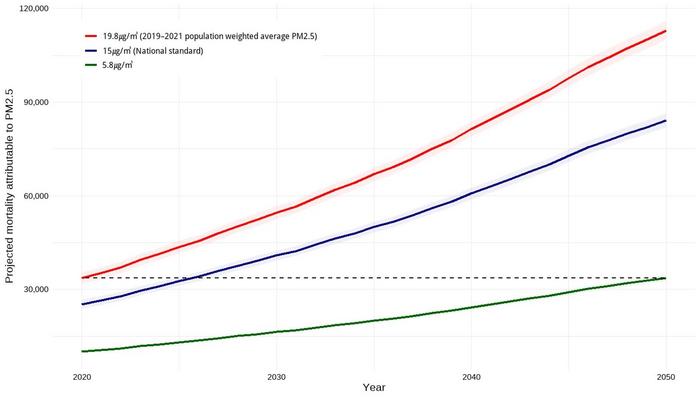
Based on these findings, the team constructed scenarios to forecast mortality attributable to PM2.5. Their analysis revealed that if concentrations of PM2.5 persist at the average level of 20 µg/m³ observed over the past three years, the projected number of deaths by 2050 could soar to approximately 110,000, more than tripling the 34,000 deaths in 2020. Even if PM2.5 concentrations were reduced to the Ministry of Environment’s annual standard of 15 µg/m³, an estimated 84,000 deaths would still occur by 2050.
Further investigation by the team concluded that reducing PM2.5 concentrations to approximately 6 µg/m³ would be necessary to maintain the mortality levels of 2020 by 2050. Despite an overall decline in population, the proportion of older individuals, who are particularly susceptible to PM2.5, is expanding rapidly. Consequently, in order to mitigate the death toll and public health burden, reductions in PM2.5 concentrations would need to significantly surpass current policy measures.
Professor Hyung Joo Lee of POSTECH remarked, “With rapidly aging populations, the number of people vulnerable to PM2.5-related health outcomes is increasing, and as a result, PM2.5 is posing a significant threat to public health.” He added, “To sustain the current PM2.5 health burdens by 2050, we must reduce PM2.5 concentrations to approximately 40% of the annual standard.” He emphasized, “Though achieving these reductions may prove challenging in the short term, it’s crucial to urgently ramp up efforts to combat PM2.5 with more stringent regulatory actions than are currently in practice.”
The research was conducted with the support from the Ministry of Environment, the National Research Foundation of Korea, and the Ministry of Science and ICT.
Journal
Environmental Research
Article Title
Ambient PM2.5 exposure and rapid population aging: A double threat to public health in the Republic of Korea
Article Publication Date
2-May-2024
Cite Scienmag News
Beatrice Stafford. (June 18, 2024). Study forecasts 110,000 premature deaths by 2050 due to PM2.5 and aging. Scienmag. https://scienmag.com/study-forecasts-110000-premature-deaths-by-2050-due-to-pm2-5-and-aging/
Beatrice Stafford. "Study forecasts 110,000 premature deaths by 2050 due to PM2.5 and aging." Scienmag, 18 June 2024, https://scienmag.com/study-forecasts-110000-premature-deaths-by-2050-due-to-pm2-5-and-aging/. Accessed 4 September 2026.
Beatrice Stafford. "Study forecasts 110,000 premature deaths by 2050 due to PM2.5 and aging." Scienmag. June 18, 2024. https://scienmag.com/study-forecasts-110000-premature-deaths-by-2050-due-to-pm2-5-and-aging/

