

Tuesday, July 14, 2026
Science
No Result
View All Result
  • Login
  • HOME
  • SCIENCE NEWS
  • CONTACT US
  • HOME
  • SCIENCE NEWS
  • CONTACT US
No Result
View All Result
Scienmag
No Result
View All Result
Home Science News Technology and Engineering

Study finds most pregnant people fail recommended seatbelt placement, despite safety need

July 14, 2026
in Technology and Engineering
Reading Time: 2 mins read
0
Study finds most pregnant people fail recommended seatbelt placement, despite safety need

Study finds most pregnant people fail recommended seatbelt placement, despite safety need

65
SHARES
587
VIEWS
Share on FacebookShare on Twitter
ADVERTISEMENT

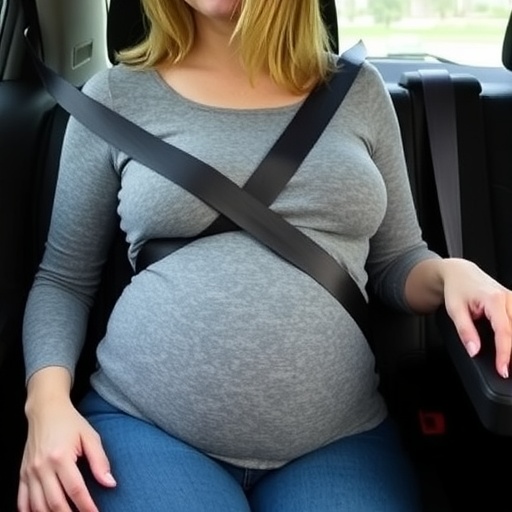
Pregnancy reshapes the biomechanics of everyday safety systems, and a new observational study from the University of British Columbia (UBC) suggests that conventional seatbelt geometry often fails to land where it should. Researchers found that nearly 9 in 10 pregnant participants could not achieve recommended belt placement, even after they received instruction and hands-on guidance. Out of 333 participants, only 11.4% placed the belt according to guidelines.

Seatbelts are engineered to route crash forces through the body’s stronger skeletal framework. When the belt rides too high or shifts laterally, more fragile soft tissues and anatomy-altering regions may absorb greater loads, potentially raising injury risk during collisions. In the study, the most consistent challenge was the shoulder belt position rather than the lap belt.

Using a performance metric defined by national recommendations, the researchers evaluated whether the shoulder belt sat between the breasts and centered on the shoulder, while the lap belt remained below the abdomen and snug across the hips and pelvis. Most participants succeeded with lap-belt placement, but few managed to keep the shoulder belt between the breasts as pregnancy advanced.

As abdominal volume increases, the belt’s contact points can migrate. The study observed that the shoulder belt frequently shifts off the chest center and can ride across the breast region instead of maintaining the intended path. This matters because restraint effectiveness depends on the belt’s trajectory relative to the occupant’s changing anatomy.

The research also identified “nesting,” a failure mode in which the lap belt folds into softer tissue beneath the abdomen rather than lying flat. Nearly one-third of participants experienced nesting, and its frequency rose with gestational stage, indicating that belt fit is not static throughout pregnancy.

To capture these dynamic fit problems, the team scanned participants using handheld 3D imaging tools while they sat in a production vehicle seat equipped with a standard belt configuration. Participants ranged from 6 to 38 weeks pregnant and represented a variety of body types, improving the study’s relevance to real-world diversity.

UBC researchers argue that these findings highlight a broader gap in vehicle safety research: human body models used for restraint design have historically underrepresented female and especially pregnant anatomy. The study therefore points toward the need for restraint systems that can accommodate anatomy changes rather than assuming a single static body shape.

Rather than questioning the importance of seatbelt use, the authors emphasize that correct use remains life-saving. Seatbelts reduce the risk of death and serious injury in crashes, and guidance should be strengthened by better engineering and usability evidence.

The work is a collaboration between UBC and the Toyota Collaborative Safety Research Center, and the team is now partnering with Autoliv to build computational models of pregnant anatomy and test future restraint concepts virtually. The findings were presented at the 10th World Congress of Biomechanics in Vancouver.

Subject of Research: People
Article Title: Pregnancy alters seatbelt fit; most participants fail recommended placement in study
Web References: https://www.nhtsa.gov/vehicle-safety/seat-belts
References: https://tc.canada.ca/en/road-transportation/publications/archived/road-safety-canada#s31
Image Credits: Emma Fennell/UBC Applied Science

Keywords

Biomechanics; Automobile design; Automotive engineering; Seatbelt fit; Pregnancy safety; 3D body scanning; Restraint systems; Crash safety; Human factors

Tags: biomechanics of safety systems in pregnancycrash injury risk pregnant womeneffects of abdominal growth on seatbelt fitimpact of pregnancy on seatbelt fitinjury prevention for pregnant vehicle occupantslap belt placement in pregnancyobservational study on pregnant seatbelt usePregnancy seatbelt safetyproper seatbelt positioning during pregnancysafety guidelines for pregnant driversseatbelt placement during pregnancyshoulder belt positioning challenges
Share26Tweet16
Previous Post

Sustained virtual smoking cessation doubles quit rates for cancer patients

Next Post

Single-Crystal Monolayer Graphene Synthesized on Cu/Ni(111) Alloy Foil

Related Posts

RASopathy Subtype Shapes Early Hypertrophic Cardiomyopathy Course, Study Finds
Technology and Engineering

RASopathy Subtype Shapes Early Hypertrophic Cardiomyopathy Course, Study Finds

July 14, 2026
UniFFBench Benchmarks Universal Machine Learning Force Fields Using Experimental Data
Technology and Engineering

UniFFBench Benchmarks Universal Machine Learning Force Fields Using Experimental Data

July 14, 2026
Special Supplemental Nutrition Program and Cerebral Palsy Risk
Technology and Engineering

Special Supplemental Nutrition Program and Cerebral Palsy Risk

July 14, 2026
KTU Researchers Develop AI System to Forecast Solar Power From Cloud Data
Technology and Engineering

KTU Researchers Develop AI System to Forecast Solar Power From Cloud Data

July 14, 2026
SwRI and SMU to Create AI Controller for Multi-Modal Microgrids, Storage
Technology and Engineering

SwRI and SMU to Create AI Controller for Multi-Modal Microgrids, Storage

July 14, 2026
JMIR News: CMR-CLIP, Stroke Rehab Simulators, and Menopause Tracking Apps
Technology and Engineering

JMIR News: CMR-CLIP, Stroke Rehab Simulators, and Menopause Tracking Apps

July 14, 2026
Next Post
Single-Crystal Monolayer Graphene Synthesized on Cu/Ni(111) Alloy Foil

Single-Crystal Monolayer Graphene Synthesized on Cu/Ni(111) Alloy Foil

  • Mothers who receive childcare support from maternal grandparents show more

    Mothers who receive childcare support from maternal grandparents show more parental warmth, finds NTU Singapore study

    27656 shares
    Share 11059 Tweet 6912
  • University of Seville Breaks 120-Year-Old Mystery, Revises a Key Einstein Concept

    1061 shares
    Share 424 Tweet 265
  • Bee body mass, pathogens and local climate influence heat tolerance

    682 shares
    Share 273 Tweet 171
  • Researchers record first-ever images and data of a shark experiencing a boat strike

    546 shares
    Share 218 Tweet 137
  • Groundbreaking Clinical Trial Reveals Lubiprostone Enhances Kidney Function

    531 shares
    Share 212 Tweet 133
Science

Embark on a thrilling journey of discovery with Scienmag.com—your ultimate source for cutting-edge breakthroughs. Immerse yourself in a world where curiosity knows no limits and tomorrow’s possibilities become today’s reality!

RECENT NEWS

  • Depression Linked to Hippocampal Subfield Volume Changes in Older Adults
  • Age-Specific Molecular Subgroups in Pediatric and Young-Onset Meningiomas Require Tailored Risk Models
  • RASopathy Subtype Shapes Early Hypertrophic Cardiomyopathy Course, Study Finds
  • Informal Dementia Caregivers as Hidden Second Patients: Stress, Resilience, Burden

Categories

  • Agriculture
  • Anthropology
  • Archaeology
  • Athmospheric
  • Biology
  • Biotechnology
  • Blog
  • Bussines
  • Cancer
  • Chemistry
  • Climate
  • Earth Science
  • Editorial Policy
  • Marine
  • Mathematics
  • Medicine
  • Pediatry
  • Policy
  • Psychology & Psychiatry
  • Science Education
  • Social Science
  • Space
  • Technology and Engineering

Subscribe to Blog via Email

Enter your email address to subscribe to this blog and receive notifications of new posts by email.

Join 5,146 other subscribers

© 2025 Scienmag - Science Magazine

Welcome Back!

Login to your account below

Forgotten Password?

Retrieve your password

Please enter your username or email address to reset your password.

Log In
No Result
View All Result
  • HOME
  • SCIENCE NEWS
  • CONTACT US

© 2025 Scienmag - Science Magazine

Discover more from Science

Subscribe now to keep reading and get access to the full archive.

Continue reading
