



image:
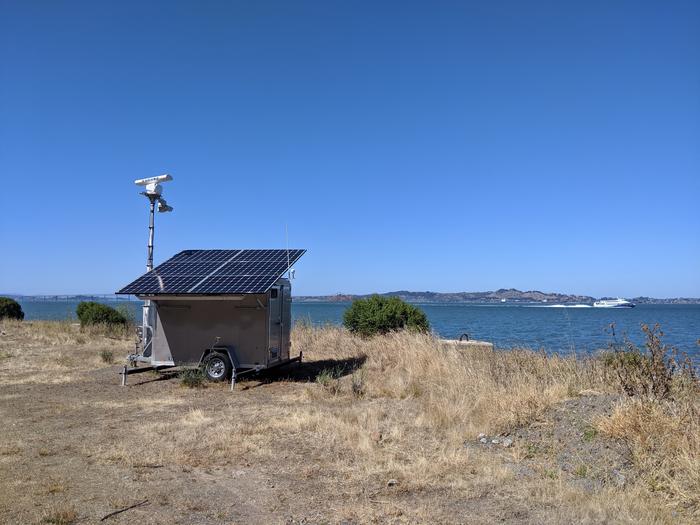
Marine Monitor Shore-Based Radar System
view more
Credit: ProtectedSeas
A new study by researchers at ProtectedSeas highlights the potential of marine radar technology to monitor speed of small vessels. The research, aimed at testing the accuracy of radar in assessing potential violations, found that the technology could detect speed violations with 95% confidence, offering a promising solution to help reduce the threat of vessel strikes on whale populations. The analysis was recently published in the journal Sensors.
The impact of small vessels on whales is becoming a growing concern in busy marine environments due to the increasing number of recreational and commercial boats in these areas. A 2020 study led by the ProtectedSeas team found that smaller boats can represent 34% of traffic in busy ports like San Francisco Bay. Unlike large commercial vessels, which are often monitored using the Automatic Identification System (AIS), smaller boats tend to go undetected, making it harder to enforce speed limits and prevent strikes, especially in areas where whales are feeding or migrating.
“Radar is a widely available tool that is accessible to a large audience, such as enforcement agencies, marine resource managers, and researchers,” said the study’s lead author Samantha King, senior scientist for ProtectedSeas Marine Monitor (M2). The accuracy values from our study can be used to confidently enforce speed limits using radar.”
The research team conducted the large-scale study comparing radar and AIS data from the M2 system across 3,097 vessel tracks at ten locations to estimate the accuracy of radar-reported vessel speeds.
The analysis found a strong correlation between radar and AIS speeds, with vessels traveling within 1.8 knots of radar-reported speeds to AIS values with 95% confidence. Understanding radar speed accuracy enables reliable reporting and analysis, supporting effective design, monitoring, and enforcement of vessel speed limit measures.
According to the researchers, radar technologies like M2 can effectively monitor speed limits to help reduce vessel collisions with endangered whales, particularly in areas like the North Atlantic right whale seasonal management areas along the U.S. East Coast, where fewer than 370 individuals remain.
“This study confirms that marine radar, similar to road speed monitors, can be used to track the speeds of smaller vessels that are not equipped with AIS,” said M2 Co-founder Brendan Tougher, a coauthor of the study. “Marine radar technology can be an effective tool to monitor and enforce speed limits for smaller vessels to better protect whale populations.”
# # #
ProtectedSeas’ Marine Monitor (M2) is a shore-based vessel monitoring platform designed to document a variety of activities in the nearshore marine environment by utilizing a marine radar to detect and track vessels and a pan-tilt-zoom camera for capturing images.The M2 system operates fully autonomously, ensuring uninterrupted, year-round data collection of vessels ranging from commercial shipping to recreational boats. Its robust and self-sufficient design allows deployment in remote and rugged areas. Learn more at:
Journal
Sensors
Method of Research
Data/statistical analysis
Subject of Research
Not applicable
Article Title
Estimating Speed Error of Commercial Radar Tracking to Inform Whale–Ship Strike Mitigation Efforts
Article Publication Date
8-Mar-2025
COI Statement
The authors declare no conflicts of interest.
Media Contact
Annie Reisewitz
Mar Communications
annie@marcom.llc
Office: 858-228-0526
Journal
Sensors
Method of Research
Data/statistical analysis
Subject of Research
Not applicable
Article Title
Estimating Speed Error of Commercial Radar Tracking to Inform Whale–Ship Strike Mitigation Efforts
Article Publication Date
8-Mar-2025
COI Statement
The authors declare no conflicts of interest.
Keywords
Cite Scienmag News
Margaret Porter. (April 16, 2025). Study Finds Marine Radar Accurately Tracks Vessel Speeds to Protect Whales. Scienmag. https://scienmag.com/study-finds-marine-radar-accurately-tracks-vessel-speeds-to-protect-whales/
Margaret Porter. "Study Finds Marine Radar Accurately Tracks Vessel Speeds to Protect Whales." Scienmag, 16 April 2025, https://scienmag.com/study-finds-marine-radar-accurately-tracks-vessel-speeds-to-protect-whales/. Accessed 3 September 2026.
Margaret Porter. "Study Finds Marine Radar Accurately Tracks Vessel Speeds to Protect Whales." Scienmag. April 16, 2025. https://scienmag.com/study-finds-marine-radar-accurately-tracks-vessel-speeds-to-protect-whales/

