


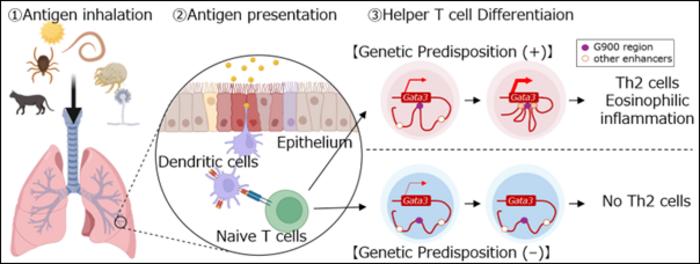
Asthma patients experience respiratory distress due to allergens like house dust mites or pollen. However, the various triggers for asthma share a common pathway involving the release of proteins called type-2 cytokines by Type-2 helper T (Th2) cells and group-2 innate lymphoid cells (ILC2s). Both Th2 and ILC2 require high amounts of GATA-binding protein 3 (GATA3) for their maturation.

Credit: Arifumi Iwata from Chiba University
Asthma patients experience respiratory distress due to allergens like house dust mites or pollen. However, the various triggers for asthma share a common pathway involving the release of proteins called type-2 cytokines by Type-2 helper T (Th2) cells and group-2 innate lymphoid cells (ILC2s). Both Th2 and ILC2 require high amounts of GATA-binding protein 3 (GATA3) for their maturation.
Specific gene sequences called enhancers are responsible for elevating the expression of GATA3 genes in humans. Studies have found that by controlling the production of GATA3, enhancers influence the development of Th2 and ILC2. The gene region G900, located close to the GATA3 gene, is currently being investigated for its role in the asthma inflammation pathway. In a recent breakthrough, a study by researchers from Chiba University that was published in Proceedings of the National Academy of Sciences, USA on June 24, 2024, has discovered that the mouse gene region corresponding to the human G900 is involved in Th2 differentiation and consequently in enhancing allergic responses, although not ILC2.
“Multiple genome-wide association studies (GWAS) have aimed to elucidate the underlying biology and predict susceptibility to asthma. The importance of single nucleotide polymorphisms (SNPs) within the 10p14 locus has been indicated in several independent studies, not only in asthma susceptibility but also in a broad spectrum of allergic diseases, including allergic rhinitis, atopic dermatitis, and eosinophilic granulomatosis with polyangiitis”, explains Professor Hiroshi Nakajima of Chiba University, the lead researcher in the study.
To investigate the role of G900 in asthma-associated inflammatory pathways, researchers including Arifumi Iwata, Takashi Kumagai, and Hiroki Furuya of the Graduate School of Medicine at Chiba University, among others, developed mice that lacked the G900 region in their genome. These mG900 “knockout mice” were subsequently exposed to allergens such as papain and house dust mites. Researchers discovered that mG900 knockout mice produce reduced inflammatory response compared to control mice with intact mG900 when exposed to house dust mites. Further, they also found suppression of Th2 differentiation in mG900 knockout mice compared to control mice.
“One aspect we elucidate in our study is the role of the murine G900 region in Th2 differentiation and allergic airway inflammation”, Prof. Nakajima explains. “This region, homologous to the human G900 region associated with asthma, is shown to be essential for in vivo Th2 cell differentiation and allergic responses, particularly in the context of house dust mite (HDM)-induced allergic airway inflammation. Furthermore, we have demonstrated that this G900 region is crucial for optimizing the three-dimensional chromatin structure near GATA3 in Th2 cells”, he further states.
The study’s findings have wide-ranging implications for asthma care as well as therapeutic interventions for other allergic diseases. In the future, methods of regulating Th2 differentiation and function by pharmacologically restricting GATA3 enhancers like G900 may help reduce exaggerated immune responses underlying allergic reactions.
“By identifying and understanding critical genetic regions that regulate immune responses, such as the mG900 region, it may be possible to develop precision medicine approaches tailored to individual genetic profiles. This could lead to more effective and personalized treatments, reducing the incidence and severity of allergic reactions and improving the quality of life for individuals suffering from these conditions”, Prof. Nakajima concludes.
About Professor Hiroshi Nakajima of Chiba University
Hiroshi Nakajima is currently a Professor at the Chiba University’s Graduate School of Medicine. Prof. Nakajima has published nearly 250 scientific articles on the molecular underpinnings of refractory allergic or autoimmune diseases. His research bridges basic research and clinical medicine by helping expedite the development of new medicines for allergies and autoimmune diseases.
Journal
Proceedings of the National Academy of Sciences
Method of Research
Experimental study
Subject of Research
Animals
Article Title
A distal enhancer of GATA3 regulates Th2 differentiation and allergic inflammation
Article Publication Date
24-Jun-2024
COI Statement
The authors declare no competing interests.
Cite Scienmag News
Juliet Wilcox. (June 24, 2024). Study elucidates role of “G900” gene enhancers in asthma-associated inflammation. Scienmag. https://scienmag.com/study-elucidates-role-of-g900-gene-enhancers-in-asthma-associated-inflammation/
Juliet Wilcox. "Study elucidates role of “G900” gene enhancers in asthma-associated inflammation." Scienmag, 24 June 2024, https://scienmag.com/study-elucidates-role-of-g900-gene-enhancers-in-asthma-associated-inflammation/. Accessed 6 September 2026.
Juliet Wilcox. "Study elucidates role of “G900” gene enhancers in asthma-associated inflammation." Scienmag. June 24, 2024. https://scienmag.com/study-elucidates-role-of-g900-gene-enhancers-in-asthma-associated-inflammation/

