


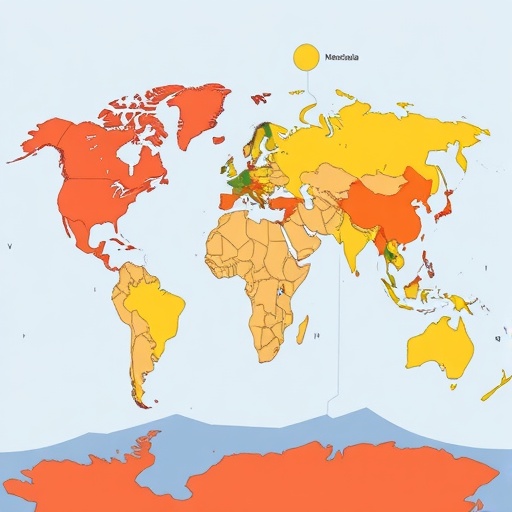
Climate change is often framed as a crisis of rising seas and melting ice, but its most intimate casualty is the human body. A sweeping new systematic scoping review published in the journal Environmental Health has assembled, for the first time on this scale, a global map of the disease burden attributable to climate-sensitive exposures—extreme heat, temperature variability, extreme weather events, and air pollution. Drawing on 199 studies spanning 157 countries, the analysis concludes that heat exposure alone accounts for roughly 1.18 percent of all-cause mortality worldwide, equivalent to approximately 800,000 deaths every year, and that the true toll is likely far higher in the regions least equipped to measure it.
The review, led by Julia Feriato Corvetto and Robin Simion of the Heidelberg Institute of Global Health at Heidelberg University, together with Perla Boutros, Nour Kassem, Kristine Belesova, Till Bärnighausen, Rainer Sauerborn and senior author Sandra Barteit, was conducted according to the PRISMA-ScR reporting guidelines and pre-registered with the international PROSPERO registry. The team searched four major databases—PubMed, Embase, Web of Science and Scopus—for peer-reviewed studies published up to November 26, 2024. From 15,538 records initially identified, 12,291 were screened by title and abstract, 545 underwent full-text review, and after rigorous eligibility checks, 199 studies remained. Each was charted by exposure type, health outcome, study design and geographic region, with the attributable fraction serving as the standardized metric that allowed otherwise heterogeneous research to be compared on common ground.
The attributable fraction, or AF, expresses the proportion of health outcomes—deaths, hospital admissions, emergency department visits—that can be linked to a specific exposure. Unlike composite metrics such as disability-adjusted life years, which demand granular data on disease severity and duration, the AF requires fewer inputs and can be calculated from established exposure–response relationships, making it particularly valuable in data-constrained settings. The Heidelberg team used it deliberately as a common currency. Where the evidence base allowed, they went further, performing selective random-effects meta-analyses using DerSimonian-Laird models with logit-transformed estimates and inverse-variance weighting, pooling results only for heat-related mortality outcomes that were methodologically comparable.
The pooled figures are sobering. Across 16 eligible studies, heat exposure accounted for 1.18 percent of all-cause mortality, with a 95 percent confidence interval of 1.01 to 1.37 percent. For cardiovascular mortality, ten studies yielded a pooled attributable fraction of 2.15 percent; for respiratory mortality, five studies produced 3.08 percent; and for stroke mortality, five studies gave 2.71 percent. In practical terms, this means that more than one in every fifty cardiovascular deaths in the studied populations was linked to heat. The researchers caution, however, that heterogeneity across studies was extreme—I² statistics reached 100 percent in every pooled analysis—reflecting differences in exposure thresholds, temperature metrics, population vulnerability and statistical modeling. The pooled values, they stress, should be read as indicative central tendencies rather than precise, universally applicable effect sizes.
Beyond the meta-analysis, the descriptive synthesis revealed a startling breadth of climate-sensitive health impacts. Fifteen distinct disease categories emerged from the International Classification of Diseases framework, including respiratory conditions, cardiovascular disease, infectious diseases, neoplasms, endocrine and metabolic disorders, mental and behavioral disorders, neurological conditions, digestive diseases, kidney and genitourinary conditions, and pregnancy-related outcomes. Heat was associated with an attributable fraction of 3.17 percent for all-cause mortality in the broader synthesis and, strikingly, with nearly 10 percent of suicide mortality in single-country evidence. Temperature variability—the fluctuation of temperatures between and within days—was linked to 5.57 percent of cardiovascular mortality and 3.28 percent of all-cause deaths. Ambient air pollution showed associations with 5.57 percent of all-cause mortality and more than 9 percent of deaths from mental disorders including dementia, though with wide uncertainty intervals that reflect the challenge of separating climatic from industrial pollution sources.
Perhaps the most striking single estimate concerned extreme weather events and mental health: floods, storms and droughts were associated with an attributable fraction exceeding 20 percent for mortality from mental disorders. Drowning showed a similarly strong signal, with 11.40 percent of drowning deaths tied to extreme events. On the morbidity side, heat exposure accounted for 6.41 percent of genitourinary disease admissions, including acute kidney injury, and 9.65 percent of infectious disease morbidity, while temperature variability was linked to 8.59 percent of cardiovascular hospitalizations. Combined exposures—temperature and air pollution acting together—pushed attributable fractions as high as 16.65 percent in individual studies, underscoring the growing recognition that compound hazards may pose risks greater than the sum of their parts.
Yet the review’s most consequential finding may be what it reveals about the geography of knowledge itself. Of the 199 included studies, 116 were conducted in China alone, followed by Brazil with 24 and Spain with 20. The overwhelming majority came from high- and upper-middle-income countries, and the evidence base leaned heavily on administrative healthcare data—hospital and emergency department records—rather than population-based surveys. Only three studies relied on nationally representative survey data. This means the evidence skews toward populations with reliable access to health systems, leaving the burden among marginalized communities, informal settlements and remote rural populations largely invisible. The authors identified acute evidence gaps for undernutrition, injuries, disabilities and non-fatal outcomes, particularly across sub-Saharan Africa, South and Southeast Asia, and Latin America.
The team was careful to distinguish between evidence density and true burden. The dominance of heat-related cardiovascular and respiratory outcomes in the literature, they note, reflects where researchers have concentrated their effort—not necessarily where the greatest health toll lies. Studies of extreme weather events remain relatively rare, and methodological inconsistency compounds the problem: the review catalogued twelve distinct definitions of heat exposure in use across the field, from mean temperature above the minimum mortality temperature to percentile-based thresholds, heatwave duration criteria, wet-bulb globe temperature and the excess heat factor. Counterfactual definitions—what counts as the “baseline” against which excess deaths are measured—vary just as widely, making direct comparison across studies treacherous.
The review builds on and extends earlier syntheses. Cheng and colleagues’ 2019 global review had estimated that more than 2.5 percent of deaths in high-income countries and over 3 percent in middle-income countries were attributable to non-optimal temperatures, but it excluded air pollution and extreme weather events and aggregated findings by country income level. The Wellcome Trust’s 2024 assessment of formal attribution science screened nearly 4,000 studies and found only 13 rigorous enough to attribute health outcomes specifically to anthropogenic climate change, most focused narrowly on heat mortality. The new review captures the post-2018 surge in the literature—197 of its 199 studies were published since that year—and covers 15 disease subgroups across exposures far beyond temperature alone. Notably, the years 2023 and 2024 show marked acceleration, with emerging representation from climate-vulnerable regions, largely driven by multi-country study designs.
The findings carry direct implications for international climate policy. Burden estimates of this kind are increasingly relevant to the “loss and damage” fund formalized at COP28, which aims to compensate vulnerable countries for climate impacts, and to the economic accounting frameworks that trace back to the Stern Review’s conclusion that health damages constitute a significant share of climate change costs. The authors argue that attributable-fraction-based indicators should be integrated into National Adaptation Plans, heat–health action plans and public health preparedness strategies, and they call on the World Health Organization and multilateral agencies to develop harmonized exposure definitions and reporting conventions aligned with the Global Burden of Disease framework and IPCC assessment processes.
On the research side, the review advocates sustained investment in longitudinal, population-based surveillance platforms, including Health and Demographic Surveillance Systems and emerging climate-health infrastructures such as the Climate Change and Health Evaluation and Response System, particularly in low- and middle-income countries. Expanding data sources beyond hospital records, the authors argue, is essential to capture non-fatal outcomes and marginalized populations that administrative datasets systematically miss. They also propose a three-axis research prioritization framework spanning geographic vulnerability, exposure complexity and underrepresented outcome domains—mental health, renal disease, infectious disease and occupational outcomes chief among them.
The authors acknowledge limitations: the very high heterogeneity that constrains generalization, the reliance on healthcare utilization data that likely underestimates burden in low-access settings, the exclusion of cold-related attributable fractions on the grounds that cold extremes are declining under warming trends, and the inherent difficulty of isolating the anthropogenic climate signal from natural variability in the observed exposure–response relationships. Ambient air pollution’s dual nature—partially climate-sensitive through meteorology but largely driven by industrial and transport sources—was handled with explicit caution.
Even with these caveats, the review delivers an empirical foundation that attribution science has lacked. It demonstrates that climate-sensitive exposures are not a distant or hypothetical threat but a quantifiable, present-day driver of death and disease across cardiovascular, respiratory, renal, infectious and mental health domains. As heatwaves intensify, floods lengthen and temperature swings widen, the population-level burden will grow even if individual risks remain constant—unless, as the authors insist, surveillance systems, methodological standards and adaptation financing catch up with the scale of the hazard. Quantifying the damage, they argue, is the first step toward making the world’s response to climate change’s health toll both evidence-based and equitable.
Cite Scienmag News
Tiffany Hanley. (September 5, 2026). Global health burden of climate-sensitive exposures: a scoping review. Scienmag. https://scienmag.com/global-health-burden-of-climate-sensitive-exposures-a-scoping-review/
Tiffany Hanley. "Global health burden of climate-sensitive exposures: a scoping review." Scienmag, 5 September 2026, https://scienmag.com/global-health-burden-of-climate-sensitive-exposures-a-scoping-review/. Accessed 5 September 2026.
Tiffany Hanley. "Global health burden of climate-sensitive exposures: a scoping review." Scienmag. September 5, 2026. https://scienmag.com/global-health-burden-of-climate-sensitive-exposures-a-scoping-review/


