


A two-semester action-research study at an urban primary school in eastern China has produced and refined a school-based evaluation framework for education for sustainable development (ESD) that weaves together three previously separate resources: Stufflebeam’s Context-Input-Process-Product (CIPP) evaluation model, the European Commission’s GreenComp sustainability competence framework, and iterative cycles of planning, action, observation, and reflection. The resulting matrix contains 15 indicators that link contextual needs, educational inputs, implementation processes, and learner outcomes to designated evaluators and specific evidence sources. When 86 pupils in Grades 5 and 6 took part in ESD-oriented comprehensive practical activities evaluated under this framework, they showed significant immediate gains in environmental knowledge, ecological affect, green behavioural intention, cooperation, and overall sustainability literacy and disposition scores, with standardized within-person effect sizes ranging from 0.85 to 1.14 (ps < .001). Scores at an eight-week follow-up remained above baseline but declined relative to immediate post-test levels. The study, published in Frontiers in Education, was led by Ying Wu of Hebei University and Depeng Zhang of Jiangxi Normal University.
The problem the study tackles is a widening gap between what international policy asks of sustainability education and what schools can actually evaluate. SDG 4.7 calls on learners to acquire knowledge and skills for promoting sustainable development, the Berlin Declaration urges integrating sustainability into curricula, pedagogy, assessment, and institutional practices, and GreenComp organizes 12 competences into four areas: embodying sustainability values, embracing complexity in sustainability, envisioning sustainable futures, and acting for sustainability. Together these frameworks imply that ESD cannot be judged by factual recall alone; assessment must also capture values, inquiry, collaboration, initiative, and action. Yet a recent systematic review found uneven coverage of sustainability competences in primary-school research, with systems thinking and collaboration receiving more attention than futures thinking, and assessment practice still leaning heavily on questionnaires and terminal measurements. Measurement tools for different age groups are multiplying, but tools alone cannot tell a school whether local goals are relevant, whether enabling conditions are sufficient, or whether learning transfers beyond a single assessment.
The challenge is especially sharp in China, where the national curriculum positions comprehensive practical activities as a compulsory, project-based, interdisciplinary component while leaving considerable implementation and evaluation autonomy to individual schools. That autonomy creates a dilemma: schools must determine not only what students learned but whether activities were feasible, participation equitable, and learning transferable. The research team treated school-based ESD evaluation as an organizational and pedagogical design task rather than the development of another stand-alone test. CIPP supplies the decision architecture: Context evaluation identifies needs, priorities, and local assets; Input evaluation examines strategies, resources, readiness, and feasibility; Process evaluation monitors enactment and provides formative feedback; Product evaluation considers intended and unintended outcomes. GreenComp supplies the substantive competence language. The frameworks were deliberately not mapped one-to-one; each indicator was first located in the CIPP domain corresponding to the decision it should inform, then assigned a primary GreenComp area according to the dominant competence expressed in the observable evidence. The operational sequence ran from competence concern through decision domain, indicator, evidence, evaluator, and tool to interpretation.
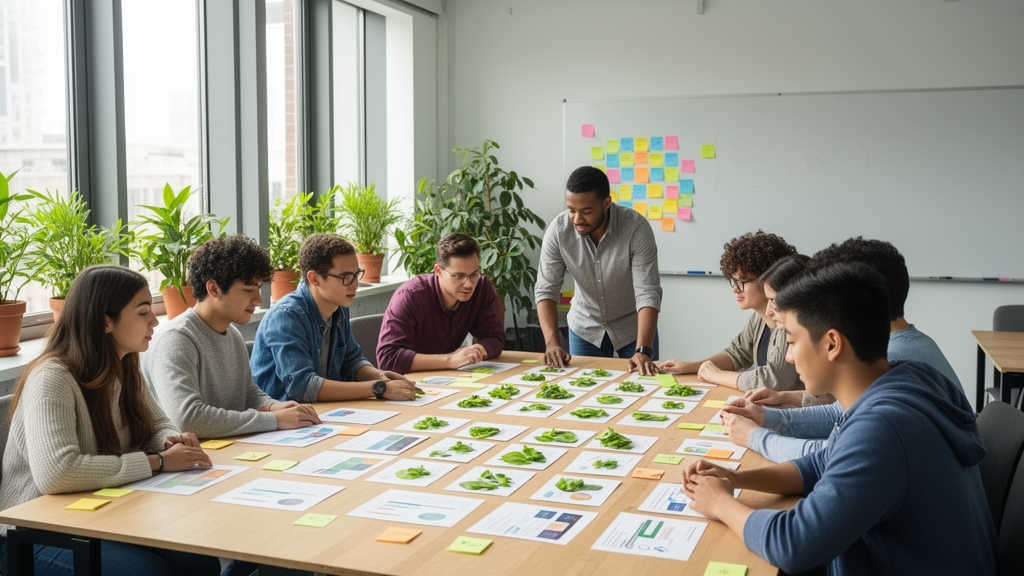
The empirical work unfolded at a single urban primary school, referred to as School H, over two consecutive semesters from September 2024 to April 2025, in three action-research cycles of six, five, and five weeks, comprising 12, 10, and 10 activities respectively. Participants included 86 pupils aged 10 to 11 (45 boys, 41 girls), 12 class and subject teachers acting as co-designers and evaluators, approximately 60 parents providing family behaviour ratings, 18 of whom also gave semi-structured interviews, and two educators from a regional ecological organization who helped draw the resource map and appraise student products. At the end of each cycle, a 90-minute structured reflection meeting reviewed evidence, discussed implementation tensions, and reached consensus decisions recorded in an audit trail. Student outcomes were measured with a locally developed 24-item Sustainability Literacy and Disposition Test covering environmental knowledge, ecological affect, green behavioural intention, and cooperation, administered at baseline, immediately after the intervention, and eight weeks later. Piloted with 30 pupils outside the analytic sample, the instrument showed a preliminary Cronbach’s alpha of .84, and an exploratory factor analysis yielded a four-factor solution broadly matching the intended dimensions.
The 15-indicator matrix is the framework’s technical core. Context indicators cover goal appropriateness, needs diagnosis, and resource relevance; Input indicators examine teacher readiness, material provision, and plan feasibility; Process indicators capture participation depth, collaboration quality, inquiry ability, and ecological ethics; Product indicators address knowledge mastery, innovation, social responsibility, behavioural intention and action, and an integrated sustainability profile. Each indicator specifies an observation focus, a primary GreenComp area, the evaluators best positioned to judge it, and an evidence source or tool. Evaluator-evidence matching was deliberate: parents could observe home behaviour teachers could not; peers contributed evidence about collaboration; community educators appraised the authenticity and feasibility of environmental proposals; and the research team supported context and input diagnosis. The framework’s function is not to generate a single terminal score but to operate an evidence-to-decision loop: evidence is collected for an indicator, interpreted against its CIPP decision function, discussed by relevant stakeholders, and used where warranted to adjust subsequent planning. Product findings can feed into the next Context diagnosis, preventing evaluation from collapsing into an end-of-unit judgment.
Because the framework itself was under development, its operational procedures were refined across the three cycles while the four CIPP domains and 15-indicator architecture remained stable. Cycle 1 exposed two Input-related problems: pupils had uneven access to the wetland and community learning site, and teachers were recording overlapping information in multiple places. The team introduced staggered site access, a shared digital template, and clearer allocation of evaluator responsibilities, deciding that access and recording burden should be treated as programme conditions rather than pupil deficits. Cycle 2 revealed declining participation during lengthy task sequences and uncertainty about peer-assessment criteria; task cycles were shortened, group accountability was made explicit, and an illustrated peer rubric was introduced, reducing dependence on teacher-only judgment. Cycle 3 showed that behavioural-intention self-reports required corroboration and that emergent pupil initiatives were not fully captured by predetermined scoring procedures; self-report was therefore triangulated with parent interviews and observed products, and space was retained for unprompted outcomes. These revisions generated identifiable changes in access planning, recording routines, task design, peer assessment, and interpretation of behavioural evidence, though teacher workload remained an unresolved constraint.
The quantitative strand documented substantial within-person change. Paired-samples t tests showed all pre-post comparisons significant at p < .001. The largest standardized change appeared for the total score (dz = 1.14), followed by green behavioural intention (dz = 1.09), environmental knowledge (dz = 1.00), cooperation (dz = 0.93), and ecological affect (dz = 0.85), with 95% confidence intervals excluding zero in every domain. Mean environmental knowledge rose from 2.45 to 3.38, ecological affect from 2.78 to 3.52, green behavioural intention from 2.32 to 3.45, cooperation from 2.89 to 3.61, and the total score from 2.61 to 3.49. Of the 86 pupils who completed pre- and post-tests, 84 completed the delayed assessment; two were absent due to illness. Delayed means, such as 3.21 for environmental knowledge and 3.35 for the total score, remained below immediate post-test levels but above baseline descriptively, a pattern consistent with partial persistence. The authors stress that without a comparison group, maturation, repeated testing, historical events, teacher expectancy, and concurrent school experiences remain plausible alternative explanations, so these figures document change during the study period rather than causal treatment effects.
Qualitative analysis of 127 initial codes from 42 source documents, refined through member checking with participating teachers and negative-case analysis, produced three themes. The first concerned expanding pupil agency: early learning logs were dominated by teacher-supplied questions, whereas later logs contained more pupil-generated questions and exhibitions displayed a broader range of proposed solutions. The second concerned the school-home boundary: 78% of participating families reported at least one noticeable change in environmentally friendly behaviour, such as more consistent waste sorting and reduced reliance on single-use plastics, though these parent reports were treated descriptively because of potential social desirability. The third theme concerned the cost of multi-agent assessment: teachers valued multiple perspectives but reported repetitive documentation and coordination demands, particularly in Cycle 1; shared digital recording and clearer role allocation reduced but did not eliminate the burden. An illustrative case showed the framework’s logic in action: after presenting exhibition proposals, a group of pupils voluntarily set up a garbage classification corner on campus, which was recorded separately as emergent behaviour evidence and considered when interpreting behavioural intention indicators.
The authors position the contribution carefully. The framework’s primary value lies in supporting systematic, evidence-informed evaluation and local adaptation rather than establishing a universally validated assessment instrument. For Chinese primary education, it offers a way to make the autonomy of comprehensive practical activities more evaluable without imposing a single national examination, responding to evidence that Chinese teachers generally recognize ESD but face fragmented implementation and uneven support. Internationally, the framework should be regarded as a design solution rather than a standard: schools near wetlands, industrial areas, or rural settings would justify different indicators and weights, while CIPP retains a common sequence for relating needs, resources, implementation, and outcomes. Limitations are explicit: a single urban school, 86 pupils, no comparison group, a locally developed measure with only preliminary reliability evidence, self-report vulnerability, the researchers’ prior familiarity with the school, an eight-week follow-up that cannot establish long-term persistence, and usability evidence that was primarily qualitative. Future research should separate framework validity, measurement validity, and programme efficacy through multi-site implementation, confirmatory instrument validation, and stronger counterfactual designs, while testing whether the framework remains feasible as external researcher support decreases.
Subject of Research: School-based evaluation framework for education for sustainable development integrating CIPP, GreenComp, and action research in primary education
Article Title: Developing a school-based evaluation framework for education for sustainable development in primary school comprehensive practical activities: integrating CIPP, GreenComp, and action research
Article References: Wu, Y., & Zhang, D. (2026). Developing a school-based evaluation framework for education for sustainable development in primary school comprehensive practical activities: integrating CIPP, GreenComp, and action research. Frontiers in Education, 11, Article 1969607. https://doi.org/10.3389/feduc.2026.1969607
Image Credits: AI Generated
DOI: 10.3389/feduc.2026.1969607
Keywords: education for sustainable development, CIPP model, GreenComp, action research, primary education, school-based evaluation, sustainability competence, mixed methods, China, assessment, Developing, school-based
Cite Scienmag News
Sloane Callahan. (October 25, 2026). Study builds school sustainability evaluation framework from CIPP and GreenComp. Scienmag. https://scienmag.com/study-builds-school-sustainability-evaluation-framework-from-cipp-and-greencomp/
Sloane Callahan. "Study builds school sustainability evaluation framework from CIPP and GreenComp." Scienmag, 25 October 2026, https://scienmag.com/study-builds-school-sustainability-evaluation-framework-from-cipp-and-greencomp/. Accessed 25 October 2026.
Sloane Callahan. "Study builds school sustainability evaluation framework from CIPP and GreenComp." Scienmag. October 25, 2026. https://scienmag.com/study-builds-school-sustainability-evaluation-framework-from-cipp-and-greencomp/


