


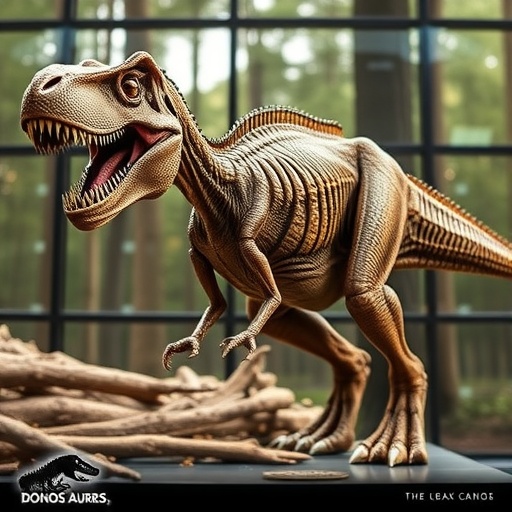
In the dimly lit confines of the paleobiology laboratory at Virginia Tech, Simba Srivastava—a senior majoring in geosciences—presented a fossil of striking peculiarity and profound significance. Though marred by the ravages of time, this lumpy and pockmarked specimen was anything but ordinary. Srivastava had devoted two years of meticulous research to unraveling its evolutionary narrative and deciphering its place in the ancient lineage of dinosaurs, culminating in a study published recently in the journal Papers in Palaeontology. His work sheds critical light on the evolutionary dynamics that scripted the dominance of dinosaurs throughout the Jurassic period.
The journey of this fragmented skull began decades ago, first unearthed in 1982 by a team from the Carnegie Museum of Natural History at Ghost Ranch, New Mexico—a site renowned for its rich Triassic deposits. Years later, Sterling Nesbitt and Michelle Stocker, two seasoned geobiologists at Virginia Tech, revisited this fossil tucked away in museum drawers. Recognizing its untapped potential, they involved Srivastava early in his academic career, providing him rare access to the entire process of paleontological research. Employing advanced computed tomography (CT) scanning technologies, Srivastava digitized the fossil, isolating and reconstructing it in three dimensions via 3D printing. This innovative approach allowed an unprecedented visual and analytical examination of the specimen’s elusive features.
The fossil represents a species of predatory dinosaur that predates the iconic Tyrannosaurus rex by more than threefold in geological time. Originating from the late Triassic period—a transformational epoch dated between approximately 252 and 201 million years ago—these early carnivores navigated a complex ecosystem where dinosaurs had yet to assume apex predatory status. Instead, they coexisted and competed alongside proto-crocodilians and early mammals, adapting to an ecological tapestry that only abruptly shifted following a catastrophic mass extinction event at the close of the Triassic.
This extinction event decimated formidable competitor species, dramatically reshaping terrestrial ecosystems and heralding the ascendancy of dinosaurs as dominant fauna in the Jurassic. Srivastava’s findings articulate this meteoric rise, illustrating how dinosaurs transitioned from peripheral inhabitants to the principal apex predators. Yet, critical to our understanding is the rarity of well-preserved end-Triassic fossils, which renders every discovery, including Srivastava’s, invaluable. His specimen stands uniquely alone as the only example found thus far with certain distinctive anatomical traits crucial to decoding evolutionary pathways.
The detailed morphology of the skull revealed a suite of intriguing characteristics: substantial, robust cheekbones coupled with an expanded braincase and a comparatively short, deep snout. These features, previously undocumented in early dinosaur fossils, point to rapid and continuous evolutionary experimentation during the Triassic-Jurassic transition. Such anatomical adaptations could have been key factors enabling survival and niche specialization in a changing environment, informing broader theories about dinosaur diversification and adaptive radiations following mass extinction bottlenecks.
In a twist of paleontological creativity, Srivastava named the species Ptychotherates bucculentus, capturing both its physical idiosyncrasies and evocative appearance—“folded hunter with full cheeks” in Latin. One paleo-artist’s whimsical characterization as a “murder muppet” underscores the fossil’s bizarre yet captivating morphology, marking it as a specimen that defies conventional dinosaur iconography. Beneath its unusual form lies a deeper narrative about the persistence and eventual demise of one of the earliest carnivorous dinosaur groups, the Herrerasauria.
Ptychotherates bucculentus emerges as one of the last representatives of Herrerasauria, a lineage long believed to have disappeared earlier. Occurring in the geological record shortly before the end-Triassic mass extinction, this finding challenges assumptions about the extinction’s impacts. It forces a reconsideration of the event as a more profound ecological reset—one that eliminated not only competing species but also some longstanding dinosaur branches. This insight revises evolutionary timelines, suggesting that certain dinosaur lineages lingered longer and were more vulnerable than formerly recognized.
The geographic context of the discovery adds another layer of significance. The American Southwest, the modern locale encompassing the specimen’s origins, may have served as a refuge or final bastion where herrerasaurians persisted when they vanished elsewhere. This insight refines our understanding of Triassic paleobiogeography and species survival strategies during periods of rapid environmental upheaval. The solitary presence of this fossil in these strata uniquely exemplifies this protracted survival and evolutionary experimentation within a localized setting.
Srivastava’s painstaking study elevates this modest fossil specimen to an emblematic status—it encapsulates not only the biological history of countless individuals spanning millions of years but also the intricate, often elusive puzzle of dinosaur origins and evolution. His work represents a bridge between raw paleontological data and the broader evolutionary stories that captivate both scientists and the public. Through his efforts, this once obscure skull now offers a vivid voice for the ancient ecosystems it once inhabited.
Moreover, the study exemplifies the power of integrating technological innovation, such as CT scanning and 3D printing, into traditional paleontology. These tools facilitate nondestructive analysis of fragile fossils, allowing scientists to gain new insights without compromising the specimens. This approach represents a paradigm shift in paleontological methods, enabling more comprehensive reconstructions and fostering collaborations between disciplines such as biology, geology, and computer science.
The scholarly collaboration also emphasizes the essential role of mentorship and early academic engagement in shaping future scientists. Srivastava’s experience highlights how immersive research opportunities for undergraduates can yield significant contributions to scientific knowledge. This inclusive approach not only accelerates individual development but also enhances the collective scientific endeavor by diversifying perspectives and encouraging innovative methodologies.
In conclusion, the unassuming and “uniquely sucky” fossil unearthed at Ghost Ranch breathes new life into our understanding of dinosaur evolution and extinction dynamics. Ptychotherates bucculentus stands as a testament to the resilience and complexity of early dinosaur taxa navigating a changing world. Srivastava’s research not only enriches the fossil record but also challenges and refines prevailing evolutionary models, underscoring the intricate interplay of survival, adaptation, and extinction that continues to shape life on Earth.
News Publication Date: (Not specified; article indicates “published today”)
Web References:
References:
- Srivastava, S., Nesbitt, S., Stocker, M., et al. (Year). [Exact citation not provided]
Cite Scienmag News
Gavin Prescott. (April 15, 2026). Student Discovers New Meat-Eating Dinosaur Species That Lived Three Times Earlier Than T. rex. Scienmag. https://scienmag.com/student-discovers-new-meat-eating-dinosaur-species-that-lived-three-times-earlier-than-t-rex/
Gavin Prescott. "Student Discovers New Meat-Eating Dinosaur Species That Lived Three Times Earlier Than T. rex." Scienmag, 15 April 2026, https://scienmag.com/student-discovers-new-meat-eating-dinosaur-species-that-lived-three-times-earlier-than-t-rex/. Accessed 4 September 2026.
Gavin Prescott. "Student Discovers New Meat-Eating Dinosaur Species That Lived Three Times Earlier Than T. rex." Scienmag. April 15, 2026. https://scienmag.com/student-discovers-new-meat-eating-dinosaur-species-that-lived-three-times-earlier-than-t-rex/


