

Sunday, July 26, 2026
Science
No Result
View All Result
  • Login
  • HOME
  • SCIENCE NEWS
  • CONTACT US
  • HOME
  • SCIENCE NEWS
  • CONTACT US
No Result
View All Result
Scienmag
No Result
View All Result
Home Science News Technology and Engineering

Structural inequality drives commuting rhythms between stationarity and mobility

July 26, 2026
in Technology and Engineering
Reading Time: 2 mins read
0
Structural inequality drives commuting rhythms between stationarity and mobility

Structural inequality drives commuting rhythms between stationarity and mobility

65
SHARES
587
VIEWS
Share on FacebookShare on Twitter
ADVERTISEMENT

A new study published in Nature Communications links inequality to how people move—and how they pause—across a typical day. By comparing mobility patterns with measures of structural disparity, researchers report that neighborhoods with stronger inequality produce distinct daily “rhythms” of stationarity and travel, reshaping when and how often residents change location.

Using large-scale location data alongside socioeconomic indicators, the team modeled mobility as more than simple average behavior. Instead of treating movement as a uniform response, they examined timing and regularity: when people remain in place for longer stretches and when they resume mobility. The results suggest that inequality influences not only how much movement occurs, but when it occurs within the 24-hour cycle.

Technically, the authors apply statistical decomposition of temporal patterns, separating regular daily components from irregular variation. This approach makes it possible to test whether inequality shifts the phase of daily activity—effectively moving peaks of mobility earlier or later—and whether it alters the amplitude, meaning how pronounced those peaks are.

The study also distinguishes stationarity from mobility by operationalizing “stays” as periods of reduced location change. In areas with higher structural inequality, these stationary intervals become more persistent and more synchronized with specific times of day. Meanwhile, mobility episodes appear compressed into narrower windows, implying a constrained schedule rather than flexible movement.

One key takeaway is that mobility is shaped by environment as much as by individual preference. Structural inequality can translate into differences in commute burdens, access to services, housing stability, and the availability of safe or affordable routes—factors that collectively create a tighter timing structure for daily movement.

To validate their claims, the researchers test robustness across model specifications and alternative inequality measures. They show that the daily rhythm effects persist, indicating that the relationship is not an artifact of a particular dataset processing choice.

The implications extend beyond mapping movement. If inequality modulates how people’s time is organized spatially, then interventions aimed at reducing disparities may also loosen mobility constraints, improving access to opportunities that depend on timing—such as education schedules, healthcare availability, and job shifts.

Finally, the work frames stationarity and mobility as coordinated behavioral outputs of social structure. In that view, daily rhythms are an observable signature of unequal systems, offering a measurable pathway for future public policy assessment.

The authors’ findings arrive with the urgency of a viral science headline: inequality may be “timing people’s lives,” turning everyday movement into a pattern written by structural forces rather than pure choice.

Subject of Research: Mobility and stationarity patterns across the daily rhythm in relation to structural inequality.

Article Title: Structural inequality shapes the daily rhythm of stationarity and mobility.

Article References: Tian, Z., Zhang, C., Li, W. et al. Structural inequality shapes the daily rhythm of stationarity and mobility. Nat Commun (2026). https://doi.org/10.1038/s41467-026-75778-z

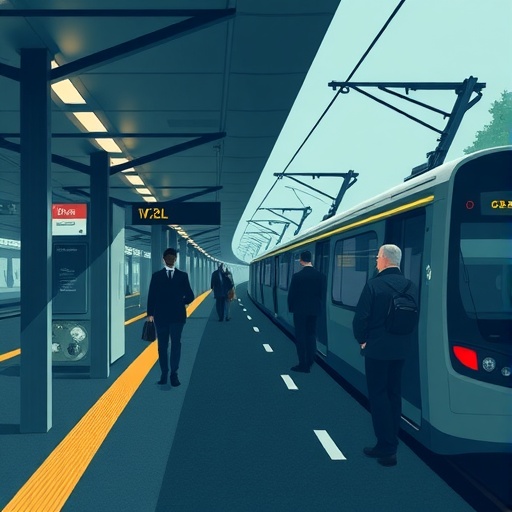
Image Credits: AI Generated

Tags: Daily rhythms of travel in socioeconomically diverse neighborhoodsEffect of structural inequality on stay durations and travel timingInfluence of inequality on phase and amplitude of daily activity peaksLarge-scale location data in mobility studiesNeighborhood-level disparities and commuting behaviorsPatterns of stationarityRegularity and irregularity in daily movement cyclesSocioeconomic disparities and daily mobility patternsStatistical decomposition of temporal mobility patternsStructural inequality impact on commuting rhythmsTemporal analysis of movement and stationarityUrban mobility and socioeconomic inequality
Share26Tweet16
Previous Post

Synchronized ventilatory chest compressions improve outcomes in asphyxiated piglets

Next Post

Low-Dose Baricitinib and Danazol Combination Shows Promise in Primary ITP

Related Posts

Metasurface Platform Enables Independent, Concurrent Emissivity Control in MWIR and LWIR
Technology and Engineering

Metasurface Platform Enables Independent, Concurrent Emissivity Control in MWIR and LWIR

July 26, 2026
Mass Spectrometry Imaging Tracks Different Starting Steps of Benzalkonium Degradation
Technology and Engineering

Mass Spectrometry Imaging Tracks Different Starting Steps of Benzalkonium Degradation

July 26, 2026
Synchronized ventilatory chest compressions improve outcomes in asphyxiated piglets
Technology and Engineering

Synchronized ventilatory chest compressions improve outcomes in asphyxiated piglets

July 26, 2026
Sacred Sites Shelter Native Plant Diversity in an Urban Tropical Landscape
Technology and Engineering

Sacred Sites Shelter Native Plant Diversity in an Urban Tropical Landscape

July 26, 2026
Closed-Loop Theranostic Hydrogel-Electronics Patch for Chronic Wound Care
Technology and Engineering

Closed-Loop Theranostic Hydrogel-Electronics Patch for Chronic Wound Care

July 26, 2026
Neural Sampling from Cognitive Maps Enables Goal-Directed Imagination and Planning
Technology and Engineering

Neural Sampling from Cognitive Maps Enables Goal-Directed Imagination and Planning

July 26, 2026
Next Post
Low-Dose Baricitinib and Danazol Combination Shows Promise in Primary ITP

Low-Dose Baricitinib and Danazol Combination Shows Promise in Primary ITP

  • Mothers who receive childcare support from maternal grandparents show more

    Mothers who receive childcare support from maternal grandparents show more parental warmth, finds NTU Singapore study

    27656 shares
    Share 11059 Tweet 6912
  • University of Seville Breaks 120-Year-Old Mystery, Revises a Key Einstein Concept

    1061 shares
    Share 424 Tweet 265
  • Bee body mass, pathogens and local climate influence heat tolerance

    682 shares
    Share 273 Tweet 171
  • Researchers record first-ever images and data of a shark experiencing a boat strike

    546 shares
    Share 218 Tweet 137
  • Groundbreaking Clinical Trial Reveals Lubiprostone Enhances Kidney Function

    531 shares
    Share 212 Tweet 133
Science

Embark on a thrilling journey of discovery with Scienmag.com—your ultimate source for cutting-edge breakthroughs. Immerse yourself in a world where curiosity knows no limits and tomorrow’s possibilities become today’s reality!

RECENT NEWS

  • Scientists uncover molecular mechanisms of Pirsonia diadema infection in diatoms
  • Cerebral Venous Flow Controls Brain Pressure and Clearance Through Meningeal Lymphatics
  • Metasurface Platform Enables Independent, Concurrent Emissivity Control in MWIR and LWIR
  • UNFCCC Shifts Preferences Among Key Actors in Climate Negotiations

Categories

  • Agriculture
  • Anthropology
  • Archaeology
  • Athmospheric
  • Biology
  • Biotechnology
  • Blog
  • Bussines
  • Cancer
  • Chemistry
  • Climate
  • Earth Science
  • Editorial Policy
  • Marine
  • Mathematics
  • Medicine
  • Pediatry
  • Policy
  • Psychology & Psychiatry
  • Science Education
  • Social Science
  • Space
  • Technology and Engineering

Subscribe to Blog via Email

Enter your email address to subscribe to this blog and receive notifications of new posts by email.

Join 5,146 other subscribers

© 2025 Scienmag - Science Magazine

Welcome Back!

Login to your account below

Forgotten Password?

Retrieve your password

Please enter your username or email address to reset your password.

Log In
No Result
View All Result
  • HOME
  • SCIENCE NEWS
  • CONTACT US

© 2025 Scienmag - Science Magazine

Discover more from Science

Subscribe now to keep reading and get access to the full archive.

Continue reading
