


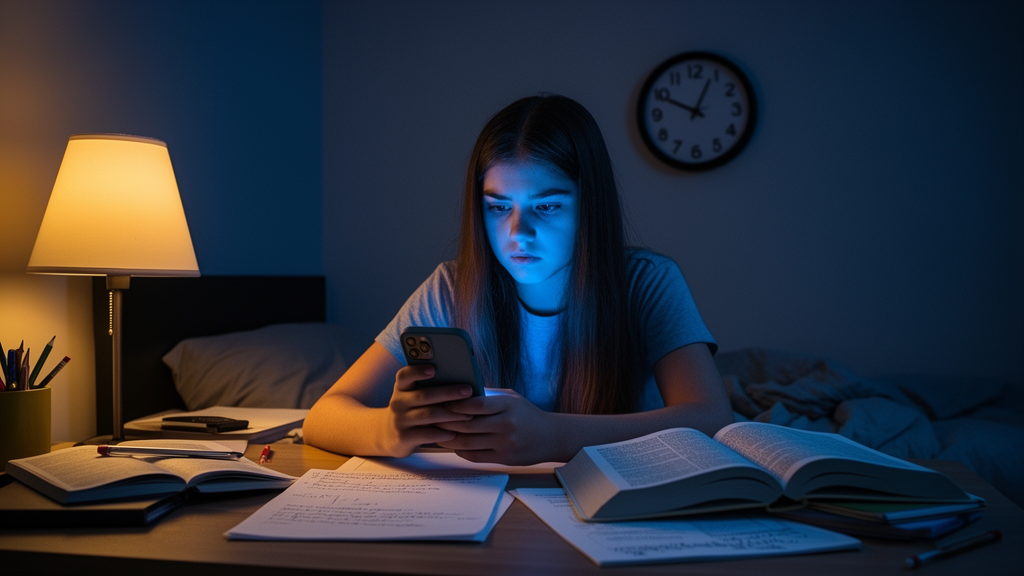
Every ping, swipe, and app switch pulls a teenager’s attention away from the page in front of them, and a new data-driven study now offers one of the most granular pictures yet of how that fragmentation relates to academic harm. Researchers analyzing survey data from 799 adolescents aged 19 and under found that perceived stress and daily social media use duration were the two strongest predictors of self-reported negative academic impact from digital media, outpacing total screen time, gaming, and demographic factors. The findings, published in Frontiers in Psychology, combine classic statistical modeling with machine learning to reveal not just which behaviors matter, but where the dangerous thresholds may lie.
The study, led by Yan Liu of Linfen Central Hospital in Shanxi, China, drew on two publicly available cross-sectional datasets hosted on the Kaggle platform: one examining smartphone usage and addiction, and another focusing on student social media addiction. After age screening and exclusion of missing values, the final sample comprised 799 adolescents with a mean age of 18.50 years. These were not light users of technology. Mean daily screen time came to 7.42 hours, climbing to 9.13 hours on weekends, while daily social media use averaged 3.29 hours and sleep averaged just 6.75 hours. Notably, 59.4 percent of participants reported that digital media use had negatively affected their academic performance, and roughly 70 percent of the sample fell into the moderate or severe range for smartphone addiction severity.
To make sense of such a rich but noisy dataset, Liu deployed an unusual four-pronged analytical framework. First, LASSO regression, a technique that applies an L1 penalty to shrink the coefficients of uninformative variables to zero, was used to distill a high-dimensional set of behavioral and psychological indicators into a core set of predictors. Tenfold cross-validation guided the selection of the regularization parameter, and all predictors were standardized beforehand to keep the penalty terms fair across variables of different scales. The result was striking: stress level emerged with the largest positive coefficient at 0.384, followed closely by social media use duration at 0.297, then number of notifications at 0.213 and number of application openings at 0.186.
Just as telling were the negative coefficients. Work and study time carried a coefficient of minus 0.152 and sleep duration minus 0.109, meaning that even within a digitally saturated environment, dedicated learning time and adequate rest were associated with lower odds of academic impairment. Age and weekend screen time, by contrast, contributed little. The overall pattern suggests that what erodes academic functioning is not simply hours in front of a screen, but the specific texture of that engagement: the constant stream of interruptions, the compulsive checking, and the psychological strain that accompanies it.
The second analytical layer, a regularized partial correlation network based on the Extended Bayesian Information Criterion graphical LASSO, mapped how all these features interconnect once every other variable is statistically controlled. The resulting network revealed a three-community structure that the author labeled digital distraction load, psychological-academic exhaustion, and academic engagement. The first cluster grouped social media use duration, notifications, app openings, and weekend screen time; the second contained stress level, sleep duration, and academic impact; the third consisted only of work and study time and age. Critically, the academic impact node sat at the intersection of the first two communities, indicating that academic harm is jointly associated with digital distraction and psychological stress rather than belonging cleanly to either domain.
Centrality and bridge analyses added further nuance. Stress level and social media use duration ranked highest on strength, closeness, and betweenness indices, marking them as hub nodes of information flow within the network. Number of notifications showed the highest bridge strength at 0.86, with social media use duration close behind at 0.79, meaning these variables connect otherwise separate clusters. That detail has practical weight, because notifications are an externally imposed, highly modifiable factor: they can be reduced through phone settings without requiring deep behavioral change, whereas social media habits involve more entrenched mechanisms that may demand cognitive-behavioral approaches.
The third component of the study was a predictive model built with XGBoost, a gradient-boosted decision tree algorithm known for its accuracy and efficiency. Trained on 75 percent of the data and tested on a held-out 25 percent, the model achieved an area under the ROC curve of 0.842, with accuracy of 0.786, precision of 0.791, recall of 0.744, and an F1-score of 0.767. An AUC above 0.80 indicates good discriminative ability, and it represents a clear improvement over the 0.72 to 0.75 range reported in earlier logistic regression studies of social media addiction. Hyperparameters were tuned by Bayesian optimization, yielding a learning rate of 0.085, a maximum tree depth of 6, a subsample ratio of 0.78, and a column sampling ratio of 0.65.
What elevates this study beyond raw predictive power is its use of SHAP, or SHapley Additive exPlanations, a method rooted in cooperative game theory that allocates each feature’s contribution to individual predictions. The SHAP global importance ranking confirmed stress level, social media use duration, and number of notifications as the top three predictors, consistent with the LASSO and network results. More provocatively, the SHAP dependence plots exposed nonlinear relationships that traditional linear models would have missed entirely. Below roughly three hours of daily social media use, the marginal contribution to predicted academic impact increased only gradually. But beyond an inflection point at approximately 3.5 hours, the contribution rose sharply. Stress showed a similar threshold-like pattern, becoming a significant predictor only at high levels. If these curves hold up in future work, the 3.5-hour mark could become a useful heuristic for educators and clinicians.
The final analytical layer, latent profile analysis, shifted the perspective from variables to people. Fitting models from one to six latent profiles and comparing fit indices including AIC, BIC, sample-adjusted BIC, entropy, and the Lo–Mendell–Rubin adjusted likelihood ratio test, the three-profile solution emerged as optimal. The first group, labeled the low-risk type and comprising 41.7 percent of the sample, reported low social media use, few notifications, low stress, and the longest sleep, with only an 18.3 percent probability of academic impact. The second, the high digital exposure type at 32.5 percent, used social media for an average of 6.8 hours daily with 212 notifications, yet showed only moderate stress and adequate sleep, and a 52.7 percent probability of academic harm, suggesting that heavy use alone does not guarantee impairment when self-regulation holds.
The third profile is where the alarm bells ring. The high stress-exhaustion type, 25.8 percent of the sample, combined moderately high social media use of 4.3 hours, very high stress with 72 percent rating their stress as high, the shortest sleep at 5.7 hours, and moderately frequent notifications. For this group, the probability of reporting academic impact reached 79.4 percent. The implication is that stress and sleep deprivation, rather than raw screen exposure, may be the toxic ingredients that convert heavy digital engagement into genuine academic dysfunction.
These findings point toward stratified rather than one-size-fits-all interventions. Low-risk adolescents might benefit from simple preventive education, the high-exposure group from self-regulation and time-management training rather than blunt screen restrictions, and the stress-exhaustion group from comprehensive support spanning stress management, sleep hygiene, and treatment of problematic social media use. Because push notifications are the most modifiable factor with high bridge centrality, tweaking device settings could be a low-cost first step for many families.
Important caveats temper the enthusiasm. The data are cross-sectional, so causality cannot be established: academic difficulties may drive teens toward social media escape just as readily as social media drives academic decline. All measures were self-reported and vulnerable to recall bias and social desirability effects, and the datasets were convenience samples from a public platform rather than a representative survey. The author also cautions that SHAP explanations have not yet been linked to individualized interventions in practice. Future research using longitudinal designs and ecological momentary assessment could track attention states in real time and test whether the 3.5-hour threshold survives scrutiny, potentially converting these hypothesis-generating associations into genuinely actionable guidance for protecting adolescent attention and achievement.
Subject of Research: Data-driven prediction of academic impact from attention-related digital behaviors in adolescents
Article Title: Digital attention disruption and academic impact in adolescents: a data-driven network and machine learning analysis
Article References: Liu, Y. (2026). Digital attention disruption and academic impact in adolescents: a data-driven network and machine learning analysis. Frontiers in Psychology, 17, Article 1930030. https://doi.org/10.3389/fpsyg.2026.1930030
Image Credits: AI Generated
DOI: 10.3389/fpsyg.2026.1930030
Keywords: adolescents, academic impact, social media use, attention, stress, sleep, machine learning, XGBoost, SHAP, network analysis, latent profile analysis, notifications
Cite Scienmag News
Teresa Odom. (October 15, 2026). Stress and Social Media Time Emerge as Strongest Predictors of Teen Academic Harm. Scienmag. https://scienmag.com/stress-and-social-media-time-emerge-as-strongest-predictors-of-teen-academic-harm/
Teresa Odom. "Stress and Social Media Time Emerge as Strongest Predictors of Teen Academic Harm." Scienmag, 15 October 2026, https://scienmag.com/stress-and-social-media-time-emerge-as-strongest-predictors-of-teen-academic-harm/. Accessed 15 October 2026.
Teresa Odom. "Stress and Social Media Time Emerge as Strongest Predictors of Teen Academic Harm." Scienmag. October 15, 2026. https://scienmag.com/stress-and-social-media-time-emerge-as-strongest-predictors-of-teen-academic-harm/


