


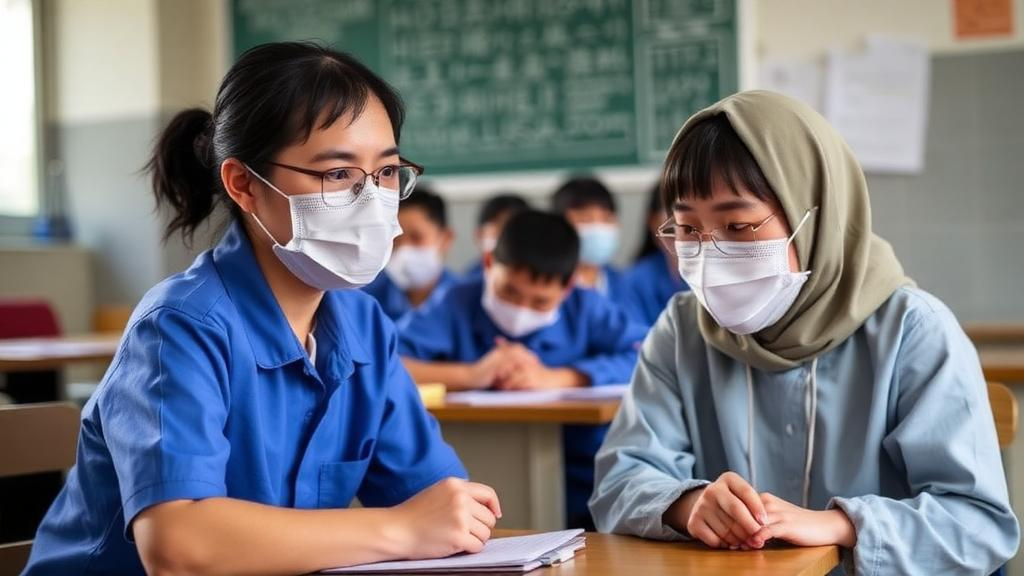
For more than a decade, China’s school-based tuberculosis control programs have focused almost entirely on students, who live and study in close quarters and are screened intensively whenever a case appears. A new long-term analysis from Chengdu, a major city in the country’s southwest, suggests that this strategy may have left a critical blind spot: teachers. According to a retrospective study published in BMC Public Health, pulmonary tuberculosis notification rates among students fell sharply between 2010 and 2024, while rates among teachers declined only slowly and remained persistently higher, ultimately reaching nearly three times the student rate by the end of the study period.
The research team, led by Qing Chen and Li Liu of the Public Health Clinical Center of Chengdu, together with colleagues at Beijing Chest Hospital, Capital Medical University, examined annual notification data for pulmonary tuberculosis among the general population, teachers, and students over a fifteen-year span. Their central question was deceptively simple: have teachers and students been following the same epidemiological trajectory, or have their trends diverged as school TB programs matured? The answer, revealed through a statistical technique called joinpoint regression, has direct implications for how schools should allocate screening resources in the years ahead.
Joinpoint regression is a method designed to detect changes in the direction of a trend over time. Rather than fitting a single straight line to a series of annual rates, the algorithm identifies the years at which the trend bends, known as joinpoints, and estimates the annual percent change, or APC, within each segment. The researchers used the National Cancer Institute’s Joinpoint Regression Program, version 6.1.0, allowing a maximum of two joinpoints and selecting the final model with permutation tests and the Bayesian Information Criterion, a statistical penalty that guards against overfitting. They also ran a parallelism test to determine whether the teacher and student trends could be considered statistically equivalent in shape, and performed sensitivity analyses that excluded the COVID-19 pandemic years of 2020 through 2022, when routine health services worldwide were disrupted.
The backdrop to these comparisons is a broad public health success. Across the general population of Chengdu, the pulmonary tuberculosis notification rate fell from 61.78 per 100,000 people to 35.63 per 100,000, a decline of 42.3 percent. That mirrors the steady progress China has made against tuberculosis nationally, driven by expanded case detection, standardized treatment, and improved surveillance. Against that baseline, the diverging patterns within schools stand out even more clearly.
For teachers, the story is one of stagnation. The joinpoint analysis found zero joinpoints in the teacher trend, meaning the rate moved in a single, essentially straight line across the entire fifteen years. The estimated annual percent change was -2.19 percent, with a 95 percent confidence interval spanning -5.04 percent to 0.75 percent, and the result was not statistically significant, with a P value of 0.130. In plain terms, tuberculosis notification rates among teachers drifted slowly downward, but the data cannot rule out that they did not decline at all. There was no inflection point, no moment when the curve accelerated downward in response to any intervention.
Students, by contrast, followed a strikingly different path with two joinpoints, one in 2017 and another in 2021. From 2010 to 2017, student notification rates fell at a healthy clip of 7.11 percent per year. Between 2017 and 2021, the decline slowed markedly to just 1.41 percent per year, a plateau that coincided with the final years before and the early years of the pandemic. Then, from 2021 to 2024, the rate plunged by 17.32 percent annually, the steepest segment in the series. This dramatic late drop likely reflects the intensification of school TB screening and management programs, including contact investigations and active case finding among student populations, which have become standard practice in Chinese schools.
The parallelism test delivered the study’s most consequential verdict: the null hypothesis of parallel trends between teachers and students was rejected, with P equal to 0.005. In other words, the two groups were not simply declining at different speeds along similar paths; their trends were statistically distinct in shape. Students experienced a dynamic, multi-phase decline, while teachers experienced a flat, sluggish drift. By 2024, the teacher notification rate stood at 16.00 per 100,000, compared with just 5.78 per 100,000 for students, making the teacher rate 2.77 times higher. The gap between the two groups, the authors note, narrowed to a minimum in the mid-2010s, widened thereafter, and has only recently begun to close slightly as student rates fell steeply.
To rule out the possibility that the COVID-19 pandemic was distorting these patterns, the team repeated the analysis excluding 2020 through 2022. The picture simplified considerably. Both groups showed zero joinpoints, with an annual percent change of -3.53 percent for teachers and -7.22 percent for students, and the parallelism test no longer rejected the null hypothesis, with P equal to 0.206. Even in this cleaner analysis, students were declining roughly twice as fast as teachers, reinforcing the conclusion that the divergence is real and not merely an artifact of pandemic-era disruptions to healthcare seeking and reporting.
Why would teachers carry a higher and more stubborn tuberculosis burden than the students they teach? The study does not establish causes, but the pattern is consistent with a structural explanation: the entire apparatus of school-based TB control in China is built around students. Student screening, case finding, and contact tracing are mandated and routinely enforced, so infections among students are more likely to be caught early and counted. Teachers, described by the authors as a potentially under-recognized group, fall outside the core of these programs and receive limited targeted attention, which can translate into delayed diagnosis and a slower decline in notification rates. Older average age, longer cumulative exposure over working lives, and less frequent health screening may all contribute to the persistent gap, although the study’s retrospective design cannot disentangle these factors.
The practical recommendation that follows from the findings is straightforward: enhanced screening and health management for teachers should be incorporated into school tuberculosis prevention strategies. As student rates continue their steep decline, the relative contribution of adult staff to transmission risk within school settings may grow, and an unmonitored reservoir of infection among teachers could undermine the hard-won gains among students. The study, approved by the Medical Ethics Committee of the Public Health Clinical Center of Chengdu and supported by the Chengdu Health Commission and the Chengdu Science and Technology Bureau, offers a rare fifteen-year window into how narrowly targeted control programs can leave adjacent populations behind. For a disease that still kills more people worldwide than any other single infectious agent, the message from Chengdu is that the people at the front of the classroom deserve the same vigilance as the children in the desks.
Subject of Research: Long-term trends in pulmonary tuberculosis notification rates among teachers and students in Southwest China
Article Title: Divergent trends in pulmonary tuberculosis notification rates between teachers and students in Southwest China, 2010–2024: a joinpoint regression analysis
Article References: Divergent trends in pulmonary tuberculosis notification rates between teachers and students in Southwest China, 2010–2024: a joinpoint regression analysis. (n.d.). https://doi.org/10.1186/s12889-026-29941-2
Image Credits: AI Generated
DOI: 10.1186/s12889-026-29941-2
Keywords: tuberculosis, pulmonary tuberculosis, teachers, students, joinpoint regression, notification rate, China, school health, epidemiology, public health, time trend, BMC Public Health
Cite Scienmag News
Phoebe Ingram. (October 15, 2026). Teachers, Not Students, May Be the Overlooked Face of School Tuberculosis in China. Scienmag. https://scienmag.com/teachers-not-students-may-be-the-overlooked-face-of-school-tuberculosis-in-china/
Phoebe Ingram. "Teachers, Not Students, May Be the Overlooked Face of School Tuberculosis in China." Scienmag, 15 October 2026, https://scienmag.com/teachers-not-students-may-be-the-overlooked-face-of-school-tuberculosis-in-china/. Accessed 15 October 2026.
Phoebe Ingram. "Teachers, Not Students, May Be the Overlooked Face of School Tuberculosis in China." Scienmag. October 15, 2026. https://scienmag.com/teachers-not-students-may-be-the-overlooked-face-of-school-tuberculosis-in-china/


