


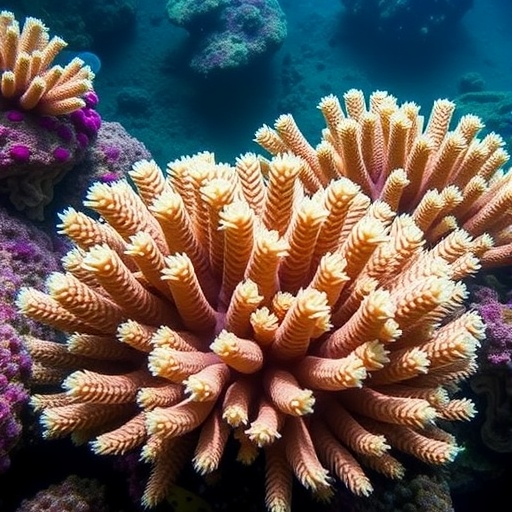
In a groundbreaking advancement for coral conservation science, a team of international researchers has unveiled new insights into the potential of assisted evolution to enhance coral resilience against intensifying climate change impacts. As marine heatwaves grow more frequent and severe due to rising global temperatures, coral reefs—vital ecosystems supporting immense biodiversity—face unprecedented threats. The recent study, led by Newcastle University, published in Current Biology, elucidates how meticulously selected genetic traits and persistent multi-generational selection could accelerate corals’ natural adaptive capacities, offering a critical lifeline to these fragile marine organisms.
For decades, coral bleaching events caused by elevated water temperatures have decimated reef systems worldwide. Though some coral populations exhibit signs of natural adaptation, this intrinsic response remains worryingly insufficient to counterbalance the rapid pace of ocean warming. The research team, cognizant of this challenge, employed an innovative pedigree-tracking approach, maintaining a dedicated coral population over eight years. This unique method enabled precise mapping of coral family lineages and allowed comprehensive quantification of several phenotypic traits including growth rates, reproductive success, and survival under stress.
The novelty of the study lies in its combination of multivariate genetic analysis and advanced computational modeling, permitting an unprecedented estimation of each coral’s breeding value for heat tolerance alongside other correlated traits. Unlike previous research relying solely on observational data, this approach captures the genetic architecture underlying trait inheritance. By disentangling these complex genetic correlations, the team gained deep insight into which specific traits drive thermal resilience, and how these may be selectively bred to maximize adaptive outcomes without inadvertently compromising essential fitness characteristics.
Dr. James Guest, the principal investigator from Newcastle University’s Coral Reef Ecology group, highlighted the transformative potential of this approach in assisted evolution. He emphasized how generating corals from well-characterized parental lines with known genetic profiles represents a paradigm shift. “This strategic pedigree management empowers researchers to predictively select broodstock with superior adaptive potential, and then observe how these selections manifest beneficial genetic effects in offspring exposed to climate stress,” Guest explained, underlining the leap from guesswork to informed intervention in coral breeding programs.
However, the findings caution that mere identification of advantageous traits is insufficient to guarantee survival gains. The study demonstrates that truly significant improvements in heatwave endurance require the implementation of very strong selective pressures—targeting the top one to five percent of the population exhibiting the greatest tolerance. This selective breeding must be sustained rigorously over multiple coral generations to culminate in durable evolutionary advances. The process raises practical and ecological challenges, including concerns over preserving genetic diversity to avoid bottleneck effects and maintain population viability amidst intense selection.
Crucially, the research indicates that selection strategies focusing on the coral host itself—rather than its symbiotic algae—are pivotal. This contrasts some prior assumptions and provides a clearer roadmap for breeding interventions designed to enhance host heat tolerance. The team’s comprehensive trait analysis further reveals an encouraging absence of detrimental genetic trade-offs. Traits such as growth rate, reproductive output, skeletal calcification, tissue biomass, and symbiont flexibility, all integral to overall coral fitness, appear to be genetically independent of heat tolerance. This genetic independence means that boosting thermal resilience does not inherently compromise other vital functions, dispelling fears that assisted evolution might inadvertently undermine coral health.
Despite the promising prospects, researchers emphasize assisted evolution is no panacea. Dr. Liam Lachs, a key postdoctoral researcher involved in the study, underscores that mitigating greenhouse gas emissions remains essential to curb ocean warming trajectories. Assisted evolution should be envisioned as a complementary strategy—bolstering coral populations’ innate capacity to cope locally with warming, while the global community strives to address the root cause of climate change. This tandem approach could buy critical time and augment coral survival odds as climate models predict more frequent severe heat stress events.
The study also advances the conceptual framework for conservation biology in marine systems. By quantitatively linking genetic data with ecological performance, it elevates coral reef restoration efforts from reactive, short-term interventions to proactive, evolutionarily informed programs. The ability to forecast how selective breeding translates to real-world fitness under climate stress heralds a new era of precision conservation, aligning evolutionary biology with applied environmental management.
The researchers advocate for scaling up these assisted evolution methods, albeit with a cautious eye toward the logistics of breeding, maintaining genetic diversity, and ecosystem integration. The intensive effort required to identify elite genotypes, breed across generations, and monitor outcomes poses notable challenges but is achievable with interdisciplinary collaboration and emerging biotechnologies. Pilot programs leveraging these scientific insights could serve as templates for future applications in diverse reef regions globally.
As climate projections underscore ocean warming projections exceeding corals’ natural adaptive limits, innovative responses like assisted evolution may prove indispensable in safeguarding these keystone species. In the words of Dr. Adriana Humanes, a contributing author, while decarbonization remains paramount, interventions that accelerate corals’ evolutionary trajectories could tip the balance in favor of reef persistence. This research not only informs immediate conservation strategies but also redefines the broader conversation on how humanity can proactively steward vulnerable ecosystems in a rapidly changing world.
Looking ahead, integration of this genetic selection framework with advances in genomic editing, microbiome engineering, and habitat restoration could synthesize multifaceted resilience strategies. By harnessing the evolutionary potential inherent within coral populations, researchers can craft targeted, evidence-based responses to climate threats. Ultimately, such synergistic approaches could transform coral reefs from endangered relics into thriving ocean sanctuaries capable of withstanding the anthropogenic pressures of the 21st century.
This study exemplifies the power of long-term investment in genetic and ecological research and highlights the indispensable role of computational simulation models in understanding complex biological interactions under stress. As the scientific community rallies to conserve coral reefs, these findings illuminate a viable pathway for enhancing coral survivorship in an era dominated by climate uncertainty. Assisted evolution, executed with scientific rigor and ecological sensitivity, emerges as a beacon of hope amid the rising tides of environmental change.
News Publication Date: 17-Apr-2026
Web References: 10.1016/j.cub.2026.03.055
Keywords
Coral bleaching, Coral reefs, Climate change, Ocean acidification
Cite Scienmag News
Gavin Prescott. (April 17, 2026). Strategic Trait Selection Key to Enhancing Coral Resilience Against Future Heatwaves. Scienmag. https://scienmag.com/strategic-trait-selection-key-to-enhancing-coral-resilience-against-future-heatwaves/
Gavin Prescott. "Strategic Trait Selection Key to Enhancing Coral Resilience Against Future Heatwaves." Scienmag, 17 April 2026, https://scienmag.com/strategic-trait-selection-key-to-enhancing-coral-resilience-against-future-heatwaves/. Accessed 4 September 2026.
Gavin Prescott. "Strategic Trait Selection Key to Enhancing Coral Resilience Against Future Heatwaves." Scienmag. April 17, 2026. https://scienmag.com/strategic-trait-selection-key-to-enhancing-coral-resilience-against-future-heatwaves/


