


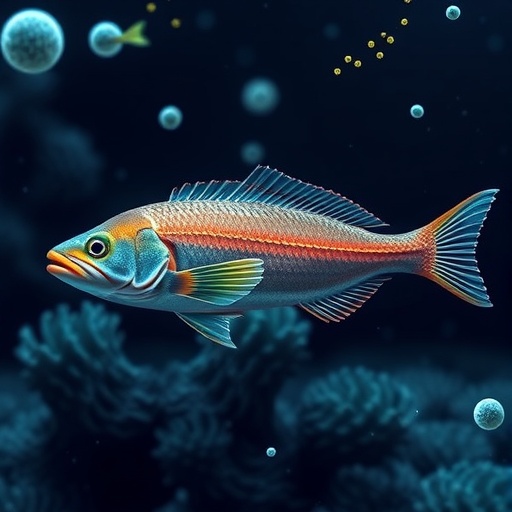
New research from the University of Miami’s Rosenstiel School has uncovered an intriguing partnership between marine fish and their gut microbes that could fundamentally alter our understanding of ocean chemistry and the global carbon cycle. Focused on the Gulf toadfish (Opsanus beta), this groundbreaking study suggests that the fish’s ability to produce calcium carbonate, a mineral crucial to regulating ocean health, is not a solo endeavor but rather a sophisticated symbiosis with specific gut bacteria. These findings shed new light on the previously underappreciated roles microorganisms play in marine biogeochemical processes.
Calcium carbonate production in marine ecosystems plays a pivotal role in the sequestration of carbon dioxide, a key player in mitigating climate change. Teleost fish, including the Gulf toadfish, contribute to this process by drinking seawater as part of their osmoregulatory mechanism, processing excess ions, and excreting calcium carbonate in solid pellet form known as ichthyocarbonates. Prior to this study, the formation of ichthyocarbonates was believed to be a purely physiological process governed by the fish themselves. However, this new work questions that notion and emphasizes a critical microbial contribution inside the fish gut.
The researchers conducted controlled laboratory experiments exposing Gulf toadfish to water with varying salinity levels, ranging from brackish to hypersaline conditions. These experiments allowed the team to observe how salinity influences ichthyocarbonate formation. As expected, fish exposed to seawater and higher salinity produced more calcium carbonate pellets, while those in low salinity environments did not exhibit this mineral excretion. This gradient response underscored the biological interplay between the fish and their environment in mineral cycling.
To unravel the mechanistic underpinnings of this phenomenon, the team analyzed samples taken from different regions of the toadfish intestine, the ichthyocarbonates themselves, and the surrounding water column. They extracted both DNA and RNA to provide a dual perspective—characterizing microbial communities present and examining their gene expression profiles. Advanced genetic sequencing techniques were employed to identify the dominant microbes and uncover the biochemical pathways potentially involved in mineral formation.
A striking discovery was the prevalence of Vibrio bacteria, particularly Photobacterium damselae subsp. damselae, within both the gut microbiome and on the mineralized ichthyocarbonates. These bacteria exhibited genetic markers associated with calcium carbonate precipitation, suggesting their active participation alongside the fish in shaping these mineral structures. This revelation fundamentally redefines our understanding of marine carbon sinks, highlighting the complex biological networks that underpin oceanic biogeochemical cycles.
The broader implications of this symbiotic relationship extend beyond basic fish biology. Microbes constitute the vast majority of Earth’s biomass and are crucial drivers of nutrient cycling and ecosystem functionality. The ocean’s immense microbial diversity orchestrates a myriad of physiological and chemical processes essential for planetary health. The toadfish–vibrio partnership revealed in this study adds a novel example to the growing catalogue of marine symbioses that influence global biochemical transformations.
The study was led by Anthony Bonacolta, a former graduate student at the University of Miami, under the guidance of senior author Martin Grosell, a renowned ichthyologist and chair of the Department of Marine Biology and Ecology. Utilizing cutting-edge molecular methods alongside traditional physiological experiments, their multidisciplinary approach enabled unprecedented insights into the hidden microbial players that regulate a fundamental marine process.
The findings highlight the importance of investigating microbial contributions to processes previously assumed to be controlled solely by higher organisms. Such insights are crucial for refining ecological models that predict responses to environmental change, including ocean acidification, temperature fluctuations, and salinity shifts induced by climate change. Understanding these microbial interactions opens avenues for innovative strategies to manage and conserve marine carbon sinks, which play a key role in buffering atmospheric CO2 levels.
Importantly, this research compels a reconsideration of how marine nutrient cycles are conceptualized, pointing to intimate host-microbe interactions as vital components of biogeochemical processes. The role of microbial symbionts in facilitating mineral precipitation inside animal hosts may extend beyond toadfish, suggesting a broader ecological paradigm where microorganisms significantly augment animal contributions to oceanic mineral fluxes.
The combined efforts of researchers from the University of Miami’s Rosenstiel School and the Institut de Biologia Evolutiva in Barcelona underscore the importance of international collaboration in unraveling complex biological systems. Their work paves the way for future studies focusing on microbial diversity, gene function, and the environmental parameters that modulate symbiotic relationships in marine settings.
This evolving understanding of fish–microbe symbiosis invites further investigation into how other marine organisms and their microbial communities contribute similarly to ocean chemistry. Such knowledge is vital for predicting how marine ecosystems will respond to anthropogenic stressors and for developing interventions that protect marine biodiversity and sustain the ocean’s capacity to regulate the global climate.
The study titled “Symbiotic bacteria may support calcium carbonate precipitation in the Gulf toadfish” was published in PLOS Biology on May 27, 2026. This work was supported in part by start-up funds from the University of Miami and grants from the Spanish Ministry of Science, Innovation, and Universities, highlighting the vital role of institutional support in advancing cutting-edge marine science.
Keywords
Gulf toadfish, ichthyocarbonates, calcium carbonate precipitation, gut microbiome, Vibrio, Photobacterium damselae, marine carbon cycle, symbiosis, osmoregulation, marine biogeochemical cycles, ocean health, microbial ecology
Cite Scienmag News
Morgan Morrow. (May 29, 2026). New Research Reveals Fish Gut Microbe’s Role in Regulating Ocean Health. Scienmag. https://scienmag.com/new-research-reveals-fish-gut-microbes-role-in-regulating-ocean-health/
Morgan Morrow. "New Research Reveals Fish Gut Microbe’s Role in Regulating Ocean Health." Scienmag, 29 May 2026, https://scienmag.com/new-research-reveals-fish-gut-microbes-role-in-regulating-ocean-health/. Accessed 4 September 2026.
Morgan Morrow. "New Research Reveals Fish Gut Microbe’s Role in Regulating Ocean Health." Scienmag. May 29, 2026. https://scienmag.com/new-research-reveals-fish-gut-microbes-role-in-regulating-ocean-health/


