


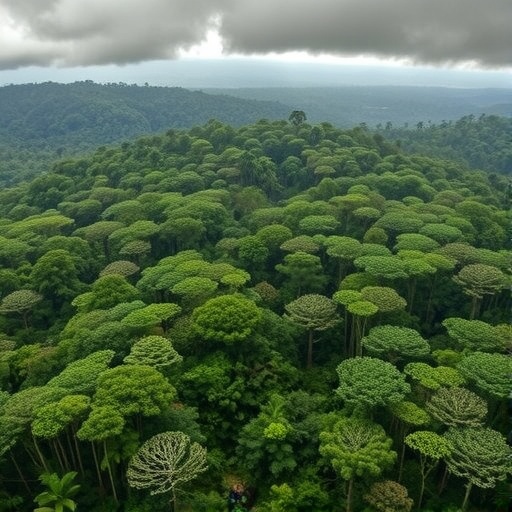
Tropical forests stand as one of the most integral components of the Earth’s carbon cycle, harboring more than 60 percent of the world’s vegetation biomass. This vast reservoir of carbon is pivotal in mitigating climate change, primarily through its ability to sequester carbon dioxide from the atmosphere. Yet, the durability of this carbon stock depends intricately on how long carbon resides within forest biomass before returning to the atmosphere—a metric known as carbon residence time. The turnover of biomass, governed by differential rates of growth and mortality in forest vegetation, critically controls this residence time, ultimately influencing the long-term carbon storage capacity of these ecosystems.
A groundbreaking study recently undertaken by researchers from the South China Botanical Garden (SCBG) of the Chinese Academy of Sciences, alongside partners from Cornell University and a consortium of international institutions, brings new insights into the vulnerabilities of Amazonian forests amid changing climatic conditions. Published in the prestigious journal Nature Climate Change, the research elucidates the mechanisms by which increasing atmospheric aridity and intensifying convective storm activity expedite biomass turnover in Amazonian forests. This acceleration of carbon cycling threatens the forest’s role as a stable carbon sink, portending significant implications for global climate regulation.
Historically, scientific inquiry into tropical forest carbon sinks has concentrated predominantly on aspects of vegetation productivity—essentially the forest’s ability to assimilate carbon via photosynthesis and biomass accumulation. However, the intricacies of tree mortality and biomass carbon turnover have not been equally emphasized. The knowledge gap is further compounded by the reliance on localized, site-specific field observations, which, due to the heterogeneous nature of tropical ecosystems, often fall short in capturing broader spatial patterns and the diverse environmental drivers at play.
Addressing these limitations, the research team pioneered an innovative methodological approach that synergizes satellite remote sensing data with extensive, long-term field plot observations across the Amazon basin. This integration facilitated the first spatially explicit estimations of tree mortality rates throughout the region, thereby enabling the construction of comprehensive maps that detail the heterogeneity of biomass carbon turnover dynamics. The approach transcends traditional observational constraints, offering a landscape-scale perspective crucial for advancing ecological understanding.
Underpinning the study is a sophisticated non-equilibrium carbon cycle framework, which allows for the quantification of carbon turnover time while accounting for the dynamic interplay between growth, death, and environmental fluctuations. Leveraging this framework, the scientists developed spatial models that reveal substantial variability in biomass carbon turnover times across Amazonian forests. This variability is shaped by a complex set of nonlinear responses to a suite of environmental factors, reflecting the sensitivity of carbon dynamics to ecological and climatic heterogeneity.
Among the diverse climatic factors influencing carbon turnover, convective storms emerged as particularly influential. Characterized by brief but intense bursts of heavy rainfall coupled with powerful winds, these storms induce substantial tree damage and mortality, thereby accelerating biomass turnover rates. Notably, the study found that the impact of convective storms on carbon residence time surpasses that of drought stress indicators, reshaping the previously held perspectives on the dominant climatic forces regulating Amazonian forest dynamics.
Incorporating interpretable machine learning models, the research quantified the extent to which environmental predictors, including atmospheric dryness and storm frequency, modulate biomass carbon turnover times. These models enabled the disentangling of nonlinear, often counterintuitive relationships, highlighting how incremental climatic shifts can disproportionately affect forest carbon stability. The methodological rigor and transparency of the machine learning approach enhance confidence in these projections.
Future scenarios presented in the study forecast a troubling trend: by the conclusion of the 21st century, biomass carbon turnover time in Amazonian forests is expected to contract by approximately 3 percent under low-emissions pathways, escalating to nearly 15 percent under high-emissions trajectories. This contraction means carbon is cycled more rapidly through forest biomass, reducing the efficiency of carbon sequestration and potentially elevating atmospheric CO2 levels, thereby contributing to further climate warming.
These findings challenge prior assumptions about tropical forest resilience, suggesting that external climatic stressors—particularly intensifying storms and atmospheric drying—may undermine the long-term stability of forest carbon sinks. The amplified biomass turnover reduces carbon residence time, turning erstwhile stable carbon reservoirs into volatile sources. This dynamic introduces a feedback loop with considerable ramifications for future climate projections.
Beyond advancing fundamental ecological science, the study’s outcomes bear critical importance for Earth System Models (ESMs), which are central to climate forecasting and carbon budget assessments. Incorporating the influence of convective storms and nuanced turnover dynamics into ESMs can significantly enhance their predictive accuracy. As WU Donghai, a corresponding author of the paper, emphasized, these insights enable a more realistic representation of tropical forest carbon dynamics under variable environmental scenarios.
The research underscores the imperative for ongoing monitoring and refined modeling efforts that capture the multifaceted effects of climate change on tropical forests. Given the Amazon’s status as a global ecological linchpin, understanding and mitigating the drivers of increased biomass turnover is vital for sustaining the planet’s carbon balance and averting more severe climate disruptions.
This study marks a pivotal step in redefining our comprehension of tropical forest carbon cycling amid an era of unprecedented climate perturbations, bridging field-based observations with cutting-edge remote sensing and machine learning techniques to deliver urgent and actionable science.
News Publication Date: 13-May-2026
Web References: DOI: 10.1038/s41558-026-02639-4
Cite Scienmag News
Russell Cooper. (May 13, 2026). Storms and Drought Speed Up Biomass Turnover in Amazonian Forests. Scienmag. https://scienmag.com/storms-and-drought-speed-up-biomass-turnover-in-amazonian-forests/
Russell Cooper. "Storms and Drought Speed Up Biomass Turnover in Amazonian Forests." Scienmag, 13 May 2026, https://scienmag.com/storms-and-drought-speed-up-biomass-turnover-in-amazonian-forests/. Accessed 5 September 2026.
Russell Cooper. "Storms and Drought Speed Up Biomass Turnover in Amazonian Forests." Scienmag. May 13, 2026. https://scienmag.com/storms-and-drought-speed-up-biomass-turnover-in-amazonian-forests/


