


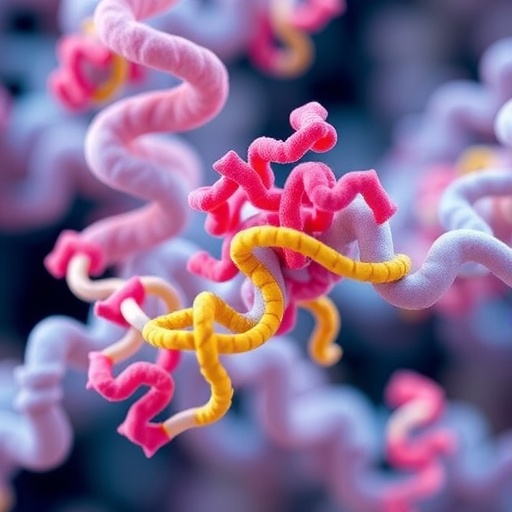
In a groundbreaking stride at the nexus of artificial intelligence and molecular biology, researchers at the École Polytechnique Fédérale de Lausanne (EPFL) have revealed an innovative AI-powered framework that models proteins in their full atomic detail, capturing not only their static structures but their dynamic dances. This novel approach surmounts long-standing challenges in computational structural biology by enabling the generation of all-atom ensembles of proteins in motion—a feat that could pivotally transform drug discovery and biomedical research.
Proteins, the molecular engines within cells, owe their intricate functionalities to their three-dimensional shapes and the subtle movements they perform, akin to machines gracefully executing complex tasks. Traditional methods like X-ray crystallography and cryo-electron microscopy have provided high-resolution static images of proteins, but fail to depict the fluidity inherent in their biological roles. While AI models such as DeepMind’s AlphaFold have revolutionized protein structure prediction by producing highly accurate static snapshots, these models fall short when describing side chain flexibility and conformational changes that regulate protein function.
Addressing this critical gap, the interdisciplinary team of protein engineers and signal processing experts led by Patrick Barth and Pierre Vandergheynst introduced Latent Diffusion for Full Protein Generation (LD-FPG), a generative AI framework that intricately models protein conformational ensembles, embracing the full atomistic details including side chains and their dynamic rearrangements. Unlike prior approaches limited to static structures, LD-FPG conceptualizes protein conformational variability as a dynamic latent space, efficiently capturing motions in a compressed representation.
The mechanism hinges on a graph neural network (GNN) that conceptualizes each protein structure as a graph: atoms representing nodes and chemical bonds acting as edges. This abstraction facilitates a low-dimensional embedding of the protein’s spatial and chemical properties, dramatically simplifying the complex landscape of molecular conformations. The latent diffusion model then learns distributions over these embeddings, generating diverse, physiologically-relevant conformational states upon decoding.
One of the hallmark achievements demonstrated by the team is the ability to capture the full conformational landscape of the dopamine D2 receptor—an extensively studied G-protein coupled receptor (GPCR) central to neurological messaging in the brain. By generating comprehensive structural ensembles depicting both active and inactive states, LD-FPG provides an unprecedented dynamic perspective into how small-molecule ligands alter receptor behavior, offering critical insights for designing more effective neurotherapeutics.
Beyond dopamine receptors, the framework exhibits promising generalizability to other pivotal drug targets, crucially those involved in cell signaling and membrane transport. The capacity to simulate protein “movies” rather than frozen snapshots ushers in a paradigm shift where drug discovery can consider not just binding affinities to static targets but also the kinetics and dynamics underlying biomolecular interactions. This can accelerate virtual screening and rational design, dramatically reducing trial and error phases.
What sets LD-FPG apart is its emphasis on modeling the collective and nuanced atomic rearrangements, including side chain movements often neglected in other AI models. Side chains dictate specificity and binding strength by engaging dynamically in molecular recognition events. Capturing their motion unveils new dimensions of protein-ligand compatibility, enabling more precise modulations of protein function.
Scientists emphasize that this advance does not bypass the indispensable role of quality data. While AI frameworks often rely on volumetric data feeds, the EPFL team stresses that meticulously curated, noise-free biological data remain essential. This ensures model reliability and relevance, underlining a balanced interplay between human expertise and AI processing power that is vital for rigorous scientific discovery.
Looking ahead, the research group intends to enhance LD-FPG’s capacity to model larger proteins and multimeric complexes, extending its applicability across a broad spectrum of biological macromolecules. Further refinements aim to boost computational efficiency and fidelity, striving for even closer alignment with experimentally observed protein dynamics.
This pioneering methodology was unveiled at the prestigious Thirty-Ninth Annual Conference on Neural Information Processing Systems (NeurIPS 2025), marking a milestone that intertwines AI innovation with real-world biomedical relevance. As AI models evolve to embrace the complexity and fluidity of biological systems, LD-FPG exemplifies how computational ingenuity can illuminate the subtleties of life’s molecular machinery.
The potential for drug development is particularly compelling given that GPCRs represent the target for approximately 40% of all modern medicinal drugs. By enabling the design of therapeutics with a dynamic understanding of target proteins, the biotech and pharmaceutical industries can pioneer new classes of medications that modulate protein actions with unprecedented specificity.
Ultimately, the integration of latent diffusion models with graph-based representations heralds a new era in computational biology where the once insurmountable challenge of modeling protein dynamics in full atomic detail is becoming a tangible reality. This advancement not only deepens our understanding of fundamental biological processes but also ignites hope for accelerated therapeutic discovery addressing complex diseases.
As AI-driven computational tools continue to expand the horizon of molecular design, studies like this affirm the irreplaceable value of cooperative efforts between computer scientists, structural biologists, and chemists in forging a future where precision medicine is crafted with atomic-level accuracy and dynamic insight.
News Publication Date: 3-Dec-2025
Web References:
LD-FPG publication at NeurIPS 2025
LPCE Laboratory at EPFL
LTS2 Signal Processing Laboratory
Keywords
Protein dynamics, artificial intelligence, graph neural networks, latent diffusion, G-protein coupled receptors, drug discovery, molecular modeling, computational biology, protein-ligand interactions, structural bioinformatics
Cite Scienmag News
Jason Bradley. (May 13, 2026). AI Produces First Comprehensive Models of Proteins in Motion. Scienmag. https://scienmag.com/ai-produces-first-comprehensive-models-of-proteins-in-motion/
Jason Bradley. "AI Produces First Comprehensive Models of Proteins in Motion." Scienmag, 13 May 2026, https://scienmag.com/ai-produces-first-comprehensive-models-of-proteins-in-motion/. Accessed 3 September 2026.
Jason Bradley. "AI Produces First Comprehensive Models of Proteins in Motion." Scienmag. May 13, 2026. https://scienmag.com/ai-produces-first-comprehensive-models-of-proteins-in-motion/


