


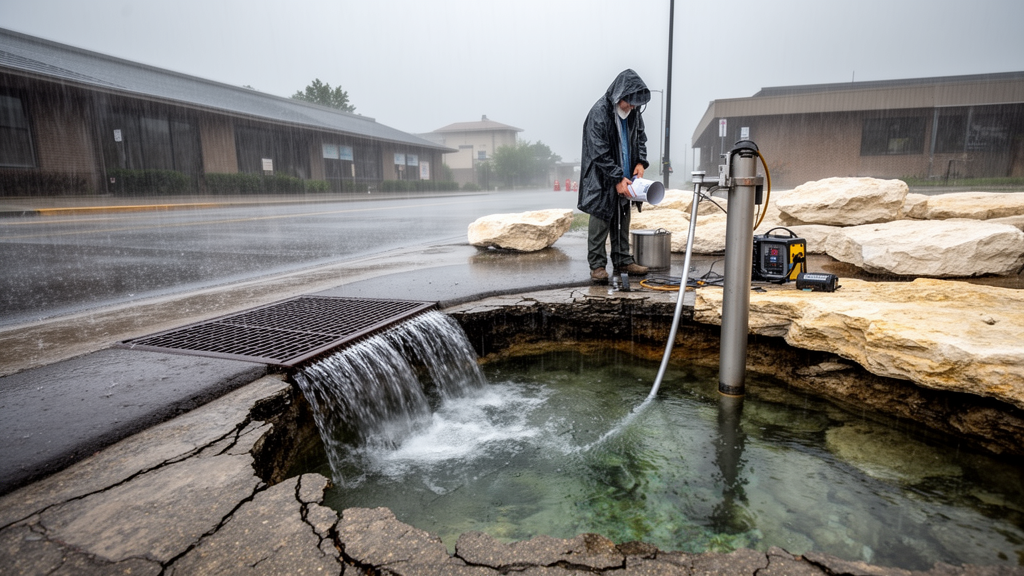
High-frequency monitoring of 27 major storms showed that water reaching an urban karst spring in southern France came from multiple underground compartments, with saturated-zone water remaining the predominant contribution even during the largest events. At the Fontaine de Nîmes observatory, researchers combined electrical conductivity, turbidity, water fluorescence and discharge records to trace the transfer of dissolved and suspended material during rainfall. The clearest contrast was between storms with high turbidity peaks, which mobilised pre-event and contemporaneous water, and lower-turbidity events dominated by pre-event water whose residence time varied seasonally.
The study was an observational investigation of storm-driven transfers in an aquifer beneath a Mediterranean urban environment. Its objective was not merely to describe changes in water quality, but to characterise and quantify the origin of water and its movement through karst compartments during individual storms. The 27-event record was used to develop a seasonal storm typology based on hydrological conditions suited to Mediterranean regions.
This framework allowed the researchers to compare events occurring under different seasonal and hydrological contexts rather than treating major rainfall episodes as equivalent. Electrical conductivity was used to examine contributions from pre-event water and water entering during the event. Turbidity recorded suspended material, while the first derivative of discharge supplied an indicator of sediment-mobilisation intensity.
Water fluorescence provided information relevant to identifying a wastewater origin. Taken together, these variables provided complementary signatures of dissolved transfers, particulate movement and the sources contributing to the observed spring response. The researchers calculated descriptors from the high-frequency physicochemical records and then cross-analysed the descriptors with information on flow and hydrological conditions.
This multi-signal approach was important because no single record could describe the entire transfer process by itself. Turbidity, for example, documented the presence and movement of suspended particulate matter but did not independently establish the origin of the water carrying it. Electrical conductivity, fluorescence, discharge change and seasonal context supplied the additional constraints used to interpret that signal.
The seasonal typology supplied an organisational framework for comparing the storm responses. It grouped 27 major events according to hydrological conditions and highlighted how the character of pre-event contributions could change through the year. Events with the highest turbidity peaks were associated with the mobilisation of both pre-event and event water during periods of high water levels.
In these conditions, the participating water was characterised by a relatively young residence time. The study therefore connected the most pronounced turbidity response to the activation of water with a comparatively short residence time within the karst system. End-member mixing analysis, known as EMMA, provided the study’s quantitative component.
By analysing end members representing different water-source and karst-compartment contributions, the method differentiated the relative roles of the saturated zone, the unsaturated zone, pre-event water and event water. The analysis showed that water from the saturated zone predominated in spring flows, including during the largest storm events. This result prevents the visible speed of a storm response from being interpreted as proof that the entire discharge consisted only of water newly supplied by the current rainfall.
Storms with lower turbidity followed a different pattern. Their spring response was characterised primarily by pre-event water, with residence time varying according to season. The contrast was therefore not simply between clean and muddy storms.
It also involved differences in which water was mobilised and how long that water had been resident before the event. The study’s interpretation rests on the combined time series and mixing analysis rather than on assigning turbidity alone to either recent rainfall or long-stored water. Fluorescence added an urban dimension to the source analysis by providing information about water with a wastewater origin.
Its inclusion meant that the researchers did not have to interpret every physicochemical change solely as a response of the karst compartments. The source evidence does not claim that EMMA by itself isolated the wastewater-associated contribution; rather, wastewater origin was one of the signals considered in the cross-analysis of the full set of physicochemical variables. This distinction is central to the study’s methodology: multiple observations were used jointly to interpret the origin of turbidity and the movement of dissolved and suspended material.
At Fontaine de Nîmes, conductivity, turbidity, fluorescence and discharge were not independent end points but complementary pieces of evidence. Their timing through 27 storms, interpreted with a seasonal event typology and quantitative end-member mixing, distinguished saturated-zone flow from contributions associated with the unsaturated zone and water present before or during rainfall. The approach captured both strong sediment-mobilisation episodes and more subdued turbidity responses with different source characteristics.
The findings apply directly to the monitored urban karst system and its major storm events, but they should not be treated as a universal description of all karst aquifers.
Subject of Research: High-frequency monitoring and mixing analysis of storm-water sources in a French Mediterranean urban karst aquifer
Article Title: Quantifying water origin of a Mediterranean urban karst aquifer using storm event typology and high-frequency physicochemical signatures
Article References: Charlier, J.-B., Bailly-Comte, V., Ladouche, B., & Maréchal, J.-C. (2026). Quantifying water origin of a Mediterranean urban karst aquifer using storm event typology and high-frequency physicochemical signatures. Hydrogeology Journal. https://doi.org/10.1007/s10040-026-03199-9
Image Credits: AI Generated
DOI: 10.1007/s10040-026-03199-9
Keywords: karst aquifer, stormwater, water source tracing, high-frequency monitoring, electrical conductivity, turbidity, water fluorescence, end-member mixing analysis, Fontaine de Nîmes, Mediterranean hydrology, Quantifying, water
Cite Scienmag News
Violet Maxwell. (October 22, 2026). Storm monitoring quantifies water origins in an urban karst aquifer. Scienmag. https://scienmag.com/storm-monitoring-quantifies-water-origins-in-an-urban-karst-aquifer/
Violet Maxwell. "Storm monitoring quantifies water origins in an urban karst aquifer." Scienmag, 22 October 2026, https://scienmag.com/storm-monitoring-quantifies-water-origins-in-an-urban-karst-aquifer/. Accessed 22 October 2026.
Violet Maxwell. "Storm monitoring quantifies water origins in an urban karst aquifer." Scienmag. October 22, 2026. https://scienmag.com/storm-monitoring-quantifies-water-origins-in-an-urban-karst-aquifer/


