


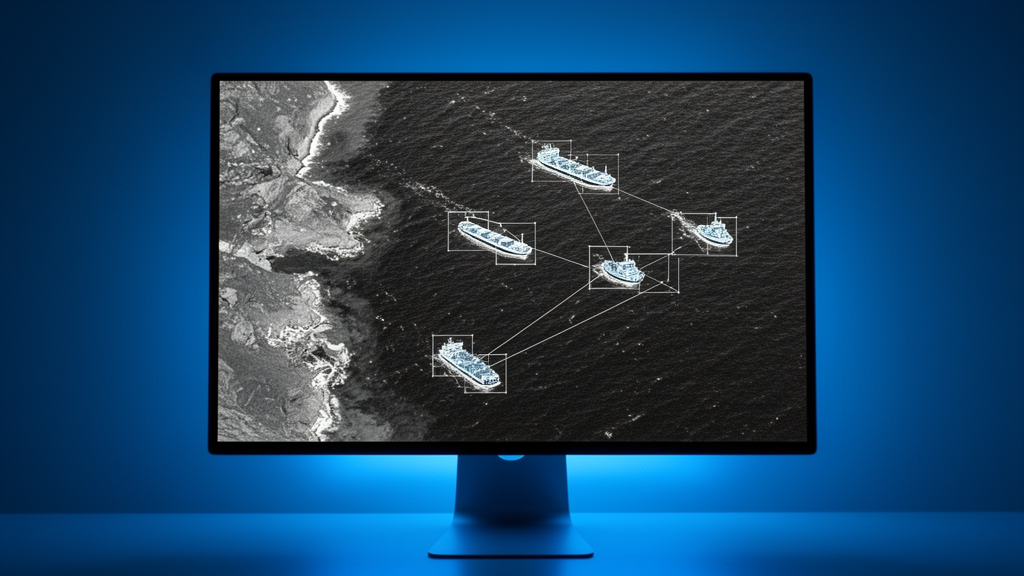
An improved YOLOv8 model developed for high-resolution synthetic aperture radar imagery increased ship-detection precision and recall while operating across multiple satellite polarizations and two external datasets. Researchers combined coordinate attention, dynamic snake convolution and a shape-aware bounding-box loss in a single-stage detector built for ships ranging from tiny offshore vessels to large tankers and container ships. On the SAR-SHIP 2021 test set, the complete model reached 0.908 precision, 0.904 recall and 0.925 mean average precision at an intersection-over-union threshold of 0.5, compared with 0.885, 0.881 and 0.911 for the original lightweight YOLOv8 baseline. The gains came with clear trade-offs: inference throughput fell from 909 to 588 frames per second, while mean average precision across the stricter IoU range of 0.5 to 0.95 declined from 0.525 to 0.514.
Synthetic aperture radar can produce two-dimensional observations regardless of daylight or weather, making it useful for maritime monitoring, but ship targets are difficult to distinguish from the surrounding sea and coast. Their radar signatures can appear as scattered bright points rather than continuous objects, while speckle noise blurs boundaries and distorts local texture. Detection is further complicated by an exceptionally wide target-size range and by settings ranging from isolated fishing boats in open water to crowded berths, islands, buildings and other coastal clutter. The study addressed these problems by modifying three parts of YOLOv8: how features are extracted, how useful features are selected during multi-scale fusion and how predicted boxes are matched to ship shapes.
Coordinate attention, or CA, was added throughout the network’s neck, where features from different spatial scales are combined. Unlike channel-only attention, which summarizes a feature map without retaining its position, CA pools information separately along the horizontal and vertical axes. It then applies learned weights that preserve coordinate cues while identifying relationships among feature channels. In the model, this mechanism was intended to strengthen valid ship responses and suppress sea-surface speckle, nearshore structures and other distracting patterns. Ablation tests showed why placement mattered. Adding CA to the backbone produced precision of 0.878 and recall of 0.874, both below the baseline, while placing it in the neck yielded 0.891 precision and 0.923 mAP@0.5. The neck-embedded version also improved mAP@0.5:0.95 from 0.525 to 0.531 without changing the reported 909-frame-per-second throughput.
The second modification replaced one standard convolution in the C2f feature blocks at the P4 and P5 backbone stages with dynamic snake convolution, or DSConv. Standard convolution samples a fixed rectangular grid, which can poorly follow the curved or irregular outlines of vessels in radar imagery. DSConv first learns offsets that describe changing contour trends, then moves its sampling positions toward informative target regions. The researchers argued that this flexible pattern can preserve fine scattering details more effectively than fixed sampling while avoiding some background responses. Comparisons with four alternative convolution modules supported that interpretation. DSConv produced 0.901 precision, 0.899 recall and 0.929 mAP@0.5, outperforming the baseline and the SPDConv, WTConv and SAConv alternatives on conventional detection accuracy. Its strict localization score of 0.495 was nevertheless below the baseline’s 0.525, and its reported throughput was 476 frames per second.
The third component, Shape-IoU, replaced the baseline’s complete intersection-over-union branch for bounding-box regression. Shape-IoU combines overlap, scale deviation, center distance and explicit aspect-ratio consistency, with weights derived from the width and height of each ground-truth box. The intended effect is to favor predicted boxes that resemble the geometry of actual ships rather than rewarding overlap alone. Used independently, the loss raised precision to 0.895, recall to 0.897, mAP@0.5 to 0.919 and mAP@0.5:0.95 to 0.531. The authors noted, however, that ships with blurred or low-contrast boundaries can have ambiguous physical outlines. Strong shape constraints may improve detection at a conventional IoU threshold while causing small boundary offsets that are penalized by the stricter 0.5-to-0.95 metric.
Joint ablation experiments exposed an interaction among the three optimizations that was not evident from their individual results. Coordinate attention alone, DSConv alone and Shape-IoU alone each maintained or improved strict localization performance. Combining CA and DSConv produced the study’s highest mAP@0.5:0.95, 0.532, but adding Shape-IoU reduced that value to 0.514. The complete configuration nevertheless produced the best precision, recall and mAP@0.5, reaching 0.908, 0.904 and 0.925. The authors describe this as a multi-module coupling effect and suggest that dynamic sampling, feature re-weighting and shape regularization may accumulate small boundary perturbations for speckle-blurred targets. Those perturbations have limited consequences at IoU 0.5 but carry greater weight when evaluation demands close pixel-level alignment across a range of increasingly strict thresholds.
The model was trained and tested on 39,729 chips generated from 210 SAR scenes in the updated 2021 SAR-SHIP dataset. The source scenes comprised 72 images from China’s Gaofen-3 satellite and 138 from the European Space Agency’s Sentinel-1 satellite. Spatial resolutions ranged from 1.7 to 25 metres, and the collection covered HH, HV, VH and VV polarizations in port, nearshore, island and open-sea environments. After cropping and deduplication, the chips were randomly divided at the image-chip level into training, validation and test sets containing 27,902, 5,980 and 5,980 images, respectively. Researchers removed geographic overlap and duplicate crops to reduce leakage, manually corrected ambiguous annotations and resized all inputs to 320 by 320 pixels. This dataset design increases geographic diversity, although chip-level random partitioning cannot represent every possible form of overlap between scenes.
Training used an NVIDIA RTX 4090 with 24 gigabytes of memory, PyTorch 2.5.0 and CUDA 12.1. All models ran for 200 epochs with a batch size of 16 and an initial learning rate of 0.0015. Precision and recall were calculated at a confidence threshold of 0.25, while mAP values were aggregated across confidence thresholds under the COCO evaluation protocol. The researchers compared the proposed detector with YOLOv5, YOLOv8, YOLOv10, YOLOv11, YOLOv12 and RT-DETR-L. At conventional thresholds, the improved model delivered the strongest reported results: its 0.925 mAP@0.5 exceeded YOLOv12’s 0.923, YOLOv10’s and YOLOv5’s 0.921, and YOLOv11’s 0.918. It also outperformed RT-DETR-L in precision, recall and mAP@0.5, while using 11.19 million parameters rather than the transformer model’s 31.99 million.
The computational cost remained close to that of the baseline: the improved model contained 11.19 million parameters and required 28.6 billion floating-point operations, compared with 11.126 million and 28.4 billion for YOLOv8. Runtime, however, was less favorable because offset prediction, dynamic sampling and feature interpolation add memory-access-heavy operations not fully represented by the theoretical FLOP count. Such irregular operations also benefit less from the highly optimized routines used for regular GPU convolution. The reported 588 frames per second therefore reflected only forward-pass inference, excluding image loading, preprocessing and postprocessing, and the authors treated throughput as a secondary indicator sensitive to hardware and system load. The results support the model for accuracy-oriented applications with moderate real-time requirements, not for systems requiring the baseline’s maximum processing speed or the precise localization captured by mAP@0.5:0.95.
Cross-dataset tests indicated that the improvements were not confined to the training source. Weights trained on SAR-SHIP 2021 were applied directly, without reported retraining, to the HRSID and SSDD datasets at the same 320-pixel input size. On HRSID, the improved model raised precision from 0.824 to 0.832, recall from 0.507 to 0.508 and mAP@0.5 from 0.544 to 0.547, while mAP@0.5:0.95 fell from 0.213 to 0.204. On SSDD, precision increased from 0.816 to 0.825, recall from 0.634 to 0.646 and mAP@0.5 from 0.684 to 0.692, with strict localization declining from 0.263 to 0.247. Visual examples across four polarization modes also showed more confident detections and fewer clutter-induced false alarms than the baseline. These findings support favorable transfer across differing SAR data distributions, but the experiment did not establish performance for every radar sensor, sea state or operating environment.
Subject of Research: Multi-module YOLOv8 optimization for ship detection in high-resolution synthetic aperture radar imagery
Article Title: Multi-scale ship detection with high-resolution SAR images based on improved YOLOv8
Article References: Liu, D., Chen, H., Chen, J., Ding, Y., Zhu, J., & Lei, P. (2026). Multi-scale ship detection with high-resolution SAR images based on improved YOLOv8. Frontiers in Marine Science, 13, Article 1943050. https://doi.org/10.3389/fmars.2026.1943050
Image Credits: AI Generated
DOI: 10.3389/fmars.2026.1943050
Keywords: synthetic aperture radar, ship detection, YOLOv8, coordinate attention, dynamic snake convolution, Shape-IoU, remote sensing, computer vision, object detection, cross-dataset generalization, Multi-scale, ship
Cite Scienmag News
Violet Maxwell. (October 22, 2026). Improved YOLOv8 Boosts Ship Detection in High-Resolution SAR Imagery. Scienmag. https://scienmag.com/improved-yolov8-boosts-ship-detection-in-high-resolution-sar-imagery/
Violet Maxwell. "Improved YOLOv8 Boosts Ship Detection in High-Resolution SAR Imagery." Scienmag, 22 October 2026, https://scienmag.com/improved-yolov8-boosts-ship-detection-in-high-resolution-sar-imagery/. Accessed 22 October 2026.
Violet Maxwell. "Improved YOLOv8 Boosts Ship Detection in High-Resolution SAR Imagery." Scienmag. October 22, 2026. https://scienmag.com/improved-yolov8-boosts-ship-detection-in-high-resolution-sar-imagery/


