

Thursday, October 22, 2026
Science
No Result
View All Result
  • Login
  • HOME
  • SCIENCE NEWS
  • CONTACT US
  • HOME
  • SCIENCE NEWS
  • CONTACT US
No Result
View All Result
Scienmag
No Result
View All Result
Home Science News Biology

Research report: Sea Ice Meltwater Alters Prokaryotic Community Structure and Interaction Networks in the Amundsen Sea, Antarctica

October 22, 2026
in Biology
Drew Townsend
By Drew Townsend Scienmag Editorial Profile - Cell Biology
Reading Time: 3 mins read
0
Research report: Sea Ice Meltwater Alters Prokaryotic Community Structure and Interaction Networks in the Amundsen Sea, Antarctica

Research report: Sea Ice Meltwater Alters Prokaryotic Community Structure and Interaction Networks in the Amundsen Sea, Antarctica

65
SHARES
587
VIEWS
Share on FacebookShare on Twitter
ADVERTISEMENT

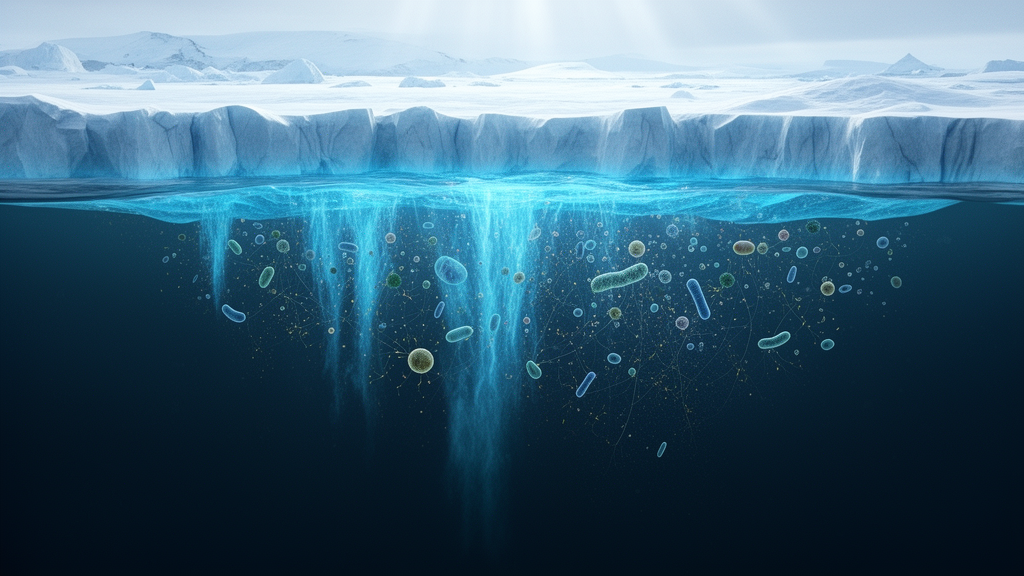
Sea-ice meltwater reduced the diversity of Antarctic prokaryotic communities and weakened their potential ecological association networks in a controlled microcosm experiment using seawater collected from the Amundsen Sea. Researchers amended communities from surface and mesopelagic layers with melted sea ice across a 0–50% dilution gradient, then assessed their responses with 16S rRNA gene sequencing and co-occurrence network analysis. The experiment found an acute laboratory response to meltwater addition, rather than a direct measurement of microbial change in the natural environment.

The study addressed the difficulty of resolving microbial responses to meltwater in situ. Meltwater signals from retreating glaciers, ice shelves and seasonal sea ice can be rapidly diluted, transported and mixed with surrounding seawater, making their biological effects difficult to distinguish directly. To examine these responses under controlled conditions, the investigators used intact microbial communities collected from two depths in the Amundsen Sea and exposed them to different proportions of melted sea ice.

Comparisons with theoretical passive-mixing expectations helped determine whether the observed changes could be explained simply by adding organisms from the sea ice. As the proportion of meltwater increased, prokaryotic diversity declined and overall community composition shifted. Opportunistic taxa, particularly Shewanella , were strongly enriched.

The increase in Shewanella was greater than passive mixing and sea-ice inoculation alone could explain, indicating that the change was not attributable solely to the transfer of sea-ice microbes into the experimental communities. In contrast, ammonia-oxidizing prokaryotes, including members of the Nitrosopumilales and Nitrosococcales, declined along the dilution gradient. Although the melted sea ice supplied ammonium, these organisms decreased as the meltwater proportion rose, suggesting that meltwater-associated environmental changes may have offset a potential stimulatory effect of ammonium availability.

Co-occurrence analysis showed a parallel contraction in the structure of the microbial association networks. With increasing meltwater addition, the networks became smaller and less connected, with reduced cohesion and fewer keystone taxa. These co-occurrence patterns represent statistical relationships that may indicate potential ecological associations; they do not by themselves demonstrate direct biological interactions or their functions.

The results nevertheless show that acute meltwater input can rapidly reorganize the diversity, composition and inferred association structure of Amundsen Sea prokaryotic communities assembled in laboratory microcosms. Particle-associated communities retained greater structural stability than free-living communities as meltwater was added, indicating that the two microbial lifestyles differed in their response. The findings are limited to the seawater communities, sampling layers, experimental design and meltwater dilution range tested, so they do not establish that the same pattern occurs throughout the Amundsen Sea or under natural mixing and transport processes.

Even so, the study offers a controlled view of how sea-ice meltwater can alter Antarctic microbial communities and weaken their potential association networks, while demonstrating the need for direct field measurements to establish responses in the ocean.

Subject of Research: Laboratory responses of Amundsen Sea prokaryotic communities to sea-ice meltwater

Article Title: Sea Ice Meltwater Alters Prokaryotic Community Structure and Interaction Networks in the Amundsen Sea, Antarctica

Article References: Choi, J., Kang, J. K., Kang, S., Kim, M. K., Lee, S. Y., Rho, A., Yun, S., Lee, W. S., & Hwang, C. Y. (2026). Sea Ice Meltwater Alters Prokaryotic Community Structure and Interaction Networks in the Amundsen Sea, Antarctica. Microbial Ecology. https://doi.org/10.1007/s00248-026-02913-0

Image Credits: AI Generated

DOI: 10.1007/s00248-026-02913-0

Keywords: Amundsen Sea, Antarctica, sea-ice meltwater, prokaryotic communities, microbial diversity, Shewanella, co-occurrence networks, 16S rRNA sequencing, microcosm experiment, ammonia oxidation, Meltwater, Alters

Cite Scienmag News

Drew Townsend. (October 22, 2026). Research report: Sea Ice Meltwater Alters Prokaryotic Community Structure and Interaction Networks in the Amundsen Sea, Antarctica. Scienmag. https://scienmag.com/research-report-sea-ice-meltwater-alters-prokaryotic-community-structure-and-interaction-networks-in-the-amundsen-sea-antarctica/


Drew Townsend. "Research report: Sea Ice Meltwater Alters Prokaryotic Community Structure and Interaction Networks in the Amundsen Sea, Antarctica." Scienmag, 22 October 2026, https://scienmag.com/research-report-sea-ice-meltwater-alters-prokaryotic-community-structure-and-interaction-networks-in-the-amundsen-sea-antarctica/. Accessed 22 October 2026.

Drew Townsend. "Research report: Sea Ice Meltwater Alters Prokaryotic Community Structure and Interaction Networks in the Amundsen Sea, Antarctica." Scienmag. October 22, 2026. https://scienmag.com/research-report-sea-ice-meltwater-alters-prokaryotic-community-structure-and-interaction-networks-in-the-amundsen-sea-antarctica/

Tags: 16S rRNA sequencingaltersammonia oxidationAmundsen SeaAmundsen Sea microbial community dynamicsAntarctic prokaryotic community response to sea ice meltwaterAntarcticachallenges in in situ detection of microbial responsesco-occurrence network analysis of Antarctic microbesco-occurrence networkscontrolled laboratory study of Antarctic microbial responseseffects of meltwater dilution on microbial diversityinfluence of sea ice meltmeltwatermicrobial community shifts in response to sea ice meltmicrobial diversitymicrocosm experimentmicrocosm experiment on microbial diversityprokaryotic communitiessea ice meltwater impact on microbial interaction networkssea-ice meltwaterShewanellaShewanella enrichment in meltwater conditions
Share26Tweet16
Previous Post

Study links osteoporosis knowledge and preventive practices in Yerevan women

Next Post

DHA and arachidonic acid linked to modest attention gains in select preterm children

Related Posts

Triploid large yellow croaker embryos show preserved development with localized molecular changes
Biology

Triploid large yellow croaker embryos show preserved development with localized molecular changes

October 22, 2026
Prototype enzyme-responsive hydrogel embeds phages for catheter-infection research
Biology

Prototype enzyme-responsive hydrogel embeds phages for catheter-infection research

October 22, 2026
Research report: Modulation of anti-tuberculosis drug-induced liver injury by gut microbiota metabolites: Insights from network pharmacology
Biology

Research report: Modulation of anti-tuberculosis drug-induced liver injury by gut microbiota metabolites: Insights from network pharmacology

October 22, 2026
Research report: PIK3CA silencing restores anoikis sensitivity in endothelial cells
Biology

Research report: PIK3CA silencing restores anoikis sensitivity in endothelial cells

October 22, 2026
Urban Habitat Mosaics Structure Invasive Termite Gene Flow Without Genetic Erosion
Biology

Urban Habitat Mosaics Structure Invasive Termite Gene Flow Without Genetic Erosion

October 22, 2026
Research report: Spatial lipidomics of Fasciola hepatica using high-resolution AP-SMALDI Orbitrap MSI – a lipid tissue atlas
Biology

Research report: Spatial lipidomics of Fasciola hepatica using high-resolution AP-SMALDI Orbitrap MSI – a lipid tissue atlas

October 22, 2026
Next Post
DHA and arachidonic acid linked to modest attention gains in select preterm children

DHA and arachidonic acid linked to modest attention gains in select preterm children

  • Mothers who receive childcare support from maternal grandparents show more optimized

    Mothers who receive childcare support from maternal grandparents show more parental warmth, finds NTU Singapore study

    27656 shares
    Share 11059 Tweet 6912
  • University of Seville Breaks 120-Year-Old Mystery, Revises a Key Einstein Concept

    1061 shares
    Share 424 Tweet 265
  • Bee body mass, pathogens and local climate influence heat tolerance

    682 shares
    Share 273 Tweet 171
  • Researchers record first-ever images and data of a shark experiencing a boat strike

    546 shares
    Share 218 Tweet 137
  • Groundbreaking Clinical Trial Reveals Lubiprostone Enhances Kidney Function

    531 shares
    Share 212 Tweet 133
Science

Embark on a thrilling journey of discovery with Scienmag.com—your ultimate source for cutting-edge breakthroughs. Immerse yourself in a world where curiosity knows no limits and tomorrow’s possibilities become today’s reality!

RECENT NEWS

  • DHA and arachidonic acid linked to modest attention gains in select preterm children
  • Research report: Sea Ice Meltwater Alters Prokaryotic Community Structure and Interaction Networks in the Amundsen Sea, Antarctica
  • Study links osteoporosis knowledge and preventive practices in Yerevan women
  • Storm monitoring quantifies water origins in an urban karst aquifer

Categories

  • Agriculture
  • Anthropology
  • Archaeology
  • Athmospheric
  • Biology
  • Biotechnology
  • Blog
  • Bussines
  • Cancer
  • Chemistry
  • Climate
  • Earth Science
  • Editorial Policy
  • Marine
  • Mathematics
  • Medicine
  • Pediatry
  • Policy
  • Psychology & Psychiatry
  • Science Education
  • Science News
  • Social Science
  • Space
  • Technology and Engineering

Subscribe to Blog via Email

Enter your email address to subscribe to this blog and receive notifications of new posts by email.

Join 5,151 other subscribers

© 2025 Scienmag - Science Magazine

Welcome Back!

Login to your account below

Forgotten Password?

Retrieve your password

Please enter your username or email address to reset your password.

Log In
No Result
View All Result
  • HOME
  • SCIENCE NEWS
  • CONTACT US

© 2025 Scienmag - Science Magazine

Discover more from Science

Subscribe now to keep reading and get access to the full archive.

Continue reading