


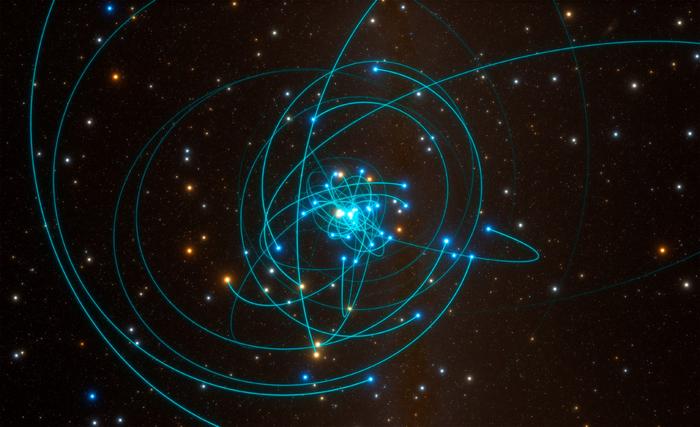
Despite their ancient ages, some stars orbiting the Milky Way’s central supermassive black hole appear deceptively youthful. But unlike humans, who might appear rejuvenated from a fresh round of collagen injections, these stars look young for a much darker reason.

Credit: ESO / L. Calçada / Spaceengine.org
Despite their ancient ages, some stars orbiting the Milky Way’s central supermassive black hole appear deceptively youthful. But unlike humans, who might appear rejuvenated from a fresh round of collagen injections, these stars look young for a much darker reason.
They ate their neighbors.
This is just one of the more peculiar findings from new Northwestern University research. Using a new model, astrophysicists traced the violent journeys of 1,000 simulated stars orbiting our galaxy’s central supermassive black hole, Sagittarius A* (Sgr A*).
So densely packed with stars, the region commonly experiences brutal stellar collisions. By simulating the effects of these intense collisions, the new work finds that collision survivors can lose mass to become stripped down, low-mass stars or can merge with other stars to become massive and rejuvenated in appearance.
“The region around the central black hole is dense with stars moving at extremely high speeds,” said Northwestern’s Sanaea C. Rose, who led the research. “It’s a bit like running through an incredibly crowded subway station in New York City during rush hour. If you aren’t colliding into other people, then you are passing very closely by them. For stars, these near collisions still cause them to interact gravitationally. We wanted to explore what these collisions and interactions mean for the stellar population and characterize their outcomes.”
Rose will present this research at the American Physical Society’s (APS) April meeting in Sacramento, California. “Stellar Collisions in the Galactic Center” will take place at 12:21 p.m. (PDT) Thursday (April 4) as part of the session “Particle Astrophysics and the Galactic Center.” Complimentary press registration is available for journalists.
Rose is the Lindheimer Postdoctoral Fellow at Northwestern’s Center for Interdisciplinary Exploration and Research in Astrophysics (CIERA). She began this work as a Ph.D. candidate at UCLA.
Destined to collide
The center of our Milky Way is a strange and wild place. The gravitational pull of Sgr A* accelerates stars to whip around their orbits at terrifying speeds. And the sheer number of stars packed into the galaxy’s center is upwards of a million. The densely packed cluster plus the lightning-fast speeds equal a high-speed demolition derby. In the innermost region — within 0.1 parsecs of the black hole — few stars escape unscathed.
“The closest star to our sun is about four light-years away,” Rose explained. “Within that same distance near the supermassive black hole, there are more than a million stars. It’s an incredibly crowded neighborhood. On top of that, the supermassive black hole has a really strong gravitational pull. As they orbit the black hole, stars can move at thousands of kilometers per second.”
Within this tight, hectic neighborhood, stars can collide with other stars. And the closer stars live to the supermassive black hole, the likelihood of collision increases. Curious of the outcomes of these collisions, Rose and her collaborators developed a simulation to trace the fates of stellar populations in the galactic center. The simulation takes several factors into account: density of the stellar cluster, mass of the stars, orbit speed, gravity and distances from the Sgr A*.
From ‘violent high fives’ to total mergers
In her research, Rose pinpointed one factor that is most likely to determine a star’s fate: its distance from the supermassive black hole.
Within 0.01 parsecs from the black hole, stars — moving at speeds reaching thousands of kilometers per second — constantly bump into one another. It’s rarely a head-on collision and more like a “violent high five,” as Rose describes it. The impacts are not strong enough to smash the stars completely. Instead, they shed their outer layers and continue speeding along the collision course.
“They whack into each other and keep going,” Rose said. “They just graze each other as though they are exchanging a very violent high five. This causes the stars to eject some material and lose their outer layers. Depending on how fast they are moving and how much they overlap when they collide, they might lose quite a bit of their outer layers. These destructive collisions result in a population of strange, stripped down, low-mass stars.”
Outside of 0.01 parsecs, stars move at a more relaxed pace — hundreds of kilometers per second as opposed to thousands. Because of the slower speeds, these stars collide with one another but then don’t have enough energy to escape. Instead, they merge to become more massive. In some cases, they might even merge multiple times to become 10 times more massive than our sun.
“A few stars win the collision lottery,” Rose said. “Through collisions and mergers, these stars collect more hydrogen. Although they were formed from an older population, they masquerade as rejuvenated, young-looking stars. They are like zombie stars; they eat their neighbors.”
But the youthful appearance comes at the cost of a shorter life expectancy.
“They die very quickly,” Rose said. “Massive stars are sort of like giant, gas-guzzling cars. They start with a lot of hydrogen, but they burn through it very, very fast.”
Extreme environment ‘unlike any other’
Although Rose finds simple joy in studying the bizarre, extreme region near our galactic center, her work also can reveal information about the history of the Milky Way. And because the central cluster is extremely difficult to observe, her team’s simulations can illuminate otherwise hidden processes.
“It’s an environment unlike any other,” Rose said. “Stars, which are under the influence of a supermassive black hole in a very crowded region, are unlike anything we will ever see in our own solar neighborhood. But if we can learn about these stellar populations, then we might be able to learn something new about how the galactic center was assembled. At the very least, it certainly provides a point of contrast for the neighborhood where we live.”
Rose’s APS presentation will include research published by The Astrophysical Journal Letters in March 2024and by The Astrophysical Journal in September 2023.
This work was supported by the National Science Foundation (grant number AST 2206428) and NASA (grant number 80NSSC20K050) as well as by the Charles E. Young Fellowship, the Dissertation Year Fellowship at UCLA, the Thacher Fellowship, the Bhaumik Institute and the CIERA Lindheimer Fellowship.
Cite Scienmag News
Bethany Barker. (April 4, 2024). Stellar collisions produce strange, zombie-like survivors. Scienmag. https://scienmag.com/stellar-collisions-produce-strange-zombie-like-survivors/
Bethany Barker. "Stellar collisions produce strange, zombie-like survivors." Scienmag, 4 April 2024, https://scienmag.com/stellar-collisions-produce-strange-zombie-like-survivors/. Accessed 3 September 2026.
Bethany Barker. "Stellar collisions produce strange, zombie-like survivors." Scienmag. April 4, 2024. https://scienmag.com/stellar-collisions-produce-strange-zombie-like-survivors/

