


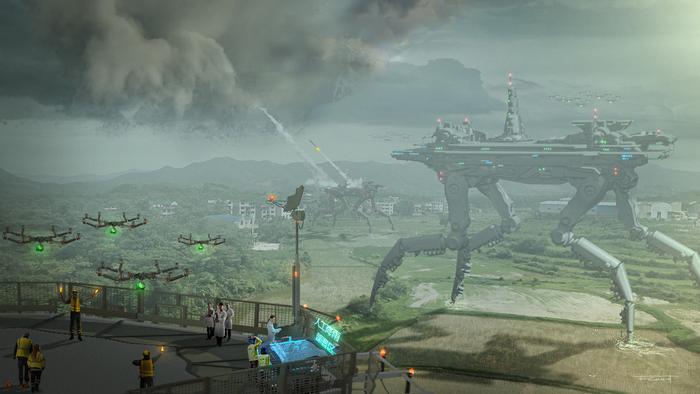
Human activity is changing the way water flows between the Earth and atmosphere in complex ways and with likely long-lasting consequences that are hard to picture.

Credit: All images are copyright protected and available for use in promotion of this research. Please credit both Patrick Keys and Fabio Comin in any use.
Human activity is changing the way water flows between the Earth and atmosphere in complex ways and with likely long-lasting consequences that are hard to picture.
Land use change is altering where clouds form and how precipitation is distributed. Meanwhile, weather modification activities like cloud seeding are shifting how nations plan for water use in the face of climate change. These and other changes to the planet’s atmospheric water cycle were once hard to imagine but are increasingly part of modern water management on the planet.
Colorado State University Assistant Professor Patrick Keys is an expert in climate and societal change. He has been studying these types of issues for years and realized there was a potential gap when it came to understanding – not only in the public but among the water research community – the lasting implications of these changes.
To better grasp how those kinds of activities could shape the world, he enlisted water scientists from around the globe to write story-based scenarios about the possible futures humanity is facing but perhaps can’t quite comprehend yet. The results were recently published in Global Sustainability as part of a creative pathway to understand atmospheric water research with an eye towards the potential economic and policy issues that may be just beyond the horizon.
The work features striking artist-made images that pair with traditional science fiction narratives as well as alternative story forms like first-person journal entries. Keys said the package offers a wide path – grounded in science – to build a shared understanding of future water management activities and problems.
“Stories are everywhere and are an integral part of human life,” he said. “They tell you something different from a graph in a research paper. They allow you to explore how people may feel or react to these kinds of changes. This kind of work provides agency for people and an opportunity to consider these changes no matter their background or level of understanding.”
Research for this work came in three distinct phases, according to Keys. First, he used computational text analysis to find recurring themes in journal abstracts about the current state of atmospheric water cycle research. He then sorted the data – identifying clusters of recurring terms against a grid of common economic goods principles for discussion. The goal, he said, was to better describe the ways humans and institutions may interact with the atmospheric water cycle in the future. Specifically: how entities in the future, such as countries or private actors, could eventually act to protect their own resources or how they may leverage advantages to gain access to water as a crucial natural resource in the future.
It’s those relationships and interactions, Keys wanted to explore in the third part of this research and where science fiction comes into play.
Science fiction and reality of atmospheric water resources beyond 2050
With a better grip on the potential future relationships of water management in this space, Keys next asked experts to imagine a world that is decades in the future where activities like cloud seeding were common and the long-term results are more apparent.
The result was an exercise in science fiction storytelling with the specific goal of probing reality and envisioning even the weirdest possible outcomes.
“I think we have a sense that some futures are more likely than others, but we need to realize that to adequately cover the possible trajectories our world could head toward, models alone may not cut it,” he said. “Especially when we are talking about things that are hard to quantify, like culture or perception, that may wind up playing a large part in the actual outcomes.”
To create the narratives Keys hosted a series of workshops with interdisciplinary water experts from all fields and backgrounds and walked them through a ‘futures thinking’ approach. The experts were not siloed by discipline and topic during the exercise, with the hope of sparking even more creativity. In the end, 10 story-based scenarios were developed and are included in the paper. Keys also worked with the artist Fabio Comin over the course of a year to create the accompanying imagery.
Keys is based in the Department of Atmospheric Science in the Walter Scott, Jr. College of Engineering. He had several partners in the paper including postdoctoral fellow Rekha Warrier from the Human Dimensions of Natural Resources Department at CSU. Other researchers came from the University of California, Davis, the University of California, Los Angeles, the Stockholm Resilience Centre, and the Potsdam Institute for Climate Impact Research.
Keys said he is now using similar approaches for another project with the Colorado Water Center. He added that one of his goals with both projects was to ignite conversations around the water cycle at what is becoming a key moment for action globally.
“These scenarios have an ability to raise interesting questions about policy, regulation and enforcement – what those all may look like,” he said. “This approach can also help us recognize some of the aspects we may not be paying attention to and make better sense of it all.”
Journal
Global Sustainability
Article Title
The dry sky: future scenarios for humanity’s modification of the atmospheric water cycle
Article Publication Date
20-Mar-2024
COI Statement
None
Cite Scienmag News
Russell Cooper. (April 4, 2024). Researchers envision sci-fi worlds involving changes to atmospheric water cycle. Scienmag. https://scienmag.com/researchers-envision-sci-fi-worlds-involving-changes-to-atmospheric-water-cycle/
Russell Cooper. "Researchers envision sci-fi worlds involving changes to atmospheric water cycle." Scienmag, 4 April 2024, https://scienmag.com/researchers-envision-sci-fi-worlds-involving-changes-to-atmospheric-water-cycle/. Accessed 3 September 2026.
Russell Cooper. "Researchers envision sci-fi worlds involving changes to atmospheric water cycle." Scienmag. April 4, 2024. https://scienmag.com/researchers-envision-sci-fi-worlds-involving-changes-to-atmospheric-water-cycle/

