


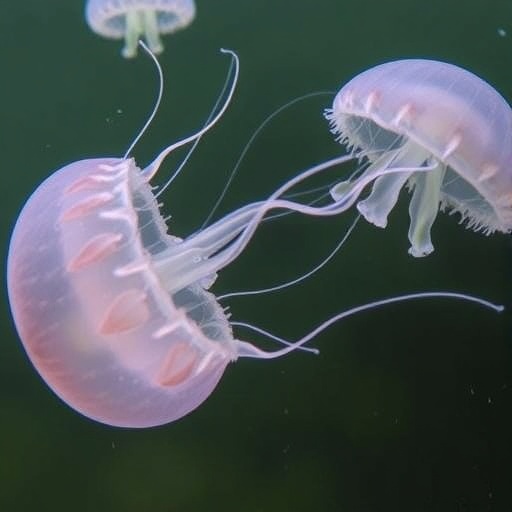
The freshwater jellyfish Craspedacusta sowerbii presents a fascinating but largely unrecognized phenomenon in the realm of invasive species globally. Despite its presence on six continents, this delicate yet resilient species flies under the public radar, a situation thoroughly investigated in a comprehensive study recently published in the journal People and Nature. The research sheds light on the substantial gap between the ecological significance of this organism and public awareness, emphasizing how this inconspicuous invader undermines environmental policy and early detection mechanisms.
Originating in the Yangtze River basin in China, Craspedacusta sowerbii was first documented outside its native territory in 1880 in an ornamental pond in London, marking the beginning of its extensive global spread. This freshwater jellyfish has since colonized aquatic ecosystems worldwide, disseminated through its microscopic polyp and podocyst stages, which can easily attach to transported aquatic plants, birds feeding on or moving between water bodies, or various submerged substrates. The species’ establishment across Europe spans a vast geographical range—from Mediterranean countries like Spain and Italy to northern regions including Finland and Russia—signaling its remarkable adaptability and dispersal capabilities.
To better understand the public’s perception of Craspedacusta sowerbii’s proliferation, the researchers conducted an exhaustive 22-month multilingual survey across 17 European nations, collecting nearly 1,400 individual responses. This survey revealed a striking deficiency in public recognition: over 80% of respondents were unable to identify the species by its scientific name, and a mere 10% recognized it correctly as Craspedacusta sowerbii. This lack of awareness signals a profound disconnect between scientific documentation of invasive species and public consciousness, a gap that could severely impede early warning and management efforts.
The study also highlighted widespread ecological misconceptions surrounding this jellyfish. Nearly half of the respondents mistakenly reported encountering the species in marine environments, despite Craspedacusta sowerbii being strictly a freshwater organism. Researchers attribute this “taxonomic confusion” to pervasive media representations that predominantly showcase marine jellyfish, inadvertently biasing public understanding. This misperception compounds the cryptic nature of the species, as its sporadic emergence and subtle life cycle phases make direct observation challenging, further enabling its silent spread within freshwater ecosystems.
Public responses to sightings of Craspedacusta sowerbii portrayed a mixture of awe and caution. Many respondents described the species using aesthetic terms such as “beautiful,” “sublime,” and “delicate,” underscoring a fascination with its ethereal appearance. However, when mass emergences occur—typically triggered by warm summer conditions—over half of those surveyed reported feelings of nervousness or caution. This ambivalence reflects an intricate relationship between humans and this enigmatic invader and hints at potential barriers to effective communication about its ecological implications.
Regarding human safety, the study provides reassuring insights. Although approximately 8% of respondents reported experiencing stings from the jellyfish, more than half of those individuals reported no pain, and instances of severe pain were exceptionally rare. Craspedacusta sowerbii is, therefore, largely perceived as an aesthetic curiosity rather than a physical threat. This benign reputation, however, may contribute to its underestimation as an invasive species with potential ecosystem impacts.
Employing a sophisticated Bayesian Network analysis, the researchers investigated which factors most effectively predict public concern and support for management of Craspedacusta sowerbii. Unexpectedly, demographic variables such as age, gender, and even formal scientific knowledge played only secondary roles. Instead, the strongest predictor was direct personal experience—those who had personally observed the jellyfish felt more compelled to advocate for public discussion and government interventions. This finding underscores the primacy of experiential learning over traditional scientific communication in shaping conservation attitudes.
The authors propose that these outcomes underscore the limitations of current approaches to invasive species management, which often prioritize species with charismatic appeal or economic impact. Craspedacusta sowerbii, as a cryptic invader, highlights the silent but significant ecological shifts that can occur unnoticed. Early detection and management frameworks must evolve to incorporate these subtle threats, which tend to evade public notice and institutional prioritization despite their potential to disrupt aquatic food webs.
The precise ecological consequences of Craspedacusta sowerbii remain an active area of research. However, it is established that the species competes with fish larvae for zooplanktonic prey, potentially altering native population dynamics. This competition could have cascading effects within freshwater ecosystems, particularly as the jellyfish proliferates. Climate change is expected to exacerbate this situation by raising water temperatures, facilitating the transition from the microscopic benthic polyp stage to the conspicuous medusa stage, and consequently intensifying blooms that capture human attention—albeit sporadically.
To bridge the awareness gap, the study advocates for management strategies centered on visual and sensory pedagogy, leveraging citizen science and other forms of field-based engagement. Unlike dry biological data that often fails to resonate with the general public, immersive experiences can foster meaningful connection and promote reporting behaviors essential for effective monitoring and control. Empowering citizens to document and share jellyfish sightings through digital platforms could fill critical knowledge gaps and enhance real-time response capabilities to ecological changes.
The case of Craspedacusta sowerbii illuminates broader challenges faced in global invasive species management. Its silent expansion and the ensuing underappreciation of its ecological role call for a paradigm shift towards recognizing and integrating “invisible” species within environmental policies. Doing so allows for a more holistic understanding of ecosystem restructuring processes underway, ensuring that subtle but impactful biological invaders receive appropriate scientific attention and public acknowledgment.
Ultimately, this research not only brings the freshwater jellyfish into the spotlight but also serves as a wake-up call, reminding both scientists and policymakers that invisibility in nature can be a potent camouflage for ecological disruption. By redefining how invasive species are communicated and managed, we can hope to safeguard aquatic biodiversity against unnoticed threats that lurk beneath serene water surfaces.
Cite Scienmag News
Courtney Benton. (May 14, 2026). Stealthy Spread: The Widespread Rise of Freshwater Jellyfish Across Europe. Scienmag. https://scienmag.com/stealthy-spread-the-widespread-rise-of-freshwater-jellyfish-across-europe/
Courtney Benton. "Stealthy Spread: The Widespread Rise of Freshwater Jellyfish Across Europe." Scienmag, 14 May 2026, https://scienmag.com/stealthy-spread-the-widespread-rise-of-freshwater-jellyfish-across-europe/. Accessed 3 September 2026.
Courtney Benton. "Stealthy Spread: The Widespread Rise of Freshwater Jellyfish Across Europe." Scienmag. May 14, 2026. https://scienmag.com/stealthy-spread-the-widespread-rise-of-freshwater-jellyfish-across-europe/


