


Osaka, Japan – Neuroendocrine tumors, including small cell lung cancer and neuroendocrine prostate cancer, are very aggressive with high chances of spreading. However, many individuals develop resistance to few available treatment options, leading to poor patient outcomes. Researchers are therefore aiming to develop new therapeutic methods that focus on the disease-specific molecular mechanisms of these tumors.

Credit: 2024 Shimojo et al., Splice-switching antisense oligonucleotide controlling tumor suppressor REST is a novel therapeutic medicine for neuroendocrine cancer, Molecular Therapy Nucleic Acids
Osaka, Japan – Neuroendocrine tumors, including small cell lung cancer and neuroendocrine prostate cancer, are very aggressive with high chances of spreading. However, many individuals develop resistance to few available treatment options, leading to poor patient outcomes. Researchers are therefore aiming to develop new therapeutic methods that focus on the disease-specific molecular mechanisms of these tumors.
In a recent article published in Molecular Therapy: Nucleic Acids, a team of researchers at Osaka University describe a strategy targeting one such mechanism, called RNA splicing.
RNA splicing is the process by which cells remove certain portions of messenger RNA (mRNA) molecules. This produces the mature mRNA that contains the instructions for making a protein for a specific gene. Because incorrect RNA splicing can result in dysfunctional or overactive proteins, this process can significantly contribute to disease development.
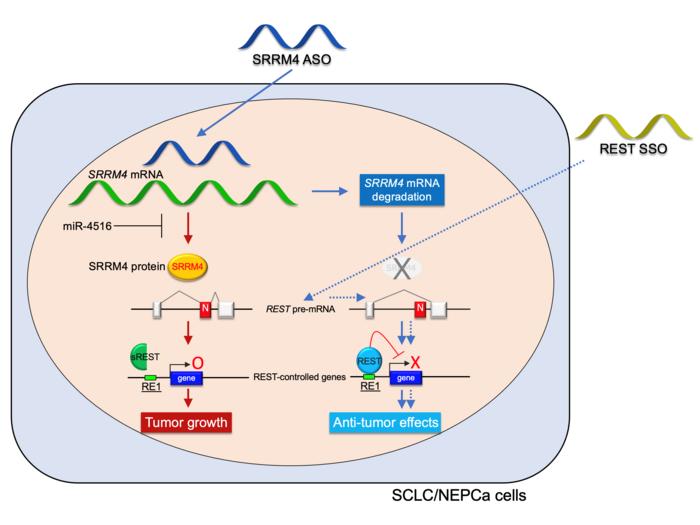
The team focused on a protein named the RE1-silencing transcription factor (REST), which typically represses certain genes that support neuroendocrine phenotypes. Interestingly, an abnormally spliced form of REST mRNA is expressed at high levels in neuroendocrine tumors.
“Incorrect splicing of REST mRNA can cause the resulting protein to lose its function, which can lead to neuroendocrine cancer development,” says Keishiro Mishima, lead author of the study. “Our group aimed to develop a molecular method that could be used to correct REST splicing patterns.”
The team used molecules called amido-bridged nucleic acid-based splice-switching oligonucleotides (SSOs). These SSOs were designed to interact with a specific portion of the REST mRNA molecule, allowing it to splice into its normal form. The researchers implanted neuroendocrine cancer cells under the skin of lab mice to form tumors. They then injected the mice into the abdomen with saline or SSO, monitored tumor growth and collected blood samples.
“We examined the levels of certain biochemical markers in the mice serum samples to ensure the SSO treatment did not induce any liver toxicity,” explains Masahito Shimojo, senior author “In parallel, we treated neuroendocrine cancer cell lines in culture with the SSOs to obtain in vitro data to support our in vivo findings.”
REST SSO treatment led to considerably fewer viable cancer cells than the control treatment. In addition, a significantly reduced tumor size was observed in mice injected with REST SSOs. The team then conducted further molecular analyses to examine the expression patterns of the genes that REST typically represses under normal conditions.
“Following treatment, REST-controlled gene expression levels significantly decreased in SSO-treated tumors compared with the control-treated tumors,” says Shimojo. “This indicated that the SSO promoted the restoration of REST function.”
Overall, the study demonstrates that this unique and novel therapeutic approach holds promise for intractable neuroendocrine cancers.
###
The article, “Splice-switching antisense oligonucleotide controlling tumor suppressor REST is a novel therapeutic medicine for neuroendocrine cancer,” was published in Molecular Therapy: Nucleic Acids at DOI:
About Osaka University
Osaka University was founded in 1931 as one of the seven imperial universities of Japan and is now one of Japan’s leading comprehensive universities with a broad disciplinary spectrum. This strength is coupled with a singular drive for innovation that extends throughout the scientific process, from fundamental research to the creation of applied technology with positive economic impacts. Its commitment to innovation has been recognized in Japan and around the world. Now, Osaka University is leveraging its role as a Designated National University Corporation selected by the Ministry of Education, Culture, Sports, Science and Technology to contribute to innovation for human welfare, sustainable development of society, and social transformation.
Website:
Method of Research
Experimental study
Subject of Research
Animals
Article Title
Splice-switching antisense oligonucleotide controlling tumor suppressor REST is a novel therapeutic medicine for neuroendocrine cancer
Article Publication Date
2-Jul-2024
Cite Scienmag News
Nathaniel Bowman. (July 3, 2024). Splicing it all together in the fight against cancer. Scienmag. https://scienmag.com/splicing-it-all-together-in-the-fight-against-cancer/
Nathaniel Bowman. "Splicing it all together in the fight against cancer." Scienmag, 3 July 2024, https://scienmag.com/splicing-it-all-together-in-the-fight-against-cancer/. Accessed 4 September 2026.
Nathaniel Bowman. "Splicing it all together in the fight against cancer." Scienmag. July 3, 2024. https://scienmag.com/splicing-it-all-together-in-the-fight-against-cancer/

