


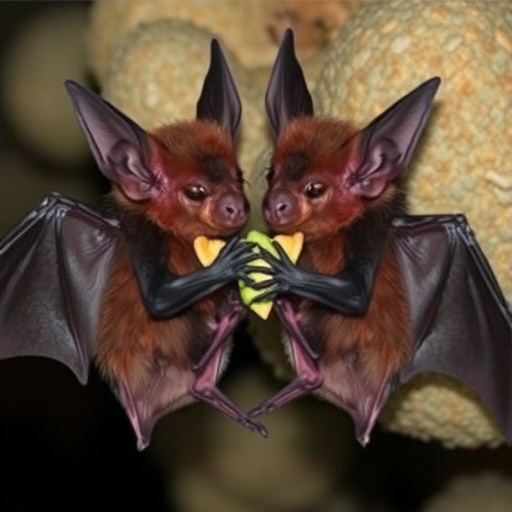
In the shadowy depths of tropical forests, a remarkable revelation about one of the animal kingdom’s most enigmatic predators has emerged. The spectral bat, Vampyrum spectrum, known as the world’s largest carnivorous bat, has long been shrouded in mystery due to its nocturnal habits and elusive nature. Recent research led by Marisa Tietge at the Museum für Naturkunde in Berlin has unveiled a surprisingly complex social life within these imposing creatures, contradicting long-held assumptions about their solitary existence. Published in the open-access journal PLOS ONE on August 20, 2025, this study paints a vivid picture of a species that thrives on cooperation, affectionate behaviors, and intricate social bonds.
Carnivorous bats like Vampyrum spectrum were traditionally believed to forage alone, relying on stealth and individual hunting prowess to capture prey. With wingspans stretching up to one meter, these nocturnal hunters inhabit hollow trees throughout forests in Central and South America. However, the logistical challenges posed by their nocturnal and arboreal lifestyles have hindered in-depth behavioral studies. To overcome this, researchers ingeniously installed motion-activated infrared cameras inside a hollow tree roost located in Guanacaste, Costa Rica. This technological approach allowed continuous observation of a family group of four spectral bats over a period of three months, providing unprecedented insight into their social dynamics.
Analysis of the extensive video footage revealed a suite of behaviors underscoring an unexpected level of sociality. Unlike the isolated hunters they were presumed to be, these bats engaged in at least eight distinct types of interactions, ranging from grooming and vocal communications to cooperative food sharing and even playful engagement. The social exchanges included a fascinating form of greeting in which one bat would wrap its wings gently around the body of another, resembling a bat-to-bat embrace. This behavior suggests not only complex social recognition but also affiliative bonding that supports group cohesion within the roost.
One of the most compelling discoveries was the voluntary transfer of prey from adult bats to younger members of the group. Adult bats returning with captured prey were observed passing food directly to juveniles. This form of food provisioning is noteworthy, as it implies a teaching strategy whereby offspring are gradually weaned from milk and introduced to solid carnivorous diets. Moreover, it provides the fledglings with essential practice in handling prey before they embark on independent foraging. This kind of parental investment, involving both members of a breeding pair, indicates a level of biparental care that is exceedingly rare among carnivorous mammals and almost unprecedented in bat species known for their fierce independence.
The observed social structure included cooperative foraging behavior as well. Researchers documented instances where bats left or returned to the roost simultaneously, sometimes transferring prey between adult males and lactating females. This suggests that hunting expeditions may occasionally involve coordinated efforts, possibly to optimize hunting efficiency or to facilitate the social learning of juvenile bats. Such cooperative behavior redefines our understanding of Vampyrum spectrum and challenges the traditional view of carnivorous bats as strictly solitary predators.
Beyond the ecological and behavioral significance, this study provides profound insights into the evolutionary biology of bats. The degree of monogamy and social complexity seen in Vampyrum spectrum is remarkable, especially given that many carnivorous mammals exhibit limited parental investment from males. The presence of pups from different birth years residing within the roost suggests that juvenile bats remain in the family unit longer than previously assumed, facilitating extended periods of learning and social integration. These aspects underscore the adaptive benefits of living in cooperative family groups, where survival chances may be enhanced through collective efforts.
Examining the nocturnal social life of this bat species was not without its challenges. Tietge recounts her observations of initial defensive reactions from the bats upon repeated human approach to their roost. The spectral bats emitted threat-like calls and scattered, breaking their typical roosting patterns. Remarkably, over the span of several weeks, the bats’ behavior shifted markedly towards tolerance, manifesting in curious glances and relaxed formations devoid of vocal alarms. This behavioral plasticity not only facilitated ongoing observation but also hinted at sophisticated social cognition and memory capacity within these animals.
A particularly touching vignette emerged when the bats were filmed forming what could be described as a “cuddle ball” as they fell asleep. Each bat wrapped one wing around its closest roost-mate, all snouts touching in a tight formation. This level of physical closeness likely serves both thermoregulatory functions and reinforcement of social bonds, further reflecting the intricate social fabric that sustains this species. In apex predators such as Vampyrum spectrum, such gentle behaviors provide an arresting contrast to their predatory reputation.
The implications of this research resonate far beyond bat biology. Social complexity, cooperative care, and biparental investment have evolved independently across diverse taxa, often correlating with ecological challenges and survival strategies. In the spectral bat, these traits may represent an evolutionary response to the demands of a carnivorous diet, nocturnal hunting, and the need to efficiently raise vulnerable offspring in a competitive ecosystem. The insights gained here contribute to a richer understanding of mammalian social evolution and offer intriguing avenues for future research on cognition and group dynamics in understudied species.
Tietge’s work exemplifies how modern technology can illuminate the secret lives of elusive animals, reshaping scientific narratives and public perceptions alike. The study’s open-access publication ensures that these groundbreaking findings reach a broad audience, fostering awareness and enthusiasm for bat conservation. Given that bats play vital ecological roles as insect controllers and seed dispersers, understanding their social systems is crucial for protecting these indispensable creatures.
In essence, the spectral bat emerges from this study not as a solitary stealth hunter, but as a creature of nuanced relationships, cooperation, and affectionate social bonding. Such discoveries underscore nature’s endless capacity to surprise and remind us how much remains to be learned about the nocturnal denizens of our planet’s forests. This revelation not only elevates the profile of Vampyrum spectrum but also invites a reexamination of how we conceptualize social behavior across the animal kingdom.
News Publication Date: 20-Aug-2025
Web References: http://dx.doi.org/10.1371/journal.pone.0321338
References: Tietge M, Artavia Durán E, Knörnschild M (2025) Cooperative behaviors and social interactions in the carnivorous bat Vampyrum spectrum. PLoS One 20(8): e0321338.
Cite Scienmag News
Courtney Benton. (August 21, 2025). Spectral Bats Exchange ‘Hugs’ and Share Food to Communicate and Bond. Scienmag. https://scienmag.com/spectral-bats-exchange-hugs-and-share-food-to-communicate-and-bond/
Courtney Benton. "Spectral Bats Exchange ‘Hugs’ and Share Food to Communicate and Bond." Scienmag, 21 August 2025, https://scienmag.com/spectral-bats-exchange-hugs-and-share-food-to-communicate-and-bond/. Accessed 3 September 2026.
Courtney Benton. "Spectral Bats Exchange ‘Hugs’ and Share Food to Communicate and Bond." Scienmag. August 21, 2025. https://scienmag.com/spectral-bats-exchange-hugs-and-share-food-to-communicate-and-bond/


